
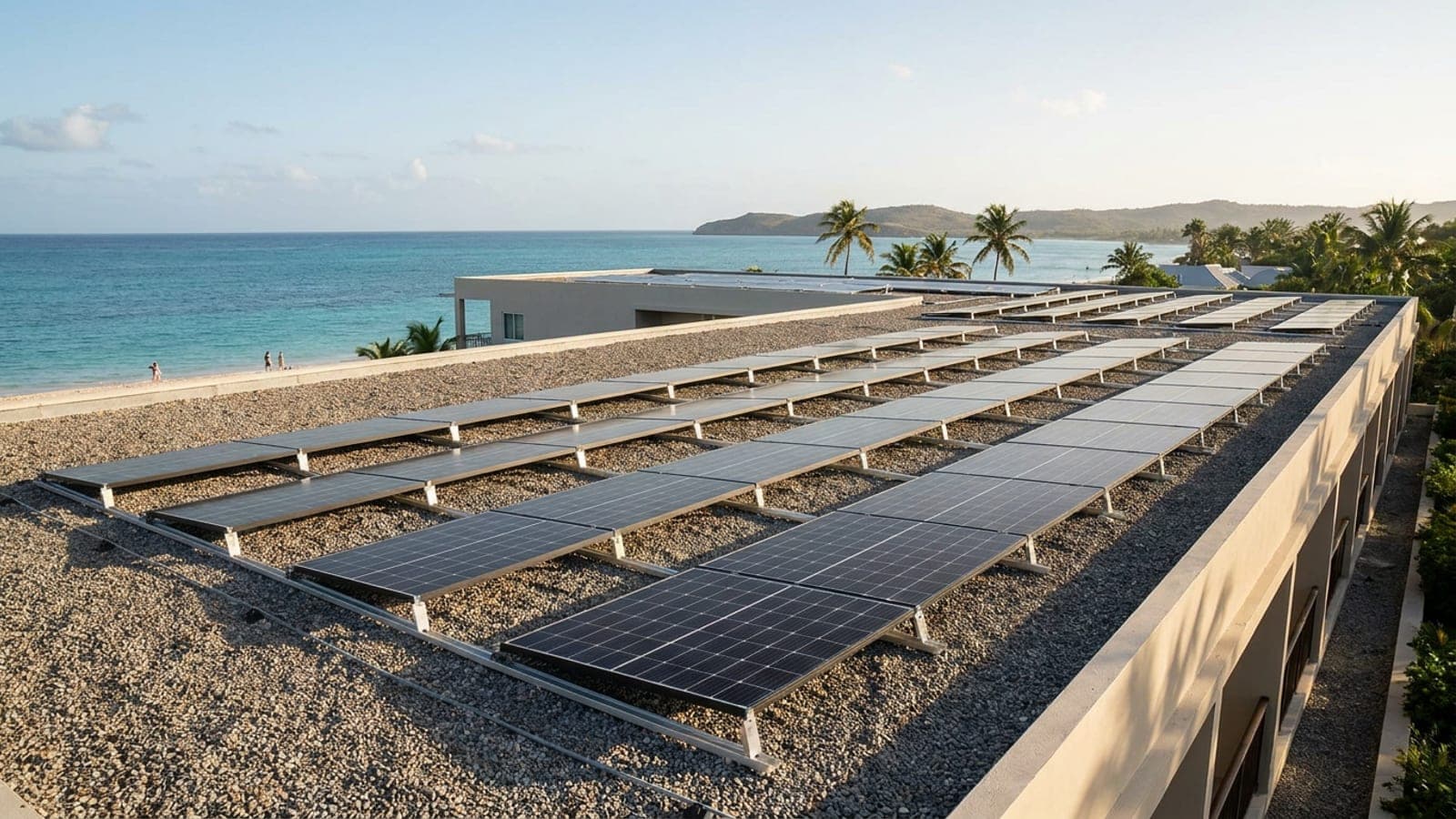
A commercial solar installation Caribbean owners actually benefit from is a different engineering problem from the same array in Georgia. The grid is small, largely fossil-fueled and expensive to run. The weather has a design case with a name. And every component has to arrive on a boat before anyone can install it. Those three facts change the sizing, the specification and the schedule.
OneWorld Solar has built at scale in the region: 800 kW at the Westin Dawn Beach Resort & Spa in St. Maarten, a 451.5 kW ground mount for the Virgin Islands Port Authority in St. Thomas, and 157 kW at the Divi Little Bay Beach Resort in Phillipsburg. We were founded in 2001, are based in Vidalia, Georgia, and have installed more than 7.8 MW for commercial customers overall.
Why do the economics work differently on an island?
Because generation is the expensive part. Utilities such as GEBE in Sint Maarten and the Virgin Islands Water and Power Authority run comparatively small systems that depend on imported fuel, and fuel cost is generally passed through to customers. The result is that commercial electricity rates in the region sit well above what a mainland US business pays — we are deliberately not printing a number here, because it moves with fuel and with tariff decisions, and yours is on your own bill.
That inverts the usual conversation. On the mainland we spend our time squeezing a payback down toward something a CFO will sign. Here, the avoided cost per kilowatt-hour is high enough that the harder questions are structural: how much of your load can the roof actually carry, what does the utility allow you to export, and what happens when the grid goes down. Treat any utility export, non-export or ramp-rate requirement as something to confirm with the utility in writing at the start of design.
800 kW
Westin Dawn Beach Resort & Spa
St. Maarten — our largest Caribbean array.
451.5 kW
Virgin Islands Port Authority
Ground mount, St. Thomas, USVI.
157 kW
Divi Little Bay Beach Resort
Roof mount, Phillipsburg, St. Maarten.
How does hurricane design change the build?
Every commercial solar installation Caribbean owners commission has to answer for the worst day, not the average one. Wind is the governing load case, not a check performed at the end. The 2017 season — Irma followed by Maria — is the reference point everyone in the region works from, and it taught the same lesson repeatedly: modules rarely fail first. Attachments, clamps, ballast assumptions and corroded fasteners fail first, and then the modules leave.
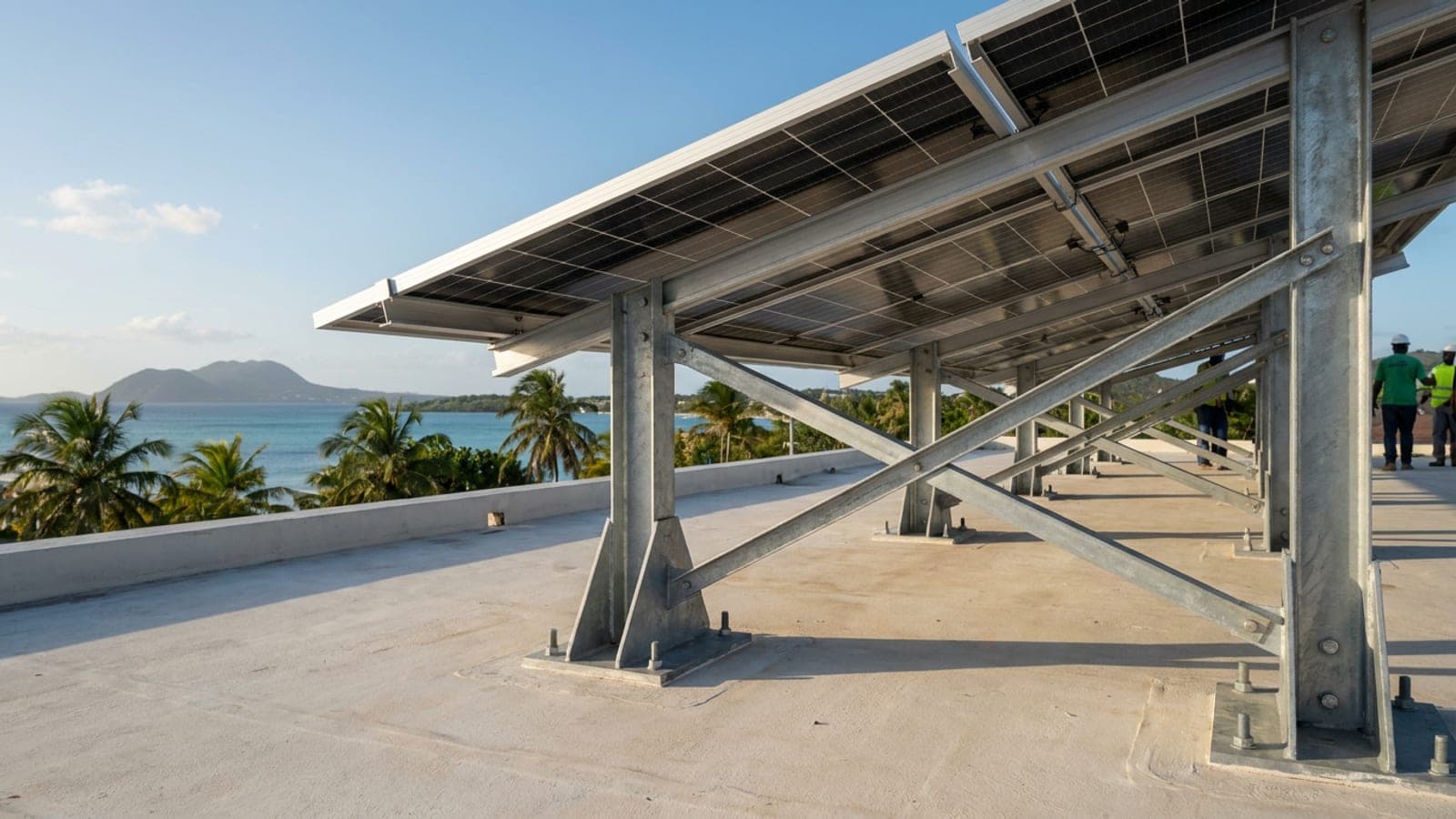
So the array is engineered from the uplift outward. Attachment density increases at roof corners and edges where pressures are highest, penetrations are detailed to the roof manufacturer's warranty requirements, and fastener metallurgy is chosen for salt exposure rather than for price. Salt air is not a coastal footnote here; it is the whole site. Dissimilar metals are isolated, enclosures and conduit fittings are specified for the environment, and torque checks are part of the maintenance plan rather than an afterthought. Our own patented racking, awarded in 2020 with a second patent in 2025, exists because racking is where these loads are resolved.
Post-storm resilience is a design decision, not a warranty claim
Ask any Caribbean solar contractor what happens the day after a storm: who inspects the array, who re-torques it, where the spare modules and inverter are stored, and how long a replacement takes to clear customs. If those answers do not exist before construction, they will not exist when you need them.
Why do storage and micro-grids matter more here?
Because an outage on an island is not a fifteen-minute inconvenience. For a resort it is failed refrigeration, dead water pressure on upper floors, dark corridors and guests checking out. Solar alone stops producing when the grid drops unless the system is designed to carry load without it.
That is why most of our regional work involves commercial battery storage and, where the site justifies it, an islandable micro-grid that keeps critical loads running when utility supply is gone. Our BatteryCube® cabinets are the same platform we used to pair 55,000 lb of storage with a 1.267 MW rooftop array in Georgia. Storage also helps a project meet utility interconnection conditions on small island grids, where a large variable generator can raise legitimate stability concerns.
What about logistics, labor and spares?
This is where Caribbean projects usually slip, and it is entirely preventable.
Equipment is consolidated and containerized so a shipment is not split across sailings. Import and customs documentation is prepared before the container leaves, because a container sitting at the port is a crew standing still. We work with local crews and licensed local trades where the jurisdiction requires it, which is both a legal matter and a practical one — local knowledge of the building stock is worth having. And spares are bought with the original order. An inverter you can replace in three days is a different asset from one you wait six weeks for.
Which properties is this right for?
Resorts and hotels first — most commercial solar installation Caribbean work we take on is hospitality, which is why our regional experience feeds directly into solar for hotels and resorts. Then ports, airports, utilities, hospitals, water plants and government facilities — anything with a large daytime load and a reason to keep operating without the grid. The Westin Dawn Beach Resort 800 kW solar case study is the closest analogue for most hospitality owners, and the Virgin Islands Port Authority 451.5 kW ground mount is the reference for public infrastructure.
US Virgin Islands projects sit under US jurisdiction, so the 30% federal solar investment tax credit and Section 179 and bonus depreciation may be relevant — your tax advisor must confirm eligibility for your entity before any of it goes into a model. Sint Maarten projects stand on avoided energy cost and resilience instead.
The delivery model is the same one described on our commercial solar EPC contractor page, adapted for shipping and island permitting. Tell us about your property and send twelve months of bills.