
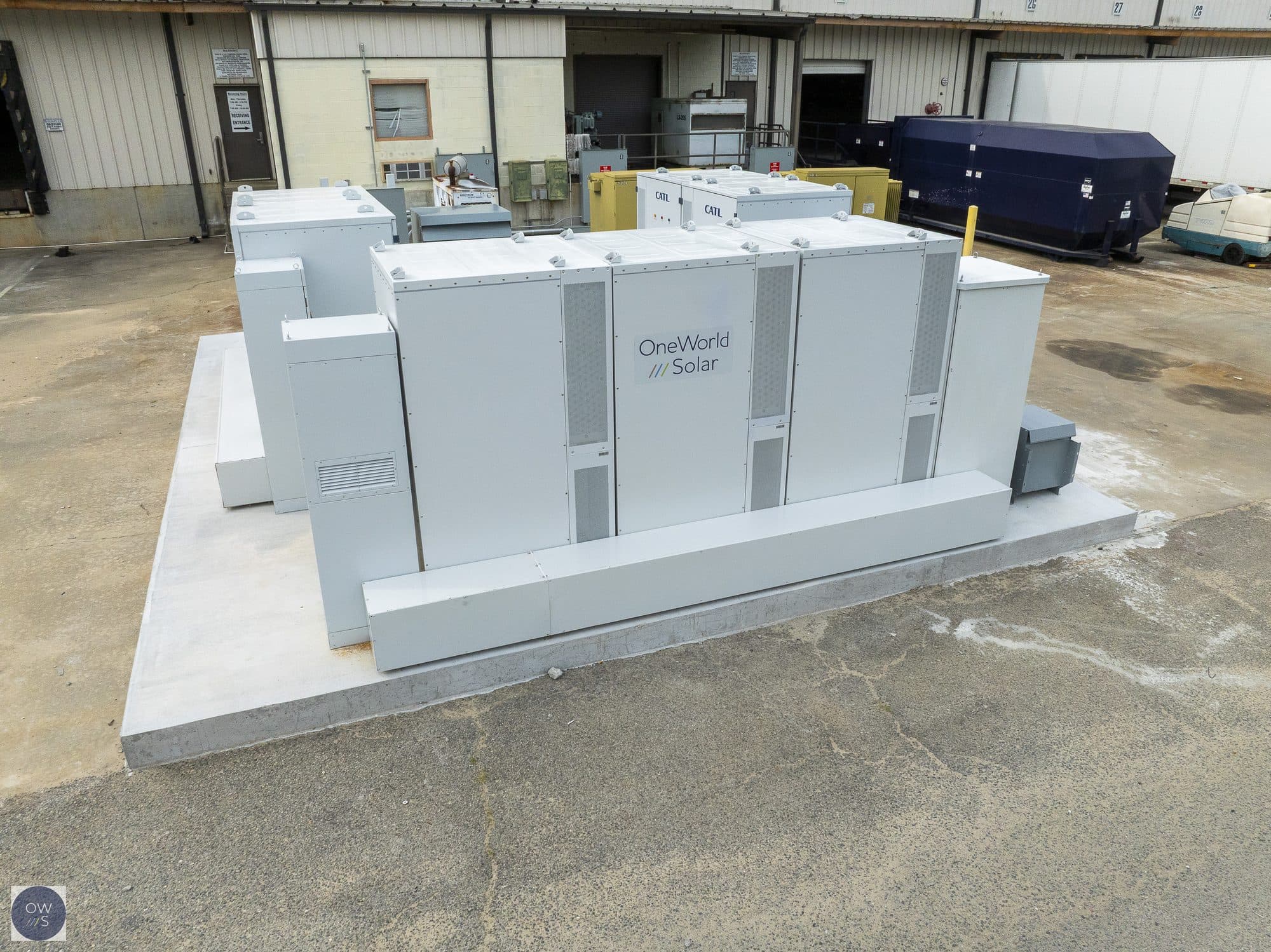
A commercial battery storage installation does one of two jobs, and the two are rarely worth the same money. Either it shaves your peak demand so the utility bills you for fewer kilowatts, or it stores energy while it is cheap and discharges it when it is expensive. A few tariffs pay for both. Most pay well for only one. What decides which applies to you is your rate schedule and your load shape, not the battery.
OneWorld Solar builds three-phase hybrid battery systems across Georgia, Florida, South Carolina, North Carolina and the Caribbean. The largest is at the Samsonite and TUMI distribution center in Vidalia, Georgia: 55,000 lb of batteries in our own BatteryCube® storage cabinets, paired with a 1.267 MW rooftop array. We install storage inside a single commercial solar EPC contract, or as a retrofit on a site that already has solar, or on a site with no solar at all.
Why does solar alone not fix your demand charge?
Because it usually cannot. Solar generates during daylight hours. Your utility sets billed demand from a single short interval in the month, and that interval can land before sunrise in January, after sunset in July, or on a rainy afternoon when the array is producing a fraction of nameplate. Solar is reliable at cutting the kilowatt-hours you buy. It is not reliable at cutting the kilowatt peak you are billed for.
We put that in writing on every proposal we issue, and it is stated plainly in our financial projections disclaimer. A solar contractor who lets you assume otherwise is setting up a conversation you will both regret at the first bill.
A battery is what closes the gap. It watches the meter, and when site draw climbs toward a threshold you set, it discharges to hold the number down. On a demand-heavy tariff, that is often where the larger half of the savings lives.
Demand-charge reduction or energy arbitrage?
These are different investments with different economics, and a proposal should tell you which one it is modeling.
| Demand-charge reduction | Energy arbitrage | |
|---|---|---|
| What it targets | The billed kW peak | The price per kWh |
| Needs | High power, short duration | Lower power, long duration |
| Works when | Demand charges are a large share of the bill | Your tariff has a real price spread by time of day |
| Typical fit | Manufacturing, cold storage, dealerships, poultry | Sites on time-of-use or real-time pricing |
Most commercial sites in the Southeast make their money on the demand side. If demand charges are a small line on your bill and your tariff is flat, a commercial battery storage installation may not be the right purchase at all, and we will tell you that before you spend anything. We walk through the arithmetic in how commercial battery storage payback is calculated.
What is included in a three-phase hybrid battery installation?
A commercial battery storage installation from OneWorld Solar is one scope of work with one price attached, covering everything from the data request to the witness test.
- Interval-data analysis. We request twelve months of interval data from the utility, not just the summary bill, and find where the peaks actually are.
- Power and energy sizing. Kilowatts and kilowatt-hours are specified separately, because a short spike and a long plateau are different problems.
- Cabinets and pad. Outdoor pad-mounted battery cabinets, foundation, spill and setback requirements, and the civil work to get there.
- Power conversion and switchgear. Hybrid inverters or a separate PCS, protection, metering and the interface to your service entrance.
- Controls. The demand threshold logic, state-of-charge reserve for backup, and the schedule that decides when the battery holds fire and when it runs.
- Interconnection. The application, single-line diagram and technical data package, through to the utility witness test.
- Commissioning and monitoring. Capacity verification, as-builts, O&M documentation and production data you can see, not just us.
How do you size a commercial battery?
- Pull twelve months of interval data and plot the load, not the monthly totals.
- Identify the demand peaks: how high above baseline, how long, how often.
- Model solar production against that same curve to see what solar already covers and what it does not.
- Set the target billed demand, then size power to hold it and energy to sustain it through the longest peak of the year.
- Add the critical loads you want carried through an outage and the reserve state of charge they require.
- Price the result against the tariff and stop if the arithmetic does not work.
What we will not do
We will not quote a battery from a monthly bill summary. Monthly kWh totals hide the peak shape entirely, and the peak shape is the whole design. If the utility will not release interval data, we install a temporary meter and log the site first.
What does 55,000 lb of batteries do at Samsonite and TUMI?
55,000 lb
Battery storage installed
CATL cells in OneWorld Solar BatteryCube cabinets, pad-mounted outdoors.
1.267 MW
Paired rooftop solar
Our largest single site, in Vidalia, Georgia.
7.8+ MW
Installed since 2017
Commercial solar and battery customers across the Southeast.
A distribution center of that size has a load profile solar cannot flatten on its own: dock equipment, compressors, conveyors and HVAC that all step on at once. The battery sits between that profile and the meter. It also gives the site the option of running critical loads through a grid event rather than shutting down and restarting a facility. The full build is documented in the Samsonite and TUMI 1.267 MW solar and battery case study.
Which incentives apply to battery storage?
Storage is eligible property under the 30% federal investment tax credit, and in many cases the credit applies to storage installed with or without solar. What we provide is the documentation: itemized cost basis, commissioning records and in-service dates. What we do not do is promise you the credit. Eligibility and amount depend on your tax position, and you and your Certified Tax Accountant own that call.
Do you need a battery, a micro-grid, or neither?
A battery holds down a bill. A micro-grid keeps a site running when the utility is gone, which is a different design with transfer equipment, critical-load separation and inverters that can form their own grid. Plenty of sites need the first and not the second. Sites where an outage costs livestock, product or guests usually need both.
Send us twelve months of bills and, if you can get it, the interval data behind them. That is enough to tell you whether storage earns its keep on your site before either of us spends real time on it.