
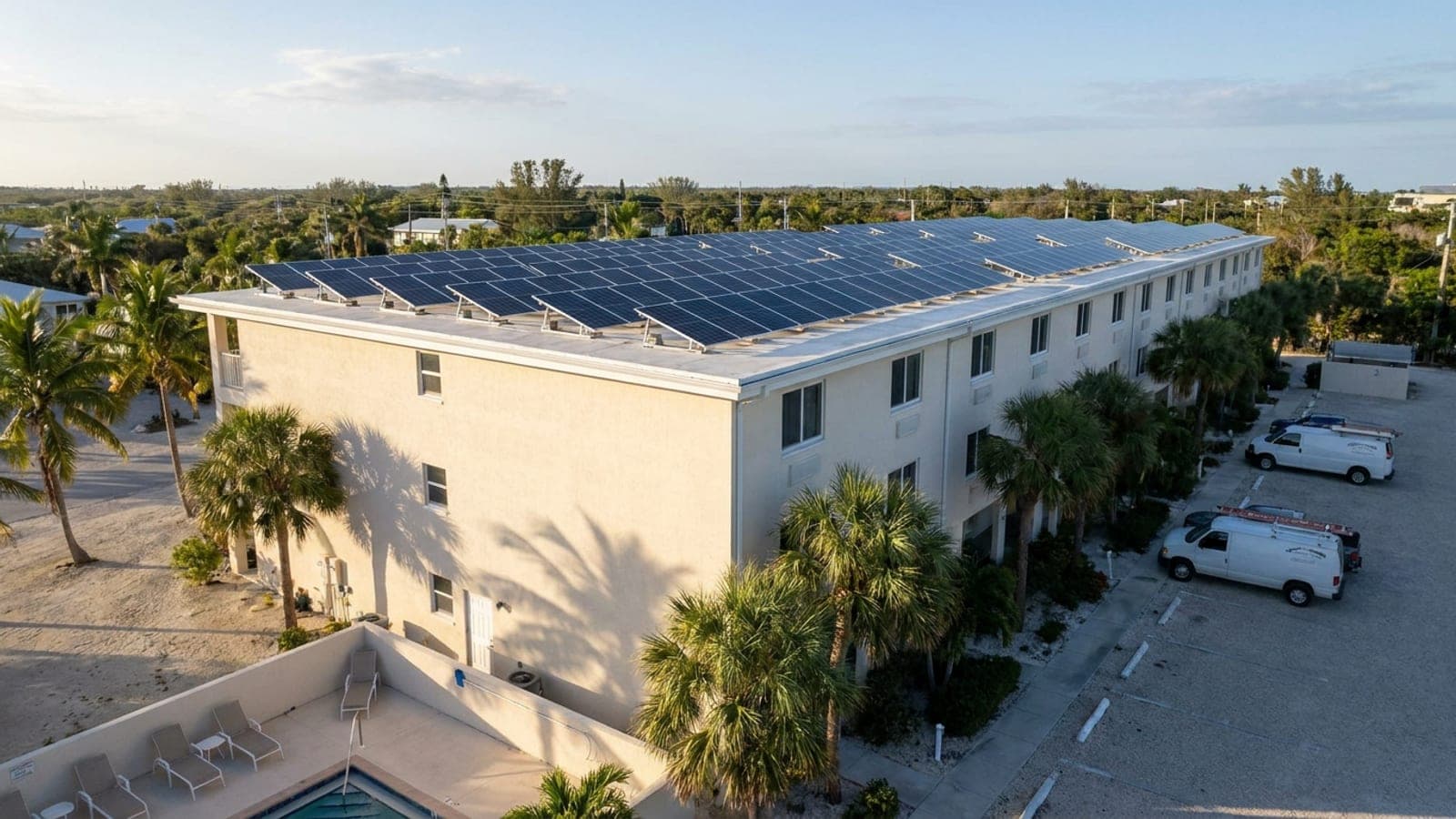
Solar for hotels and resorts is a different problem from solar for an office or a warehouse, because a hotel never turns off. Chillers run around the clock, laundry runs seven days a week, kitchen refrigeration never stops, and pool pumps and domestic hot water carry on regardless of how many rooms are sold. That steady base load is exactly what a solar array is good at serving, and it is why solar panels for hotels are one of the more predictable investments to model in commercial solar.
OneWorld Solar built the 800 kW array at the Westin Dawn Beach Resort & Spa in St. Maarten, along with 157 kW at the Divi Little Bay Beach Resort in Phillipsburg and a 23 kW roof mount at the Homewood Suites by Hilton in Savannah, Georgia. We work across Florida, Georgia and the Caribbean.
Which hotel loads does solar actually offset?
Four load groups dominate a full-service property, and they behave differently.
- Chillers and air handling. The largest single load in a warm climate, and it peaks in the afternoon, which lines up well with production.
- Laundry. Heavy, scheduled and usually daytime. Easy to serve directly.
- Kitchen and refrigeration. Continuous, with evening peaks in the kitchen.
- Pool pumps, water features and domestic hot water. Continuous, and often the easiest load to shift into daylight hours with nothing more than a control change.
That last point matters. On several properties the cheapest gain is not another row of panels, it is moving pumping and laundry schedules into the production window so more of what you generate is consumed on site.
Why do island economics change the answer?
On the mainland, commercial solar competes against a relatively cheap grid. In the Caribbean it competes against electricity generated from imported fuel, and the difference is not small. A resort in St. Maarten, St. Thomas or the wider region routinely pays a rate that is a multiple of what a comparable property pays in Georgia or Florida. We work from your own number rather than a published one: current island rate, $/kWh, from the latest bill.
The consequence is straightforward. The same array, at roughly the same installed cost, pays back far faster on an island than it does on the mainland, and a battery that would never justify itself on a cheap tariff can look obvious. This is the core of our commercial solar installation work in the Caribbean, and it is the reason the Westin project was built at the scale it was.
We will not quote you a rate we have not seen
Island tariffs move with fuel surcharges, and published rates are often out of date within a quarter. Any payback figure built on an assumed rate is a guess. Send us twelve months of actual bills, including the fuel adjustment line, and we will model against what you are really paying.
What about hurricanes and outages?
For a hotel in the hurricane belt, resilience is worth as much as savings and sometimes more. A property that can keep guest floors conditioned, elevators moving and refrigeration cold through a regional outage protects both its guests and its reputation.
Panels alone will not do it. A grid-tied inverter disconnects the moment the utility fails, by design and by code. What does the job is a commercial micro-grid that can island the property, run selected circuits from the array and commercial battery storage, and bring the generator in only when it is genuinely needed. That structure also cuts generator run hours in normal operation, which is a real fuel saving on an island.
Mounting and attachment detailing carry the same weight. In a high-wind zone the array has to be engineered to the local wind speed with the uplift calculations to prove it, and that engineering is where our own patented racking earns its place.
What have we built in hospitality?
800 kW
Westin Dawn Beach Resort & Spa
St. Maarten. Our largest hospitality installation.
157 kW
Divi Little Bay Beach Resort
Roof mount, Phillipsburg, St. Maarten.
23 kW
Homewood Suites by Hilton
Roof mount, Savannah, Georgia.
The Westin Dawn Beach Resort 800 kW solar project is the reference for a large island property. At the other end of the range, the Homewood Suites by Hilton 23 kW rooftop solar installation shows what a select-service property with a small roof can do. Solar panels for hotels of either size sit alongside the rest of our commercial solar work by industry, and the engineering behind all of it is the same.
How do you build on an occupied property?
Nobody books a room to watch a roof crew work. Construction on a live hotel is sequenced around occupancy rather than around our convenience, which means staged deliveries, defined crane windows, crew access routes kept off guest paths, and one roof or one wing at a time so no large area of the property closes at once. On a seasonal resort the practical answer is often to build in your shoulder season and accept a slightly longer schedule.
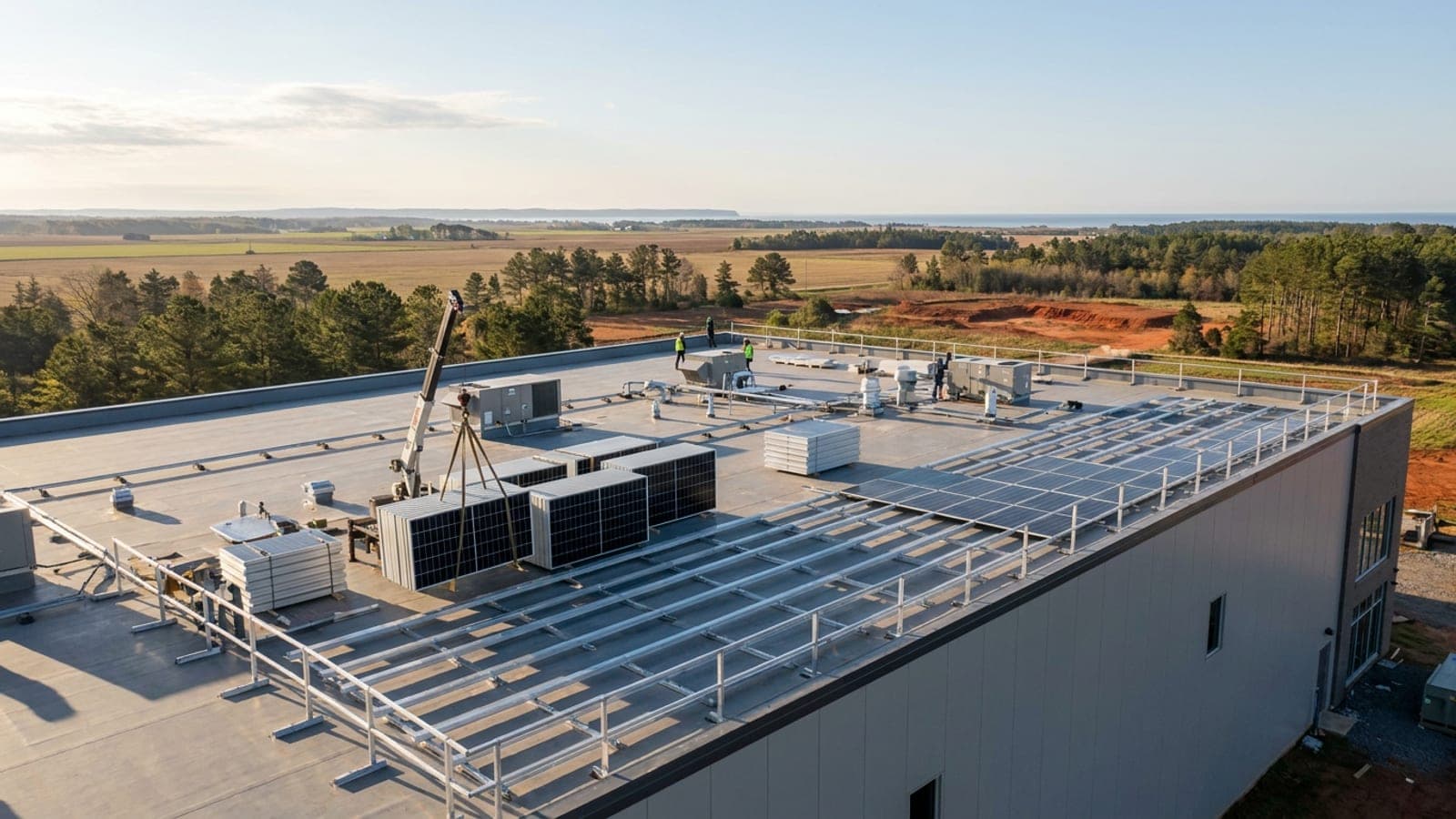
The other timeline to plan for is approval. Branded and franchised properties run roof modifications past the management company and the brand, and structural review can take longer than the engineering itself. We provide sealed drawings and calculations for that review as part of the project. Our VP of Engineering is a licensed Professional Engineer in Florida, Georgia, South Carolina, North Carolina, Virginia and Texas and a NABCEP board-certified Photovoltaic System Inspector.
If your property is on the mainland, our commercial solar installation in Florida covers the same ground with a very different tariff behind it. Either way, solar for hotels and resorts starts the same way: send twelve months of bills and let us tell you what the roof can carry.