
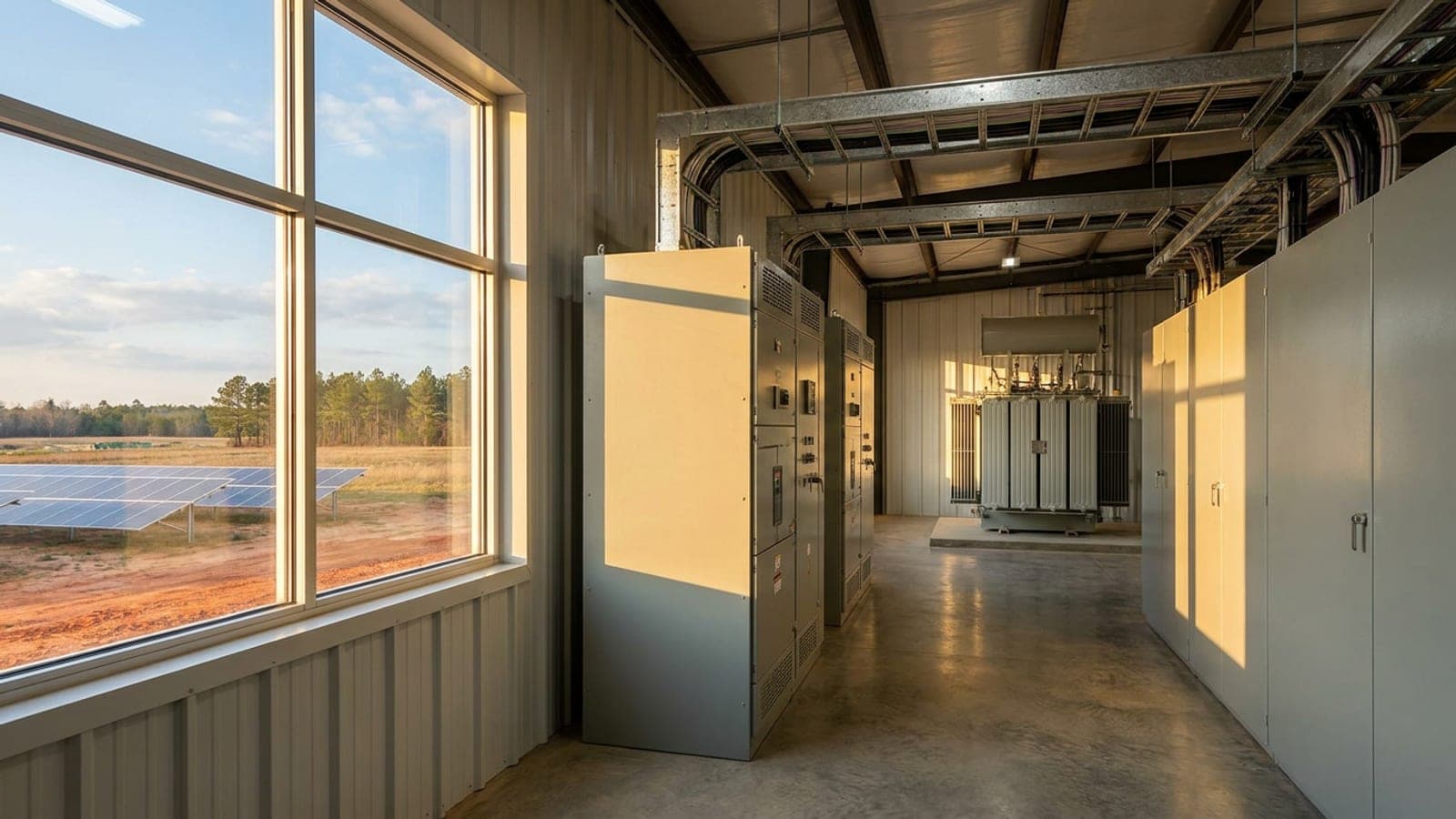
Power factor correction services are the cheapest electrical work on this site, and on a motor-heavy facility they are usually the first thing worth doing. A poor power factor means your utility is delivering more current than your equipment converts into useful work, and most commercial tariffs charge you for that. Correcting it removes a penalty you are paying every month for nothing in return, and it does not require an interconnection agreement, a roof survey or a tax credit to work.
We include a power factor review in every commercial solar EPC feasibility study, and we sell correction on its own. If the review says correction is the better investment and solar is not, that is what we will tell you.
What are kW, kVA and kVAR?
Three numbers describe the same electricity.
- kW — real power. The part that turns a shaft, moves air, makes heat and shows up as work. This is what your kilowatt-hour charge is built on.
- kVAR — reactive power. The part that magnetizes motor and transformer windings. It does no work, but it has to be there, and it flows back and forth between the utility and your equipment continuously.
- kVA — apparent power. The total the utility's wires, transformers and substation must physically carry: real and reactive combined.
Power factor is kW divided by kVA. At a power factor of one, everything delivered does work. At 0.80, the utility has to move roughly a quarter more current to your site than your equipment converts into work. That extra current heats their conductors and consumes their transformer capacity, so they charge for it.
How does a utility bill you for poor power factor?
Two ways, and you may be paying under either without noticing.
- An explicit penalty. The tariff sets a threshold — commonly 0.90 or 0.95 — and adds a surcharge for each month you fall below it. It appears as its own line, often abbreviated.
- Billing demand in kVA instead of kW. No penalty line ever appears. The demand charge is simply calculated on apparent power, so poor power factor quietly inflates the largest number on the bill.
The second is easy to miss and often the more expensive of the two. Because thresholds and rates differ by utility and by rate schedule, we read your actual tariff rather than assume one. Send us twelve months of utility bills and we will tell you which mechanism is on your account and what it has cost you over the last year.
Why do motor-heavy sites run a poor power factor?
Induction motors draw reactive power to build their magnetic fields, and they do it whether they are working hard or barely working at all. So the sites with the worst power factor are the ones running many motors for long hours, especially motors that are oversized for their duty:

- Poultry houses. Banks of tunnel ventilation fans, feed augers and circulation fans running through the growing cycle. This is one reason solar panels for poultry farms so often come with a correction recommendation attached.
- Manufacturing and warehousing. Compressors, pumps, conveyors, dust collection and injection equipment, which is the usual profile behind solar for manufacturing facilities.
- Cold storage. Refrigeration compressors running near-continuously.
- Dealership and shop environments. Air compressors, lifts and welders that spend much of the day lightly loaded.
Welders, variable frequency drives and LED retrofits complicate the picture, because they introduce harmonics. On a site with significant harmonic content, plain capacitors can resonate with the system and make things worse rather than better. That is why the study comes before the equipment.
What does correction cost, and what does it pay back?
Power factor correction services are priced from the kVAR the site needs, not from the size of your building, which is why they are so often the best return on the bill. It is common for a correction project to pay for itself in a fraction of the time a solar array takes, because the equipment is inexpensive relative to the penalty it removes.
Do this before you buy solar
Correction is cheap, fast and needs no utility approval to start saving. A solar project takes months of engineering, permitting and interconnection review before it produces a kilowatt-hour. Paying a power factor penalty throughout that period when a capacitor bank would have ended it is money given away for no reason.
There is a limit worth stating: correction only removes the penalty. It does not reduce the kilowatt-hours you consume. If your bill has no power factor charge and no kVA demand billing, correction saves you nothing, and we will say so rather than sell you a cabinet. The commercial solar savings calculator covers the consumption side of the bill; correction covers the penalty side.
What do OneWorld Solar's power factor correction services include?
- Bill and tariff review. Twelve months of bills, and the rate schedule they are billed under, to confirm a penalty exists and quantify it.
- Metering study. Log real power, reactive power and harmonics at the service and at major motor groups over a full production cycle.
- Design. Fixed or automatically switched stages, detuned reactors where harmonics require them, and a decision on whether to correct centrally at the service or locally at the large motors.
- Installation. Capacitor bank, switchgear connection and protection, engineered and inspected as electrical work, not as an accessory.
- Verification. Re-meter after commissioning and check the next two bills. The penalty line should be gone. If it is not, we come back.
What should you do first?
Look at last month's bill. If there is a power factor figure below one, or the demand is stated in kVA, you have a problem worth about the price of a small capacitor bank to solve. Fix that, then look at solar, then look at whether commercial battery storage can take down the demand charge that remains. In that order, each step is sized against a load that has already been cleaned up by the one before it.