
Commercial solar cost per kW in Georgia is the question every buyer asks first and almost no solar website answers. There is a reason for the silence: the number moves with system size, roof condition, the distance from the array to the point of interconnection, and whatever the utility decides it needs on its side of the meter. Publish one figure and it will be wrong for most readers.
The alternative is to explain how the number is built, so you can read a quote and know whether it is cheap because the contractor is efficient or cheap because something has been left out. That is what this article does. Every price in it is an illustrative planning range, marked for verification, and none of it is a quote for your building.
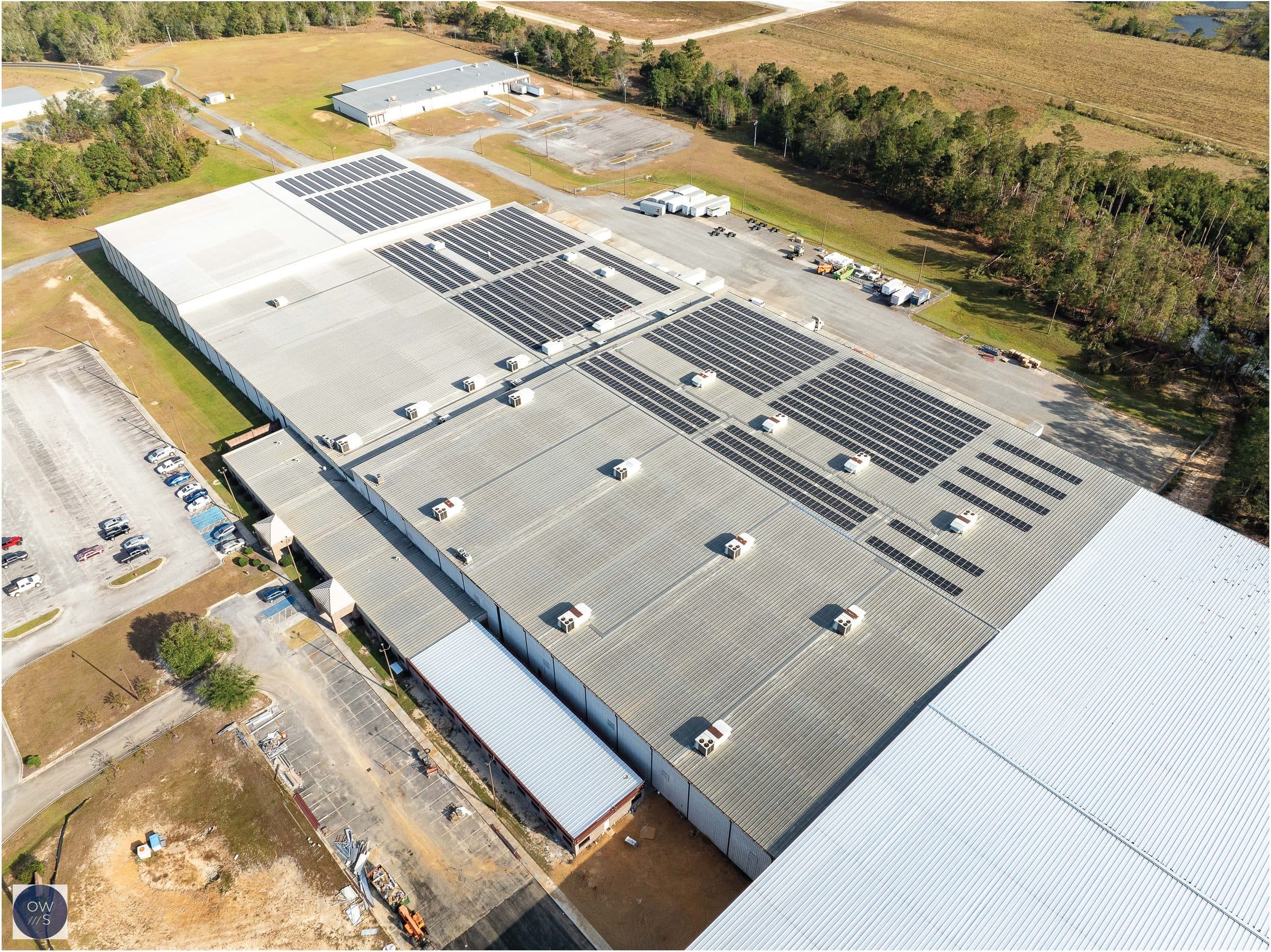
We have installed more than 7.8 MW for commercial and agricultural customers, most of it in Georgia, including the 1.267 MW rooftop solar and battery installation at Samsonite and TUMI in Vidalia. The ranges below are how we think about pricing before a site walk.
Why does the cost per watt fall as the system gets bigger?
Because a large share of a solar project is fixed regardless of size. Design hours, the stamped drawing set, the permit application, the interconnection application, mobilizing crews and equipment to site, and the commissioning process cost roughly the same on a 150 kW array as on a 600 kW one. Spread over four times the capacity, they are a quarter of the burden per watt.
As illustrative planning bands for Georgia, before incentives:
| System size | Illustrative installed cost | What changes at this size |
|---|---|---|
| 100–250 kW | $2.20–$2.90 per watt | Fixed engineering and mobilization dominate |
| 250–500 kW | $1.90–$2.50 per watt | Better module and inverter pricing; string inverters still |
| 500 kW–1 MW | $1.70–$2.20 per watt | Larger inverters, medium-voltage interconnection likely |
| 1 MW and above | $1.50–$2.00 per watt | Utility-side work becomes a bigger share of the total |
Treat that table as a way to sanity-check a proposal, not as a price list. The break points are soft and a difficult site in one band will price like the band above it.
What is actually in the number?
An installed cost per watt is a bundle of at least a dozen line items, and only one of them is the thing most people shop on.
| Cost driver | Illustrative share of installed cost | What moves it |
|---|---|---|
| Modules | 25–35% | Wattage class, tariffs, domestic content |
| Inverters | 8–14% | String vs central, DC:AC ratio, monitoring |
| Racking and attachments | 8–15% | Roof type, wind load, ballast vs penetration |
| DC and AC wiring, combiners | 6–12% | Distance from array to point of interconnection |
| Switchgear and protection | 4–10% | Utility protective relaying requirements |
| Structural and civil work | 0–15% | Purlin reinforcement, foundations, site prep |
| Engineering and permitting | 4–8% | PE stamps, AHJ review, structural calculations |
| Interconnection and utility upgrades | 2–15% | Study result, transformer, service capacity |
| Labor and construction management | 15–25% | Site access, height, roof complexity |
| Commissioning and monitoring | 1–3% | Testing, witness test, as-builts |
The interesting thing about that list is how wide the ranges are on the items nobody puts on the front page of a proposal. Structural work and interconnection can each be zero on an easy site and a large number on a hard one. Modules, which is where the price conversation usually starts, are the most predictable item on the sheet.
Which four variables swing a Georgia quote the most?
- Roof type and remaining life. Standing seam metal is the friendliest surface in the Southeast because clamps attach without penetration. Ballasted membrane roofs need a structural check. And a roof with fewer years left than the array is a decision to pay for removal and reinstallation later, which belongs in the economics now rather than in year ten.
- Distance from the array to the point of interconnection. Copper, conduit and trenching are priced by the foot. A ground mount 800 feet from the service entrance can cost meaningfully more per watt than the same array 200 feet away, and the loss on the run has to be engineered around.
- What the utility requires. A transformer replacement, a protective relaying package or a service upgrade is utility-side work you pay for, and it does not scale with the array.
- Whether storage is included. Batteries are priced separately and change the value case as well as the cost. On demand-charge-heavy tariffs they can be the better part of the return.
Is a roof, a ground mount or a canopy cheaper?
In Georgia the hierarchy is fairly consistent. Roof mounts are usually the cheapest per watt: no land, no foundations, no site work, and the array sits close to the load. Ground mounts add foundations, site preparation, fencing and a longer conductor run, but buy you correct orientation and tilt, no roof risk, and easy maintenance access. Canopies cost the most, often 1.5 to 2 times a comparable rooftop array, because the structure is doing two jobs — carrying panels and covering vehicles — and the steel is engineered for both.
Choose on remaining roof life first and price second. That decision is made during the feasibility stage of our commercial solar EPC contract, before anything is designed around a roof that will not last.
Why can an interconnection study change the economics more than module pricing?
Because a module price swing of a few cents per watt moves a 500 kW project by a modest amount, while an interconnection study that calls for a transformer and protective relaying can move it by a much larger one — and it arrives after the design, when you have already spent money.
Ask who carries the interconnection risk
The most expensive words in a commercial solar proposal are "utility upgrades excluded". If the study comes back requiring utility-side work, someone pays for it. Get it in writing whether that is you, the contractor, or a shared cap.
This is also the argument for having the interconnection looked at by someone who does it for a living before the layout is fixed. Our VP of Engineering has been working medium- and high-voltage renewable interconnections since 1992, and vets sites for interconnection compatibility and congestion constraints as part of the design. Finding a problem before the study is a design change; finding it after is a change order.
How do incentives change the net number?
They do not change what the work costs. They change what you pay for it.
The federal solar investment tax credit, currently 30%, applies to eligible project cost, and Section 179 and bonus depreciation affect how quickly you recover the balance. Rural and agricultural sites may also be eligible to apply for a USDA REAP grant, which is competitive and never guaranteed. Your accountant determines what you can actually claim.
Compare proposals on gross installed cost per watt first, then apply incentives. Doing it the other way around makes an expensive system with an optimistic tax assumption look like the better deal. To model your own site, the commercial solar savings calculator turns a monthly bill into a system size, an annual saving and a payback range.
How should you compare two quotes that look different?
Line the two proposals up and check five things before you look at the price.
- DC:AC ratio. More modules per inverter changes production and clipping. Two systems described as "500 kW" can have different module counts.
- Racking and attachment method. Penetrating, clamped or ballasted, and whether the detail meets the roof manufacturer's warranty requirements.
- Warranty terms. Module, inverter and, separately, the workmanship warranty on the installation itself.
- Interconnection risk. Included, excluded, or capped — and who pays if the utility study comes back expensive.
- Production estimate methodology. What software, what weather data set, what soiling and degradation assumptions.
A cheaper number is legitimate when a contractor is efficient, buys well or is already working nearby. It is not legitimate when it is cheaper because the structural work, the trenching or the utility upgrade has been left for you to find later.
If you want the same treatment applied to your building, our pages on commercial solar installation in Georgia and solar for manufacturing facilities cover the utility landscape and the building types we price most often. Send twelve months of bills and we will price the site rather than the postcode.