
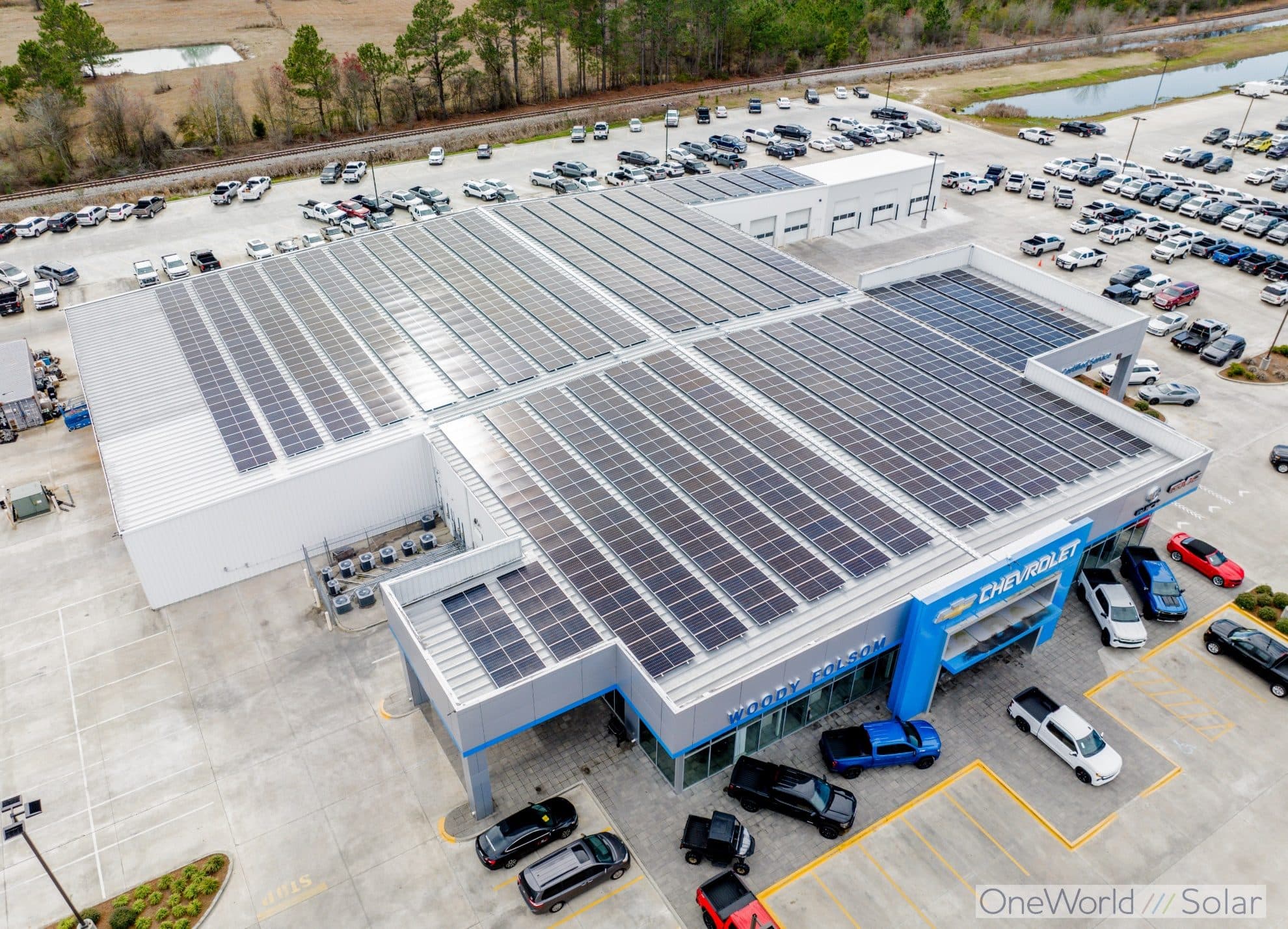
Solar for car dealerships works for a plain reason: a dealership uses a lot of electricity during business hours, and business hours are when the sun is out. Showroom HVAC runs from open to close, the sales floor is lit to a brightness no other retail format matches, service bays run compressors and lifts all day, and the body shop adds ventilation and paint booth load on top.
OneWorld Solar has installed more than 1 MW across the Woody Folsom Automotive Group, covering their Chevrolet, Ford and Chrysler Dodge stores in Georgia, plus a 127 kW rooftop array at Headquarter Honda in Clermont, Florida. We build the whole project under one contract, including the utility interconnection.
What does a dealership's load profile actually look like?
Dealerships have an unusual load shape, and it matters for how you size a system.
- Daytime base load is high and flat. Showroom conditioning and lighting run continuously through opening hours. Solar covers this almost perfectly.
- Service and body shop load is spiky. Compressors, lifts and paint booth exhaust cycle hard, which is what sets your monthly demand charge.
- Lot lighting runs all night. Solar does nothing for it. If your lot lighting is still metal halide, relamping to LED will usually beat adding panels to cover the same kilowatt-hours.
- EV charging is the new variable. A Level 3 charger can add more peak demand in fifteen minutes than the rest of the store draws all day.
That mix is why we read the tariff before we size the array. Reducing kilowatt-hours and reducing peak kilowatts are two different jobs, and on a demand-heavy dealership tariff the second one is often worth more.
Rooftop array or solar canopy over the lot?
Solar for car dealerships comes down to two structures, and most stores can use either. The right answer depends on the buildings.
A rooftop array on the showroom and service building is the cheaper path per watt. There is no steel to buy and no foundation work, the array sits directly over the load, and it is invisible from the customer approach, which keeps it clear of most facility image questions.
A solar canopy over the inventory lot costs more per watt but does three other things at once: it shades new inventory from heat and hail, it gives you a structure to mount lot lighting and EV chargers on, and it is visible in a way that a roof array is not. For a brand pushing an EV program, a canopy is often the more useful asset even when the rooftop math looks better.
We model both and show you the two cash flows side by side rather than picking one for you. Either way, the engineering runs through our commercial solar EPC contract, so one company carries the design, the permit, the interconnection and the build.
How do you handle EV charging and demand charges?
This is the question that has changed the most in the last few years. Adding DC fast charging to meet a manufacturer requirement can quietly reset your billing demand for the entire month, because most commercial tariffs bill on the highest fifteen-minute peak, regardless of when it happened.
Solar shaves that peak only if the charging happens at midday. Battery storage shaves it whenever it happens. A commercial battery storage system discharging alongside the charger keeps the meter from ever seeing the full spike, which converts a variable demand charge into something you can predict.
Separately, service departments with a lot of motor load often carry a power factor penalty they have never noticed on the bill. Power factor correction is usually the cheapest kilowatt you will ever buy back, and we check for it before proposing anything larger.
An honest caveat about lot lighting
Solar will not reduce your overnight lot lighting cost. Grid-tied panels produce nothing at 2 a.m., and sizing a battery to carry lot lighting all night rarely pays for itself on a normal tariff. If overnight lighting is a large share of your bill, fix the fixtures first and then size the array around what is left.
What have we built for auto groups?
1 MW+
Woody Folsom Automotive Group
Chevrolet, Ford and Chrysler Dodge stores in Georgia.
127 kW
Headquarter Honda, Clermont FL
Roof-mounted array on a single-store site.
7.8+ MW
Installed since 2017
Across commercial solar and battery customers.
The Woody Folsom Automotive 1 MW solar rollout is the clearest example of a multi-store program: three brands, three separate buildings, one engineering package. The Headquarter Honda 127 kW rooftop solar project shows what a single Florida store looks like. Both sit alongside the rest of our commercial solar work by industry.
Which incentives apply to a dealership?
Nothing about solar for car dealerships is treated differently by the tax code. Dealerships are ordinary commercial taxpayers, so the full federal stack is available. The 30% investment tax credit applies to the system. Accelerated and bonus depreciation apply to the basis, and Section 179 solar depreciation can pull a large share of the deduction into year one, which matters if you had a strong year in new and used sales. Your CPA validates what you can actually claim; we supply the documentation.
For the arithmetic on how these change the timeline, our breakdown of the solar payback period for car dealerships walks through the assumptions. Most of the automotive work sits within commercial solar installation in Georgia, though we build across the Southeast and Florida. Send twelve months of bills for one store and we will model the group.