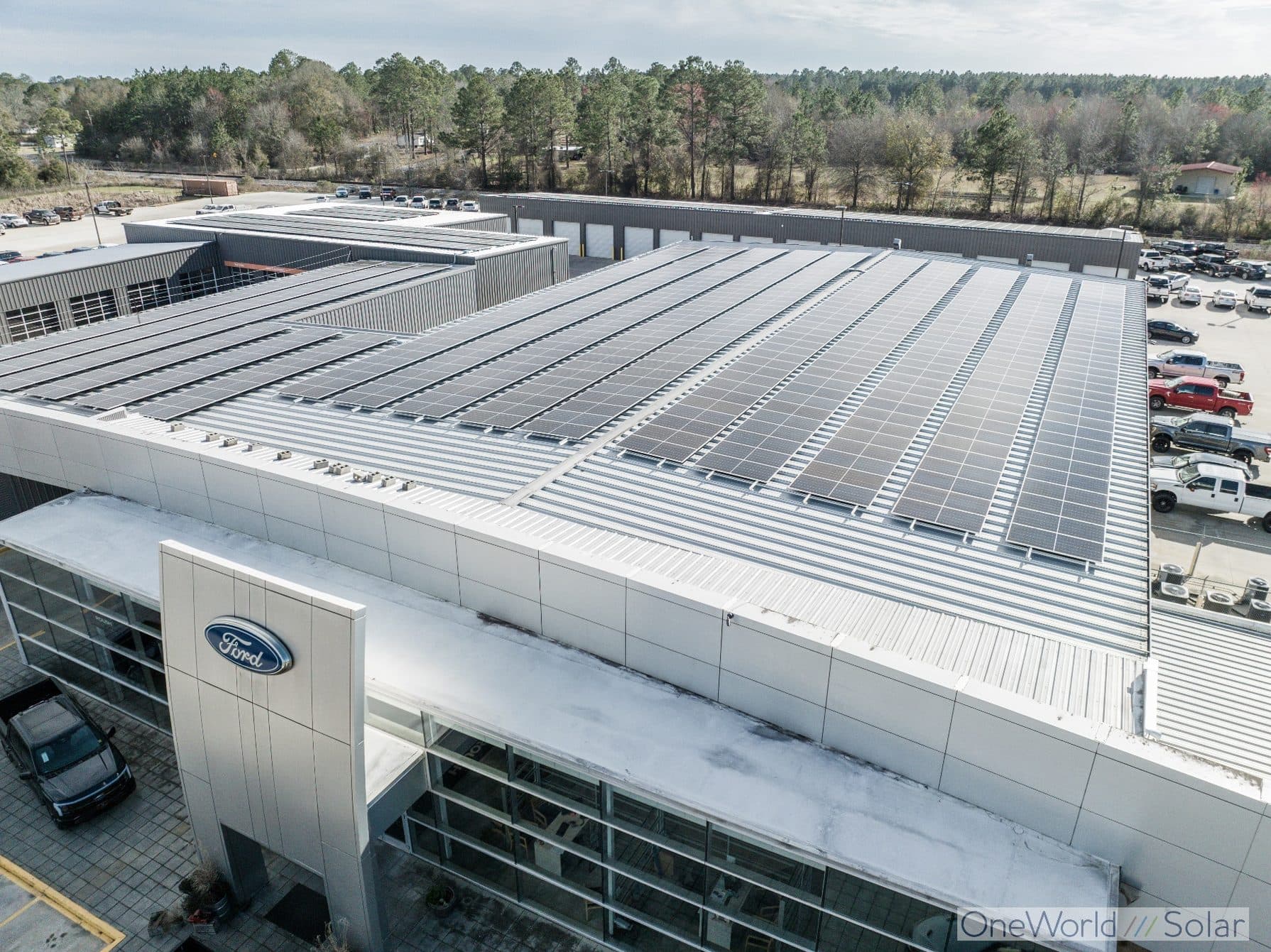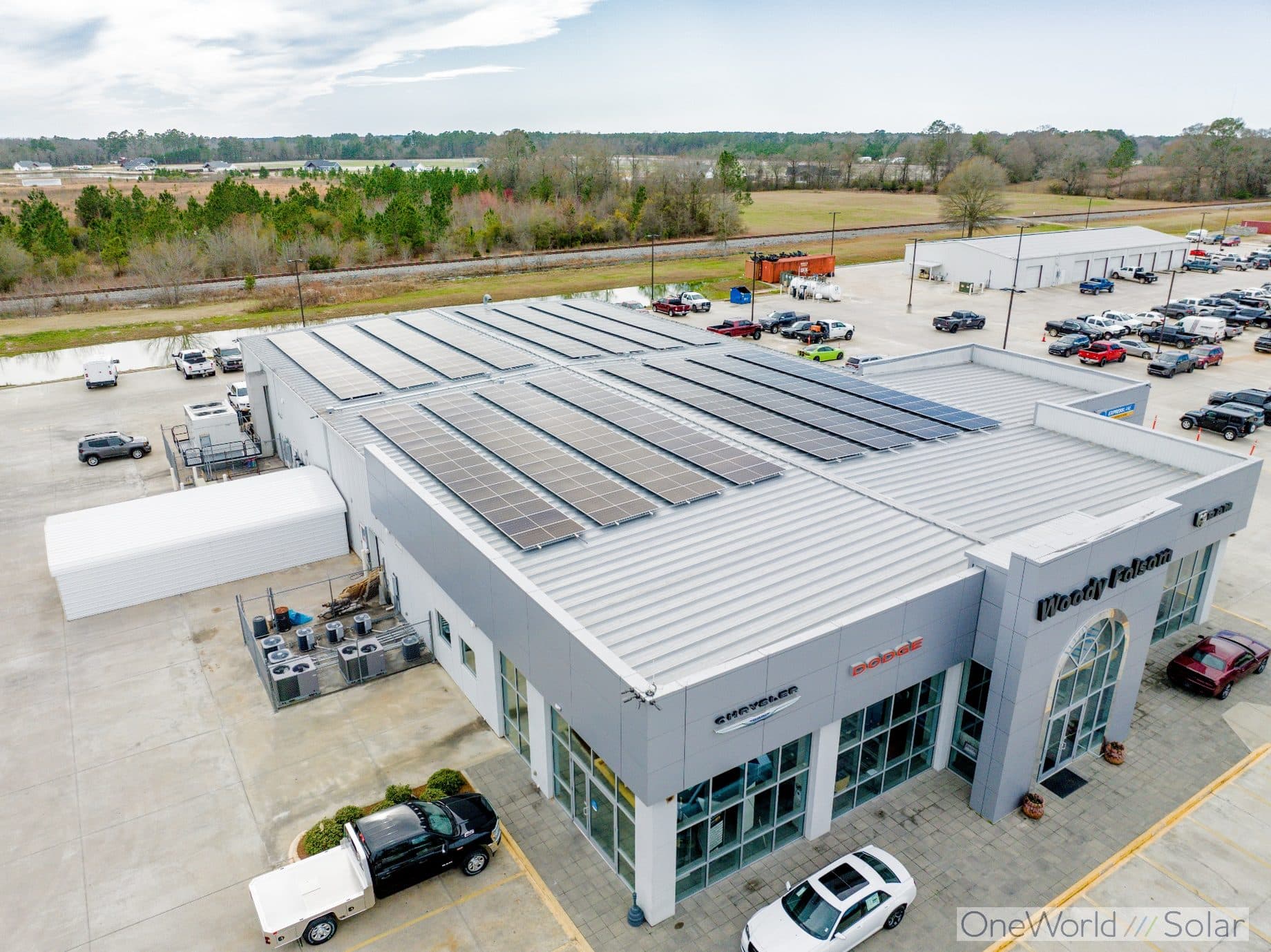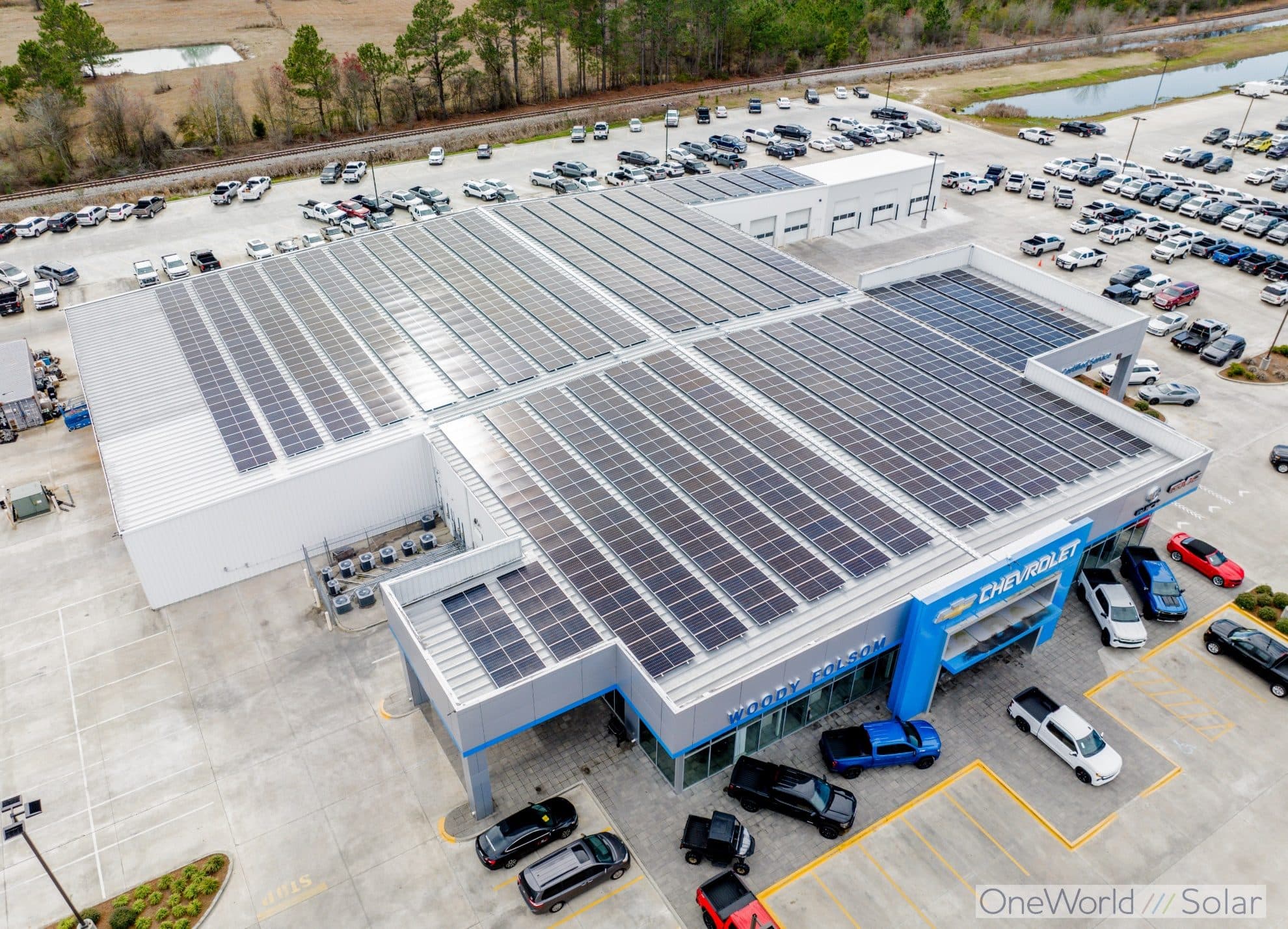
This solar for car dealerships case study covers three rooftops rather than one. OneWorld Solar installed more than 1 MW of rooftop photovoltaics across the Woody Folsom Automotive Group's Chevrolet, Ford and Chrysler Dodge dealerships in Georgia, and the interesting part is not the capacity — it is that the group treated three buildings as one program instead of three separate purchases.
Dealerships are good solar buildings for reasons that have nothing to do with being dealerships. They have large single-story footprints, they run heavy daytime loads, and they are open when the sun is up. What makes a group like this unusual is that the same owner controls several of those roofs at once.
The problem: three roofs, three utility accounts, one owner
A dealership's electrical load is dominated by things that only happen in daylight: showroom HVAC working against a lot of glass, showroom and lot lighting, service bay compressors and lifts, and body shop equipment. That is a near-ideal production match. The difficulty is procedural rather than technical.
Run as three separate projects, a group pays for the same work three times. Structural and electrical engineering gets redone to the same standard. Three interconnection applications go into the utility on three schedules. Crews mobilize and demobilize three times. Equipment is bought in three smaller lots. And the finance and tax work lands in three unrelated conversations with the accountant, potentially straddling tax years.
Which store is in which town
The group operates in Baxley and Vidalia, Georgia, and we have not confirmed which individual franchise sits in which town for publication. Rather than guess, the town-level split is flagged for verification with OneWorld Solar before this page goes live.
The solution: one program across three dealership roofs
1 MW+
Combined rooftop capacity
Across the three dealership buildings.
3
Dealership roofs
Chevrolet, Ford and Chrysler Dodge.
One
Engineering and construction program
Not three separately procured projects.
OneWorld Solar delivered the portfolio under commercial solar EPC contracting: one engineering standard applied to three buildings, one procurement package, a coordinated set of interconnection applications, and construction sequenced so crews moved between stores rather than remobilizing.
Each roof still got its own layout. Dealership roofs are not warehouse roofs — they are interrupted by rooftop mechanical units, skylights, canopies and parapet setbacks, and the service side of a store is usually built differently from the showroom side. What was standardized was the engineering approach, the equipment and the paperwork, not a copy-and-pasted array.
The results
OneWorld Solar has not published production or bill-savings figures for this installation. The scope described above is what the company confirms; anything beyond it should come from OneWorld Solar directly.
What is documented is the scope: more than 1 MW of rooftop generation across three Woody Folsom dealerships, engineered, procured, built and interconnected by one contractor. For a dealer group, the number that usually decides the question is payback rather than capacity, and that is worked through in solar payback for car dealerships.
Why this matters if you own more than one store
If you operate a group, the single most valuable thing you can do is stop treating each rooftop as a standalone capital request. Bundling gives you better pricing, one engineering standard, one construction schedule, and a single tax position to take to your accountant.
- The wider case for solar for car dealerships covers load profiles, canopies and EV charging.
- The 30% commercial solar tax credit and Section 179 solar depreciation are what turn a multi-site rollout into a defensible capital decision. Your accountant confirms what you can claim; we supply the evidence.
- If your demand charges are the real problem, read how we approach commercial battery storage installation.
- We build this kind of portfolio throughout commercial solar installation in Georgia, from Vidalia.