
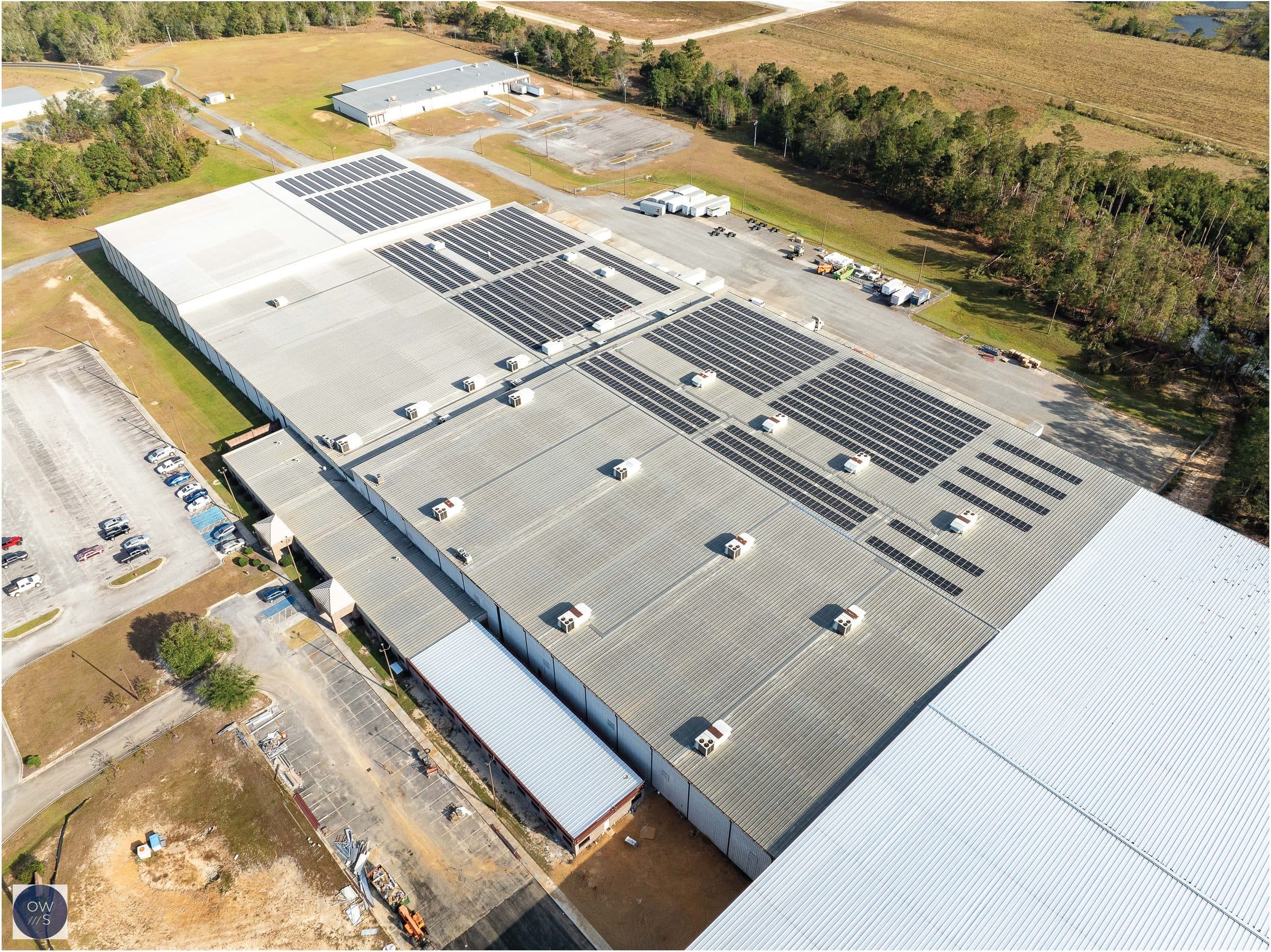
Solar for manufacturing facilities starts with an asset you already own and are not using. A plant or distribution center typically sits under acres of flat or low-slope roof that generates nothing, carries no rent and needs replacing on a schedule anyway. Putting an array on it turns a maintenance liability into a generating asset sitting directly behind your meter.
OneWorld Solar built the 1.267 MW rooftop array at the Samsonite and TUMI facility in Vidalia, Georgia, paired with 55,000 lb of battery storage using CATL cells in our own BatteryCube® cabinets. It is the largest single site we have built and the clearest demonstration of what an industrial roof can do.
What does an industrial electricity bill really cost you?
Industrial tariffs are not simple energy rates, and this is where most solar proposals for manufacturers go wrong.
- Energy charges cover kilowatt-hours consumed. Solar reduces these directly and predictably.
- Demand charges are set by your highest short peak in the billing period, typically measured over fifteen minutes. Solar reduces these only if the peak happened to occur at midday under a clear sky.
- Ratchet clauses carry a share of your highest peak forward for months after it occurred. One unlucky startup sequence can set a floor on your bill for the rest of the year.
- Power factor penalties appear when large motor loads pull reactive power. Many plants pay these for years without noticing the line item.
Every proposal we write for solar for manufacturing facilities starts by reading twelve months of bills and separating those four numbers. Sometimes the honest recommendation is power factor correction services first, because correcting kVAR is often cheaper per dollar saved than adding a single panel.
Where does battery storage fit in a plant?
Where demand charges are a large share of the bill, storage frequently earns more than incremental solar does. A battery discharges when you tell it to rather than when the weather allows, so it can hold the meter below a target demand level through a compressor start, a furnace cycle or a shift changeover.
That is the reasoning behind the Samsonite installation. The 55,000 lb of commercial battery storage there is doing three jobs at once: clipping the peaks that set billing demand, moving midday production into hours when the plant is drawing but the array is not producing, and holding critical load through an interruption. The cabinets themselves are BatteryCube commercial battery energy storage systems, designed and branded by us.
Does solar work if you run around the clock?
Here is the part that gets left out of most pitches.
A single-shift daytime plant is the best case for solar. Production and consumption line up hour for hour, essentially everything generated is consumed on site, and every kilowatt-hour is worth full retail rather than an export rate.
A plant running second and third shifts is a different calculation. The daytime production is still consumed, but a much larger share of your annual consumption happens in the dark, so the array covers a smaller percentage of the total bill. That does not make it a bad investment. It does mean the payback model has to be built from your actual hourly profile rather than from an annual kilowatt-hour total divided by twelve.
When we will tell you to wait
If your roof has fewer than ten years of life left, we will recommend you re-roof first or go to a ground mount. Mounting a twenty-five year array on a roof you will replace in eight is a decision to pay for removal and reinstall later, and that cost is rarely in anyone's model. The same applies to a ballasted system on a structure that has no spare load capacity.
What has to be checked before design starts?
- Structural capacity. Metal roofs are assessed at the purlin, ballasted roofs at the deck and frame. Either way the calculation is done and sealed, not assumed.
- Remaining roof life and warranty. Attachment details are built to the roof manufacturer's requirements so the existing warranty survives.
- Service entrance and interconnection point. On a large industrial service, the distance from array to switchgear and the utility's protection requirements can move the cost more than module pricing does.
- Fire access and setbacks. Code-required pathways reduce usable roof area, sometimes significantly on a building with many roof units.
All of that sits inside a single commercial solar EPC contract, so one company carries the engineering, the permit set, the interconnection application and the build. Our VP of Engineering is a licensed Professional Engineer in Georgia, Florida, South Carolina, North Carolina, Virginia and Texas, and has worked on medium- and high-voltage interconnections since 1992.
What does the flagship project look like?
1.267 MW
Samsonite / TUMI rooftop array
Vidalia, Georgia. Our largest single installation.
55,000 lb
Battery storage installed
CATL cells in OneWorld Solar BatteryCube cabinets.
7.8+ MW
Built since 2017
Across commercial solar and battery customers.
The full write-up of the Samsonite and TUMI 1.267 MW rooftop solar and battery project covers the roof survey, the interconnection and how the storage was sized.
Which incentives and reporting benefits apply?
Manufacturers are ordinary commercial taxpayers, so the 30% federal investment tax credit applies, and Section 179 solar depreciation plus bonus depreciation can pull much of the deduction forward. Your tax advisor confirms what you can claim; we provide the cost documentation and commissioning records.
Separately, on-site generation reduces reported Scope 2 emissions because it displaces purchased electricity at the facility itself, with metered production data your auditors can trace. That is increasingly what large customers ask suppliers to evidence.
Most of this work sits within commercial solar installation in Georgia. If you want to see how solar for manufacturing facilities compares with what we build elsewhere, our commercial solar work by industry covers poultry, automotive and hospitality on the same terms.