
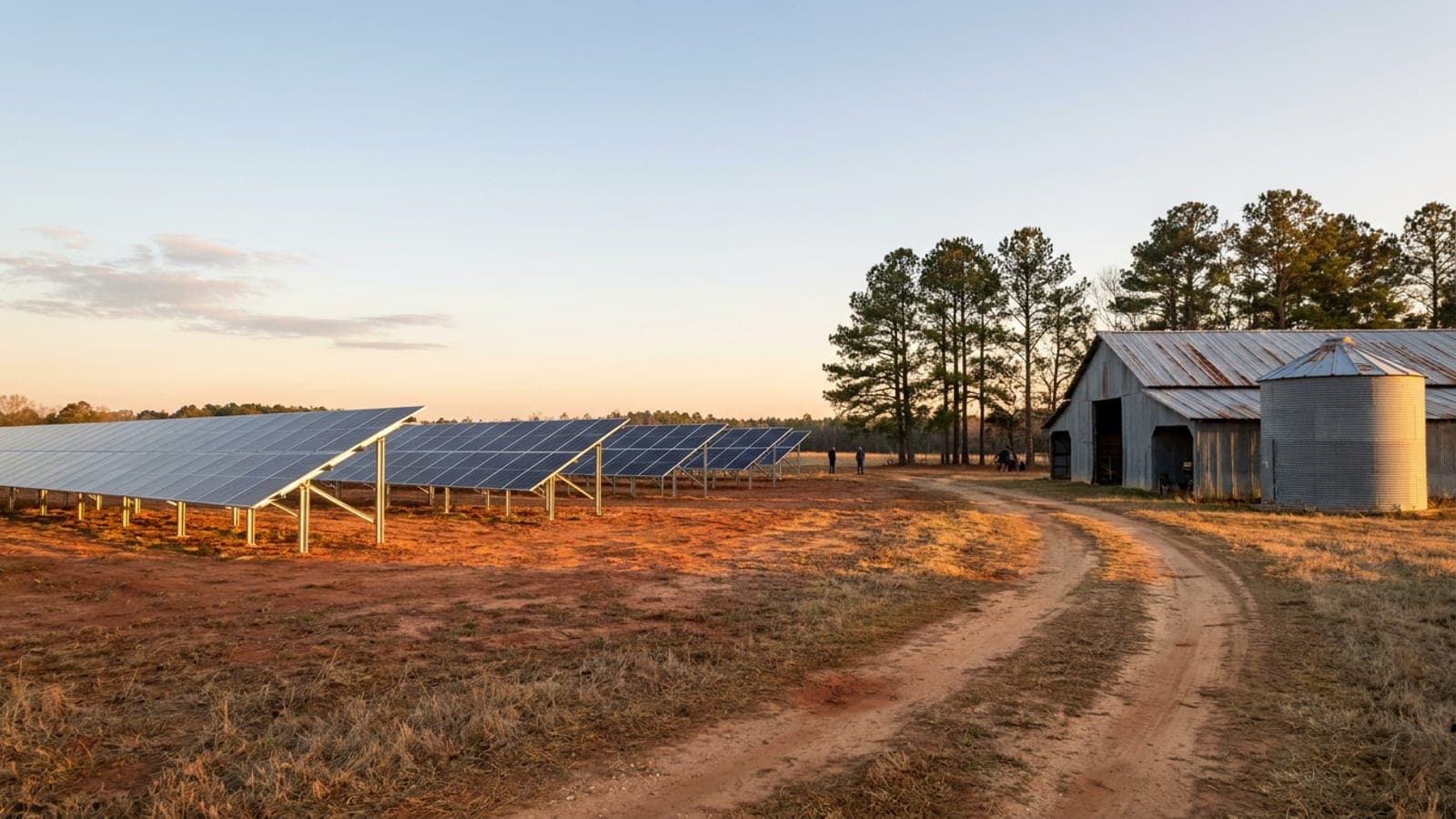
For a farm or a rural small business, USDA REAP grant solar funding is often the difference between a project that pencils and one that stays in a drawer. It is a federal cost-share program run by the U.S. Department of Agriculture to put renewable energy and efficiency equipment on agricultural operations and small businesses outside the metro areas.
It is also widely misunderstood. A REAP grant is not a rebate you claim after the fact, it is not automatic, and no solar contractor can promise you one. It is a competitive application scored inside a funding round, and the award comes before you build, not after.
OneWorld Solar has installed more than 4.8 MW on U.S. poultry operations and works alongside REAP applicants regularly, but the grant itself is yours to procure and validate.
Verify before you rely on this
Every figure on this page — percentages, caps, deadlines, thresholds — changes. REAP is funded on a cycle, application windows open and close each year, and the caps and match requirements come from the rules in force for the round you apply to, not from this page. This is a general explanation of how the program works, not tax, legal or grant advice. Confirm current terms with your USDA Rural Development state energy coordinator, and anything with a tax consequence with a Certified Tax Accountant, before you budget.
What is the Rural Energy for America Program?
Applications go to USDA Rural Development state offices rather than one national desk, so your state energy coordinator is the person who will read your file. Call them early.
The program funds renewable energy systems — solar, wind, geothermal, digesters — and efficiency improvements such as lighting, ventilation and motors. An array on a poultry house, a packing shed or a rural manufacturing building sits in the first category.
Money arrives in two forms, which can sometimes be combined:
- Grants cover a share of eligible project costs, capped both as a percentage and by a maximum award — up to 50% of eligible project cost, with a maximum renewable energy system grant of $1 million and a minimum request of $2,500.
- Guaranteed loans, where USDA guarantees part of a loan your own lender makes, up to $25 million. That improves your terms; it is not free money.
- Combined grant and loan requests, with their own ceiling of 75% of eligible project cost.
Whatever the grant does not cover, you cover. Matching funds must be documented and genuinely available — at least 50% of project cost from non-federal sources on a grant-only application — and USDA wants evidence of them.
Who is eligible for a REAP grant?
Two groups. Agricultural producers, who generally must derive a substantial share of gross income from agricultural operations — at least 50% — and who can qualify whether or not the operation sits in a rural area. And small businesses, which must meet the size standard for their industry and must be at an address USDA classifies as rural.
That word "rural" catches most people out. USDA uses a specific definition tied to population and to mapped eligibility boundaries — generally areas outside cities and towns of more than 50,000 residents and their adjacent urbanized areas. A site that feels rural can fall inside a mapped boundary and be ineligible, and the reverse happens just as often. Check the address on USDA's map first.
Applicants must also be current on federal debt, not debarred, and registered in SAM, the federal System for Award Management, with an active UEI number. SAM registration takes longer than people expect.
Is a REAP grant automatic?
No, and this is the most important thing on the page. USDA REAP grant solar awards are competitive and scored: applications compete inside a funding round, and USDA awards against a published rubric.
Points go to the energy the system replaces, the size of the applicant, the share you fund yourself, and whether you have had REAP support before. Paperwork quality therefore matters as much as system quality. A thin assessment and a one-page quote will score below a full technical report, for the same array.
What does a REAP application require?
- An energy assessment or a full energy audit. Projects above $200,000 in total project cost generally need a full audit by a qualified professional.
- A technical report covering design, equipment, production estimate, installer qualifications, permits, interconnection and the O&M plan.
- Financial statements — typically three years of history plus projections, showing the business can carry the project.
- Evidence of matching funds: a bank statement or a loan commitment letter.
- Environmental review under NEPA, plus any historic preservation, floodplain or endangered species screening your site triggers.
- Active SAM registration and a UEI number before submission.
- Site control — deed, lease or easement proving you can build where you say.
The order to tackle it in is covered step by step in our REAP grant application guide for solar.
How long does REAP take, and when can I build?
Think in quarters. USDA publishes application deadlines — recent years have run multiple windows per fiscal year — and awards follow 60 to 120 days after a window closes. From first conversation to funds in hand, six to twelve months is a fair planning assumption.
Do not start construction before the award
Federal grant programs generally require that the funded work has not begun before the award is made. Breaking ground, and in some cases ordering major equipment, can render those costs ineligible or disqualify the application outright. If the roof needs replacing first, or lead times are long, agree the sequencing with your USDA state coordinator in writing before anything happens on site — and confirm the current rule with USDA, not with this page.
Why REAP fits poultry and agriculture
Poultry houses are close to an ideal candidate: heavy ventilation and lighting loads year-round, demand peaking in the months a Southeast array produces most, and an operation that almost always satisfies the agricultural-producer test.
The same load profile raises a second question that solar alone does not answer. Ventilation failure in a full house is a mortality event measured in minutes, not hours, which is why growers who start with a grant application often end up asking about commercial battery storage and about a microgrid that can island the ventilation load when the grid drops. Whether any of that is eligible for REAP funding depends on how the project is scoped, and is a question for your USDA state coordinator rather than for us.
Our poultry work includes a 210 kW system on a 6-house breeder farm, 450 kW on a 14-house broiler farm and 410 kW on a 16-house broiler farm, part of more than 4.8 MW installed on U.S. poultry operations. There is more on solar panels for poultry farms and on commercial solar installation in Georgia, where most of it was built. REAP is federal, so the same rules apply across our territory — see commercial solar installation in North Carolina and in South Carolina for how the interconnection and utility picture differs there.
REAP is also frequently considered alongside the 30% federal solar investment tax credit and Section 179 and bonus depreciation for solar. How a federal grant affects your depreciable basis and your credit basis belongs to a Certified Tax Accountant, not to us.
What we do, and what you do
We are a commercial solar EPC contractor, not a grant writer and not a tax adviser. We supply the engineering half of the file: system design, production modeling, an itemized cost breakdown, equipment specifications, interconnection detail and installer credentials. Our VP of Engineering is a Professional Engineer licensed in six states and a NABCEP board-certified Photovoltaic System Inspector, and the technical report carries his seal.
You, usually with a grant writer and your accountant, submit the application and procure and validate the grant. That division is written into our contract. To test whether your site is a candidate for USDA REAP grant solar funding, talk to us about a REAP-backed solar project and send twelve months of bills.