
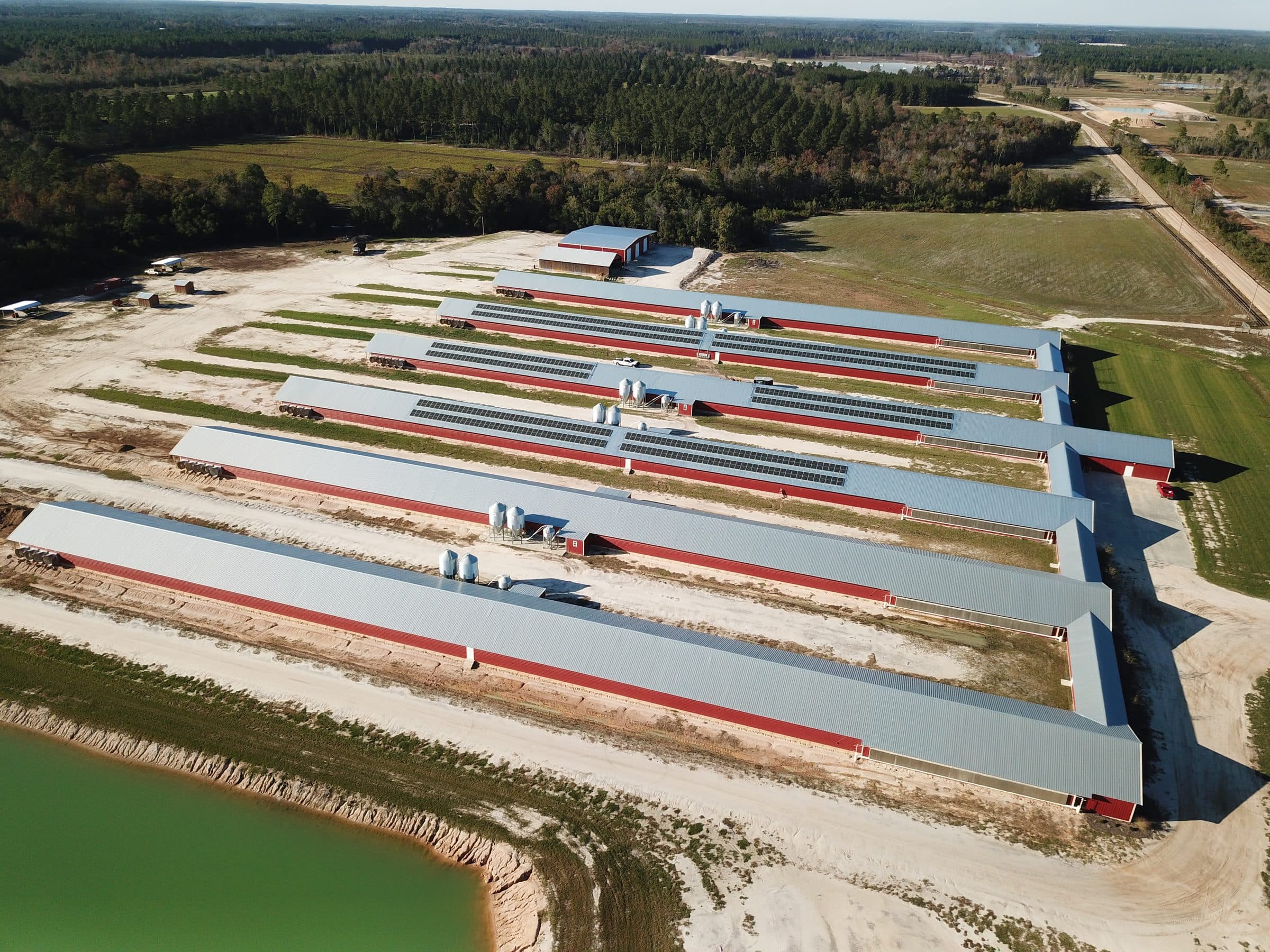
A REAP grant application for solar is closer to a loan submission than a form. USDA Rural Development wants proof that you are eligible, an independent view of how much energy your operation uses, a technical design a reviewer can check, several years of financials, a federal vendor registration and an environmental clearance — and it wants all of that before your project is scored against everyone else who applied in the same funding window.
We prepare the technical and energy portions of these applications for rural clients across the Southeast, most of them poultry growers within a couple of hours of our office in Vidalia, Georgia. The terms move: cost-share percentage, maximum award, audit threshold and filing dates are all set in the funding notice for the round you file in, so every figure below is marked for verification. The sequence does not move, and that is what this guide covers.
For what the program is and who it is for, start with our page on the USDA REAP grant for solar. This article is about getting through it.
Verify every number here before you rely on it
Percentages, caps, thresholds and deadlines in this article are illustrative and change between funding notices. Nothing here is tax, legal or grant advice, and no contractor can promise you an award. Confirm the current terms with USDA Rural Development and your own advisors.
Are you eligible to apply?
Two gates come first, and both are worth settling before you spend a dollar on anything else.
Location. The site has to sit in an eligible rural area, which is defined by population rather than by how rural it feels — commonly a place outside a city or town above roughly 50,000 people and its adjacent urbanized area. USDA publishes a mapping tool that answers this by address. A farm on the wrong side of a boundary is not eligible, no matter how many houses it runs.
Business type. Applicants are generally either agricultural producers, who must derive a share of gross income from agricultural operations — at least 50% — or small businesses located in an eligible rural area, sized against SBA standards for their industry. Poultry growers usually clear the agricultural producer test comfortably, which is one reason solar panels for poultry farms and REAP come up together so often.
Beyond that, expect to certify that the operation has no delinquent federal debt or outstanding federal judgments, and that the equipment is commercially available, proven technology installed at the site of the operation.
Do you need an energy assessment or a full energy audit?
Every renewable energy application has to be supported by a documented view of the site's energy use. For smaller projects an energy assessment is enough. Once total project cost passes a threshold — illustratively $200,000 — a full energy audit, prepared to a recognized standard by a qualified auditor, is generally required instead.
Find out which one applies before you build a schedule. An audit is a real piece of work with a real fee, it takes weeks, and it has to reconcile against your utility bills. If the audit says the farm uses one thing and the bills say another, that discrepancy is the first thing a reviewer finds.
Who writes the technical report?
The technical report is the engineering heart of the application, and it is usually where a weak submission shows. A reviewer expects the design basis, equipment specifications and data sheets, the system layout, the production estimate with the methodology behind it, the interconnection arrangement, an operations and maintenance plan, and the qualifications of the company doing the work.
This is the part we write, because it is essentially the same package that goes to the building department and the utility under our commercial solar EPC contract. Our VP of Engineering is a Professional Engineer licensed in six states and a NABCEP board-certified Photovoltaic System Inspector. A production estimate is more persuasive when the person standing behind it holds credentials the reviewer recognizes.
What financial and registration paperwork is required?
Two separate piles. The financial pile shows the business can carry the project; the registration pile lets the federal government pay you. You need a Unique Entity ID and an active SAM.gov registration: free, not instant, and it lapses annually if nobody renews it. Start it early. Once you accept an award you are a federal award recipient, with the reporting and record-keeping obligations that come with it.
- Twelve months of utility bills for every meter on the site
- The energy assessment or full energy audit
- The technical report, drawings, equipment data sheets and production estimate
- An itemized quote from the installer, broken into line items rather than one number
- Business tax returns and financial statements, typically for the last three years
- Balance sheet, income statement and a current schedule of debt
- Evidence of the agricultural income share, or a small business size determination
- Written evidence of matching funds: cash on hand, a bank commitment letter or a loan term sheet
- Unique Entity ID and an active SAM.gov registration
- Site maps, aerial imagery and photographs for the environmental review
- Ownership structure, formation documents and the required federal certifications
Why is the grant not the whole project cost?
Because REAP is a cost-share program. The grant covers a portion of eligible project cost — illustratively up to 50%, subject to a maximum award for renewable energy systems of $1 million — and you must document where the rest is coming from.
Here is a worked illustrative example. It uses round numbers rather than a quote, and shows only the mechanics. On a project priced at $600,000, a cost share of 50% would mean an application for a grant of $300,000 and $300,000 that you have to fund yourself, from cash, a conventional loan or a USDA guaranteed loan. Applications that show committed matching funds read as ready to build; applications that leave the balance unexplained do not.
Separately, the federal solar investment tax credit, currently 30%, and depreciation may also apply to the project. How a grant interacts with your depreciable basis is a question for your CPA, not your solar contractor — have that conversation before you file.
What does the environmental review involve?
USDA cannot obligate funds until the project clears a review covering historic properties, threatened and endangered species, wetlands and floodplains, and general site impact. Expect to supply maps, aerial imagery and site photographs.
Roof-mounted arrays on existing buildings are the simplest case, because there is no ground disturbance to assess. Ground mounts on undisturbed land take longer, which is one practical argument for putting the array on the house roofs where the structure allows it. Nothing may be disturbed on site until the review is finished.
How is a REAP application scored?
REAP is competitive and points-based. You are not measured against a pass mark, you are ranked against everyone else who filed in the same window, with a finite pool of funds behind it. The criteria are published in the funding notice and typically reward the share of your energy use the system replaces, cost effectiveness, the applicant's size and type, whether matching funds are committed, and how ready the project is to proceed.
In practice, the applications that score well are the complete ones. An audit that reconciles to the bills. Commercially proven equipment. A production estimate a reviewer can reproduce. Matching funds evidenced in writing. Every signature present. Points are lost to administrative gaps far more often than to weak projects.
When should you apply, and when can you break ground?
Applications are accepted against cutoff dates published in the funding notice, so the practical planning question is which window you are filing into and whether the audit and the registrations will be finished in time.
Then the rule that costs growers the most money: do not begin construction before an award. Costs incurred beforehand, and any site disturbance ahead of the environmental review, are commonly treated as ineligible. Ordering early to beat a price increase can disqualify the spend it was meant to protect. Sign the EPC contract with the start conditioned on the award, and wait for written authorization to proceed.
What happens after an award?
Reimbursement, not a check in the mail. In most cases you build the system, pay your invoices, then submit requests for payment with invoices and proof of payment attached. Some awards allow partial draws against completed milestones; final payment usually waits until the system is complete, inspected and producing. Plan construction cash flow, and any interim financing, on that basis. After that come the obligations people forget at signing: performance reporting for a defined period, keeping the system operational and insured, and retaining records for inspection.
Should you hire help with the application?
Honestly, most growers do. The application is administratively heavy, the narrative sections reward experience, and the cost of a rejected filing is a year. Some hire an independent grant writer; others rely on their EPC contractor for the technical half and handle the business half themselves.
On rural projects we prepare the technical report and the energy documentation as part of the job rather than as an extra line item, which is how most of our farm work under commercial solar installation in Georgia gets filed. Talk to us about a rural solar project early enough to make the next funding window rather than the one after it.