
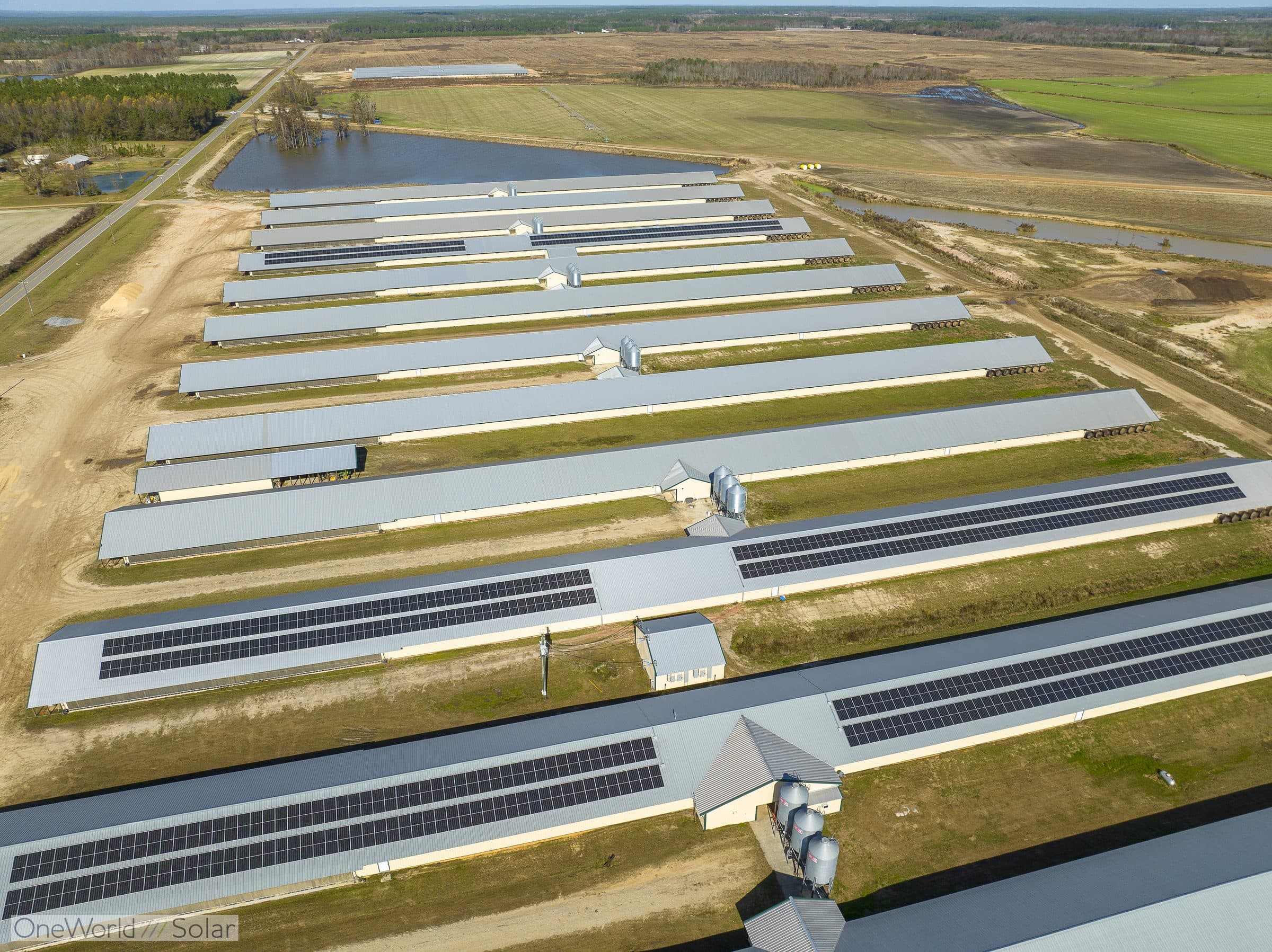
Solar for broiler houses works for one blunt reason: the load and the sunshine arrive at the same time. Tunnel fans, stir fans, cool-cell pumps and wells pull hardest on a hot afternoon, which is exactly when a roof-mounted array produces most. This project put 450 kW across all 14 houses on a broiler farm in southeast Georgia, and it is the largest single poultry site OneWorld Solar has built.
The grower is not named here. What is worth publishing is the sizing logic and the way a job like this is delivered, because both transfer directly to any multi-house operation looking at the same decision. The farm sits inside a portfolio of more than 4.8 MW that we have installed on U.S. poultry houses.
The problem: 14 roofs, one power bill, one growing season
A 14-house broiler operation is a small industrial site that happens to be agricultural. The electrical load is heavy, seasonal and almost entirely daytime, and it scales with house count in a way that makes a partial answer unattractive. Three things had to be resolved before a single rail went down:
- Roof capacity, not roof area. Broiler houses give you long, unbroken metal planes with nothing to shade them, which is close to ideal. The limiting factor is structural: purlin spacing, attachment detail and uplift, not square footage.
- Doing 14 houses without doing 14 projects. Engineering, the utility interconnection package and mobilization are largely fixed costs. Split across a handful of roofs they hurt; split across 14 they are the reason the cost per watt on a farm this size beats a two-house system.
- Timing around bird placement. Work on an operating farm is scheduled around flocks, not the other way around. That is a coordination problem, and it is the contractor's to solve.
The solution: one array, one contract, all 14 houses
450 kW
Rooftop photovoltaic array
Spread across every house on the farm.
14
Broiler houses covered
No house left out of the design.
~32 kW
Average per house
Simple average of system size over house count.
OneWorld Solar delivered the farm as a single commercial solar EPC contract: engineering and stamped drawings, the utility interconnection application, procurement, construction across all 14 roofs, and commissioning. The array is roof mounted using racking developed for exactly this structure — long metal agricultural roofs are the application our 2020 racking patent came out of.
The per-house average of about 32 kW is arithmetic, not a design rule. It is published here because growers ask for a benchmark, and it sits at the upper middle of the range we have seen across our solar panels for poultry farms portfolio. Your own number depends on fan horsepower and flock schedule far more than on house count.
What we will not promise about REAP
A farm this size is a strong USDA Rural Energy for America Program candidate: documented energy use, an unambiguously rural address, a clear producer relationship. It is still a competitive, scored grant, and no contractor can promise you an award. We prepare the technical and energy-assessment portions as part of the job — see the USDA REAP grant for solar page for what the application actually asks for.
The results
OneWorld Solar has not published production or bill-savings figures for this installation. The scope described above is what the company confirms; anything beyond it should come from OneWorld Solar directly.
What can be stated without qualification is the scope: 450 kW of rooftop generation across 14 broiler houses, engineered, procured, built and interconnected by one contractor on a working farm.
What a multi-house grower should take from this
If you run ten houses or more, this is the closest reference point we have. The roofs are usually the easy part; the value is in doing every house under one engineering and interconnection effort instead of returning three times.
- Compare it against the 210 kW 6-house breeder farm array and the 410 kW 16-house broiler system to see how differently the per-house figure lands.
- Read what drives poultry farm solar cost and results before you compare quotes.
- If outage protection matters more to you than savings, start with commercial micro-grid installation.
- Run your own numbers with the commercial solar savings calculator.
This farm is one of many we build across commercial solar installation in Georgia, from our base at 609 Church Street in Vidalia — in the middle of poultry country.