
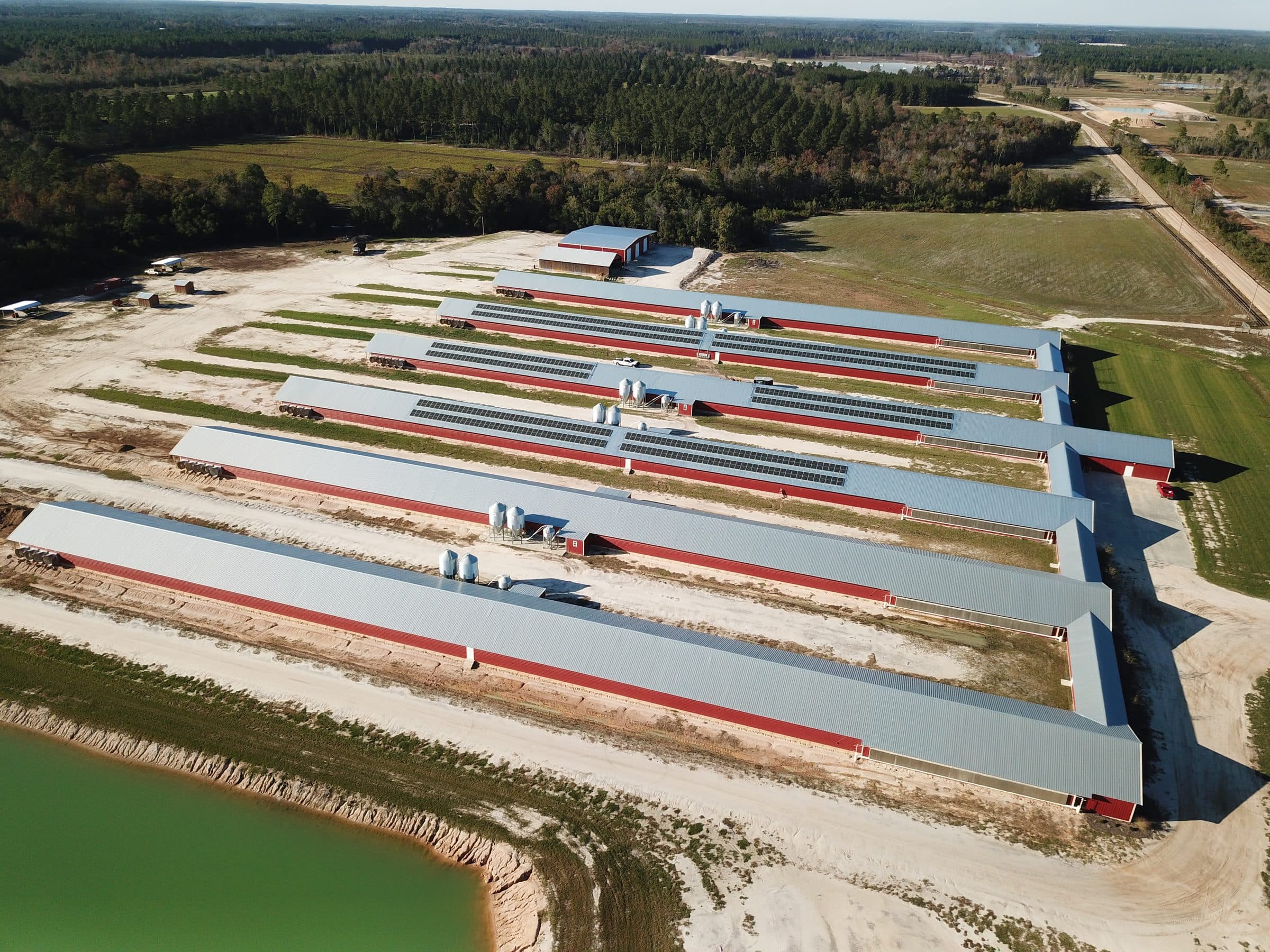
Solar for poultry breeder houses sizes differently from solar for broilers, and this farm is the clearest example we have. Six houses, 210 kW, roof mounted — 35 kW per house, the densest per-house sizing of the three poultry farms OneWorld Solar publishes, on the smallest farm of the three.
The operation is a breeder farm in southeast Georgia and is not named at the grower's request. It sits within the 4.8 MW-plus we have installed on U.S. poultry houses, and it is the project we point smaller operations to when they assume solar only works at fourteen houses and up.
Why breeder houses have a different load profile
A finishing broiler house is defined by its hot-weather peak: tunnel fans and cool cells running hard on summer afternoons, then far less in cool weather. A breeder house is defined by its run hours. Flocks are held on a light program, so lighting runs long and predictably; feed systems, water, nest equipment and egg handling all draw during the working day.
The practical consequence is a flatter, longer daytime curve rather than a sharp seasonal spike. That curve suits a rooftop array well, because a high share of what the panels make is consumed in the house rather than exported, and self-consumed power is worth full retail to the grower. It also means the economics are less dependent on a handful of hot months than a broiler farm's are.
The solution: 210 kW across six roofs
210 kW
Rooftop photovoltaic array
Across all six breeder houses.
6
Breeder houses covered
One design, one interconnection package.
35 kW
Average per house
The densest of our three published poultry farms.
OneWorld Solar built the farm as a single commercial solar EPC contract — engineering and stamped drawings, the utility interconnection application, procurement, construction and commissioning. Racking on long agricultural metal roofs is the application our own racking patent came out of, and it is why a six-house farm does not carry the mobilization overhead you might expect.
The 35 kW per house figure is a simple average of system size over house count, published as a benchmark rather than a design rule. Read it next to the 450 kW 14-house broiler farm at about 32 kW per house and the 410 kW 16-house broiler system at about 26 kW, and the point makes itself: house count does not size an array. Bills do.
On grant funding for a smaller farm
Six-house operations are often told they are too small to bother applying for federal grant funding. That is not our experience. The USDA REAP grant for solar is scored on the merits of the application, and a well-documented small farm can compete. It is still competitive, still discretionary, and still something no contractor can promise you.
The results
OneWorld Solar has not published production or bill-savings figures for this installation. The scope described above is what the company confirms; anything beyond it should come from OneWorld Solar directly.
The scope stands on its own: 210 kW of rooftop generation across six breeder houses, engineered, procured, built and interconnected under one contract.
What this means for other breeder operations
If you run breeder houses, do not benchmark yourself against a broiler farm's kilowatts per house. Your run hours are longer, your peak is lower, and both change the answer. Ask any contractor to show you the daytime load curve they sized from.
- The full picture on solar panels for poultry farms covers roof mount versus ground mount and what solar will not do for you.
- Cost drivers are broken down in poultry farm solar cost and results.
- If keeping ventilation alive through an outage matters more than savings, look at commercial battery storage installation.
- We work throughout commercial solar installation in Georgia from Vidalia, and further across the Southeast.