
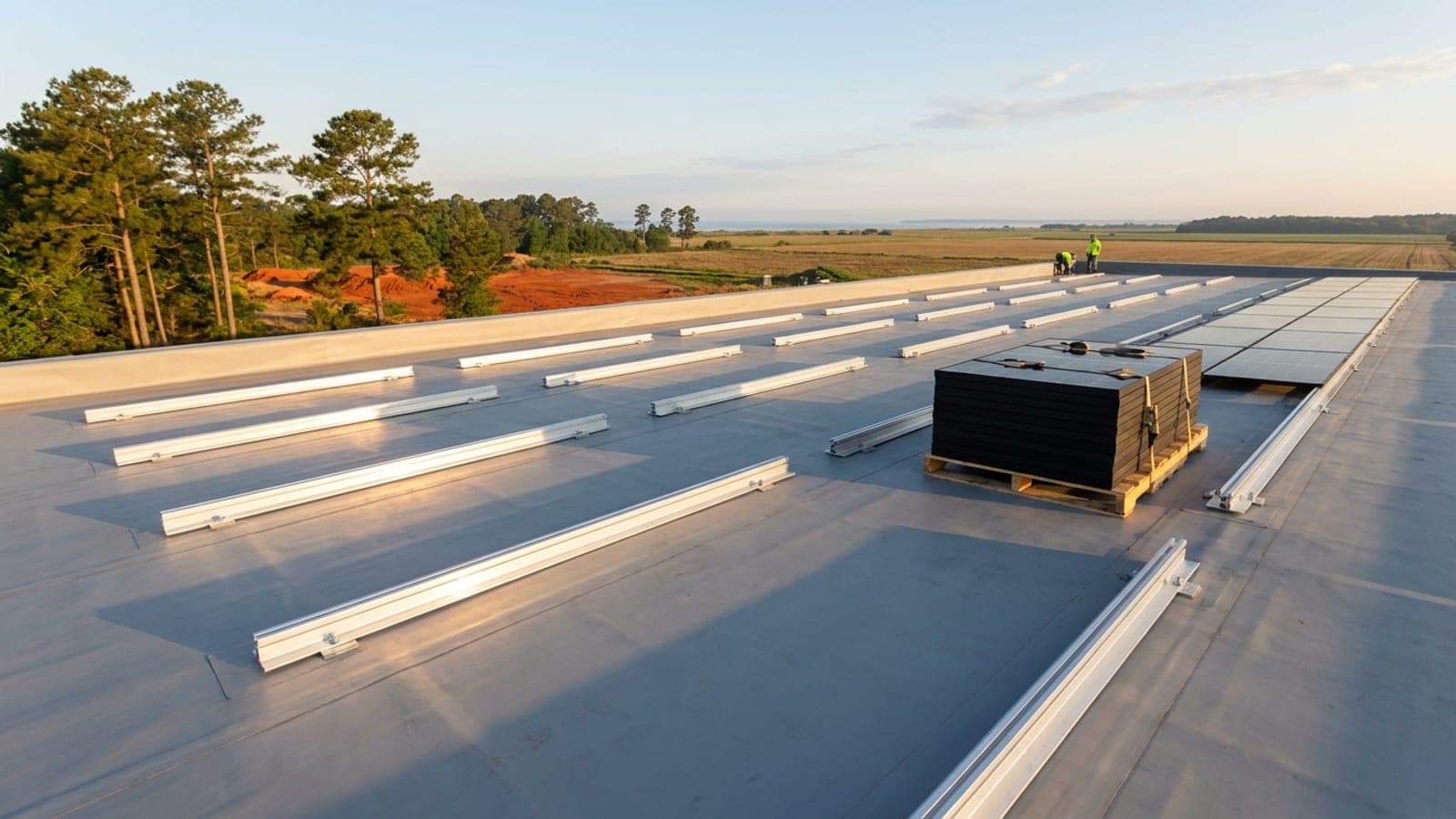
The commercial solar tax credit, 30% in recent federal law, is the largest single lever on the cost of a commercial array — and the one most often described carelessly. It is a federal investment tax credit, which means it reduces the tax your business owes rather than the income your business is taxed on. That distinction is worth more than it sounds.
A deduction of $100,000 saves you your marginal rate multiplied by $100,000. A credit of $100,000 saves you $100,000, dollar for dollar, against tax owed. Which is precisely why the qualifier in the next section matters so much and gets left out of almost every solar sales pitch.
This page explains the structure of the credit. It does not tell you what your business can claim — that depends on your entity, your liability, your placed-in-service year and the version of the law governing your project.
Verify before you rely on this
Federal energy tax law has been amended repeatedly, and rates, adders, thresholds, wage rules and deadlines have all moved. Every percentage, dollar figure and date on this page is marked for verification for that reason. This is a general explanation of how an investment tax credit is structured. It is not tax advice, and OneWorld Solar does not give tax advice. You are responsible for verifying all tax information with a Certified Tax Accountant before you rely on any of it.
Do I need tax liability to use the credit?
Yes, and this is the qualifier to settle before anything else. The commercial solar tax credit, 30% or any other rate, is applied against tax you owe. If your entity owes no federal tax in the year the system is placed in service, there is nothing for the credit to offset in that year.
That catches more businesses than you would think: entities carrying forward losses, pass-throughs whose owners have limited passive income, non-profits, and businesses having a poor year in exactly the year they finally build. Federal law has historically allowed unused credit to be carried back three years and carried forward up to 22 years, and recent law has introduced transferability and elective payment mechanisms that let some taxpayers monetize a credit they cannot personally use. Whether any of that is available to you, and what it is worth after discount, is a Certified Tax Accountant's answer, not ours.
How is the 30% rate actually structured?
Recent federal energy credits have not used a single flat percentage. The commercial solar tax credit, 30% at the top of its range, comes out of a two-tier structure: a low base rate of 6% of eligible basis, multiplied by five to 30% when the project satisfies prevailing wage and apprenticeship requirements during construction and, for a defined period, during alteration and repair.
Smaller projects have generally been exempt from those labor requirements and have qualified for the full rate automatically, with the exemption drawn at 1 MW AC of nameplate capacity. Most of what we build sits below that line, which simplifies the question considerably — but it does not remove it, and the threshold is measured in a specific way you should confirm.
Where the labor rules do apply, they are a documentation obligation on the construction contract: certified payroll, apprenticeship hours and ratios, and records kept for the statutory period. That has to be agreed before construction starts, not reconstructed afterwards, which is one reason to settle it during commercial solar EPC contracting.
What adders might apply to my project?
Federal law has attached bonus percentages on top of the base credit for certain projects. The ones that have mattered most for commercial buyers:
- Domestic content — an additional 10 percentage points where a required share of steel, iron and manufactured products is produced in the United States. The required share has been set on a schedule that rises over time, and the calculation is genuinely technical.
- Energy community — an additional 10 percentage points for projects located in areas defined by coal closures, fossil-fuel employment history or brownfield status. Eligibility is by mapped location, and the maps are revised.
- Low-income or qualifying location allocations — an additional 10 or 20 percentage points under a capacity-limited, application-based program rather than an automatic entitlement.
We can tell you what equipment goes on your roof and where the site is. We cannot tell you which adders your project qualifies for, and you should be skeptical of anyone in solar who says they can. Ask your accountant to confirm each against current guidance.
Does battery storage qualify?
Standalone energy storage has been treated as eligible property under recent federal law, which was a substantive change from the earlier position where storage only qualified if it was charged by an on-site renewable system. A minimum capacity threshold of 5 kWh has applied, and charging conditions have varied between versions of the rules.
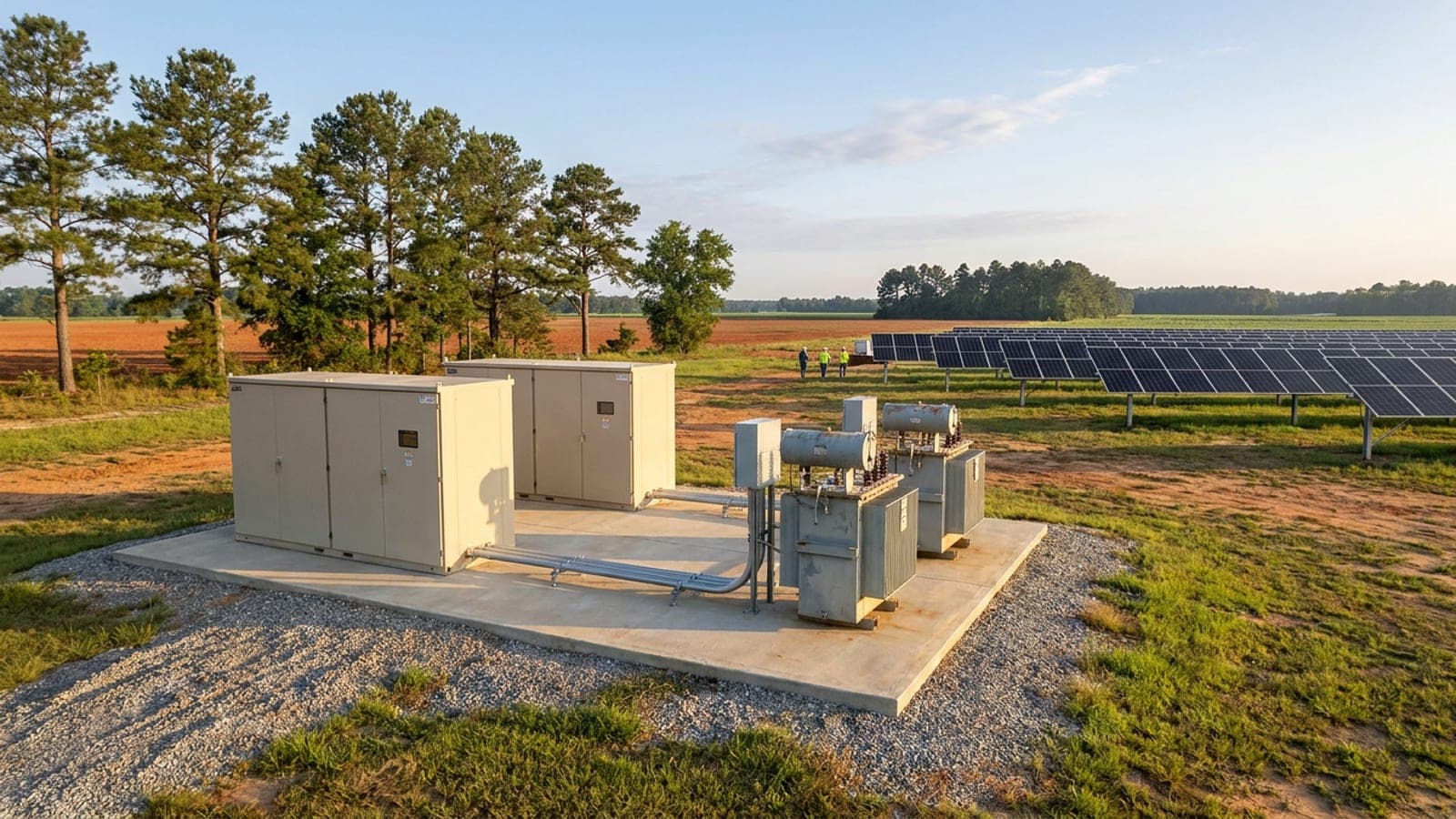
That matters because storage is often where the operating savings are, not the solar. Our commercial battery storage installation work targets demand charges and peak shaving, and the BatteryCube® battery energy storage system is our own cabinet product, built around CATL cells — 55,000 lb of it sits alongside the 1.267 MW rooftop array at the Samsonite and TUMI facility in Vidalia, Georgia. Whether your storage configuration is eligible in your placed-in-service year is, again, a question for your tax adviser.
How does the credit interact with depreciation?
Claiming the credit has historically required reducing the depreciable basis of the property by 50% of the credit claimed. You do not get to depreciate the entire installed cost and take the full credit on top of it.
This is where the real arithmetic of a commercial project lives, because the credit, Section 179 and bonus depreciation for solar interact with each other and with your taxable income in an order that changes the outcome. We walk through how the pieces fit in stacking the solar tax credit with Section 179, and for rural and agricultural sites there is a third piece in the USDA REAP grant for solar, where a federal grant has its own effect on basis.
Sequence and eligibility are your accountant's decisions. Ours is to make sure the underlying records support whatever they decide.
What are the deadlines after the One Big Beautiful Bill Act?
The law signed on July 4, 2025 did not lower the 30% rate for a business. It put a calendar on it, and the calendar now decides more than the rate does. As summarized by the AICPA's Tax Adviser and confirmed in IRS Notice 2025-42:
- Construction beginning after July 4, 2026: the solar facility must be placed in service by December 31, 2027 to qualify. Miss that date and the credit is lost for that facility.
- Construction begun before July 5, 2026: the older continuity safe harbor applies, generally placed in service within four calendar years after the year construction began.
- How "beginning of construction" is proved: for larger solar and wind facilities only the physical work test now counts, but a solar facility with a maximum net output of 1.5 MW or less can still use the 5% safe harbor, meaning paying or incurring 5% of the total cost and then making continuous efforts to complete it. Almost every system we build is under that line.
- Energy storage is on its own, longer schedule: the section 48E credit for storage phases down only for construction beginning in 2034 and later.
- Prohibited foreign entities: for construction beginning after December 31, 2025, material assistance from a prohibited foreign entity can disqualify the facility, so equipment sourcing is documented from the first purchase order.
We reported these rules in more detail when they became the deciding factor for projects starting this year, in the commercial solar tax credit deadline for 2027. The practical consequence is that a project beginning this fall has to be designed, interconnected and commissioned inside a fixed window, which is why the schedule is part of our proposal rather than an afterthought. As with every other figure on this page, the dates are the current federal rules as we understand them and must be confirmed by a Certified Tax Accountant for your project.
What OneWorld Solar provides for the claim
We supply evidence, and we are careful not to supply opinions:
- An itemized cost breakdown that separates eligible equipment and labor from scope that is unlikely to qualify, such as unrelated roof replacement, site work or building improvements bundled into the same contract.
- Equipment specifications and supplier documentation, including the manufacturer statements a domestic content analysis starts from.
- Commissioning records — performance testing, as-builts and O&M documentation.
- Placed-in-service evidence, dated: final inspection, the utility witness test and energization, which fixes the credit to a tax year.
- Construction-start records, where the vintage of the law applied to your project turns on them.
If you want to see how the credit and depreciation move a payback range before you talk to anyone, the commercial solar savings calculator will give you a system size, an annual saving and a payback band from your monthly bill. Its output is an estimate, and the estimate assumes tax benefits that only a Certified Tax Accountant can confirm you are able to use.