
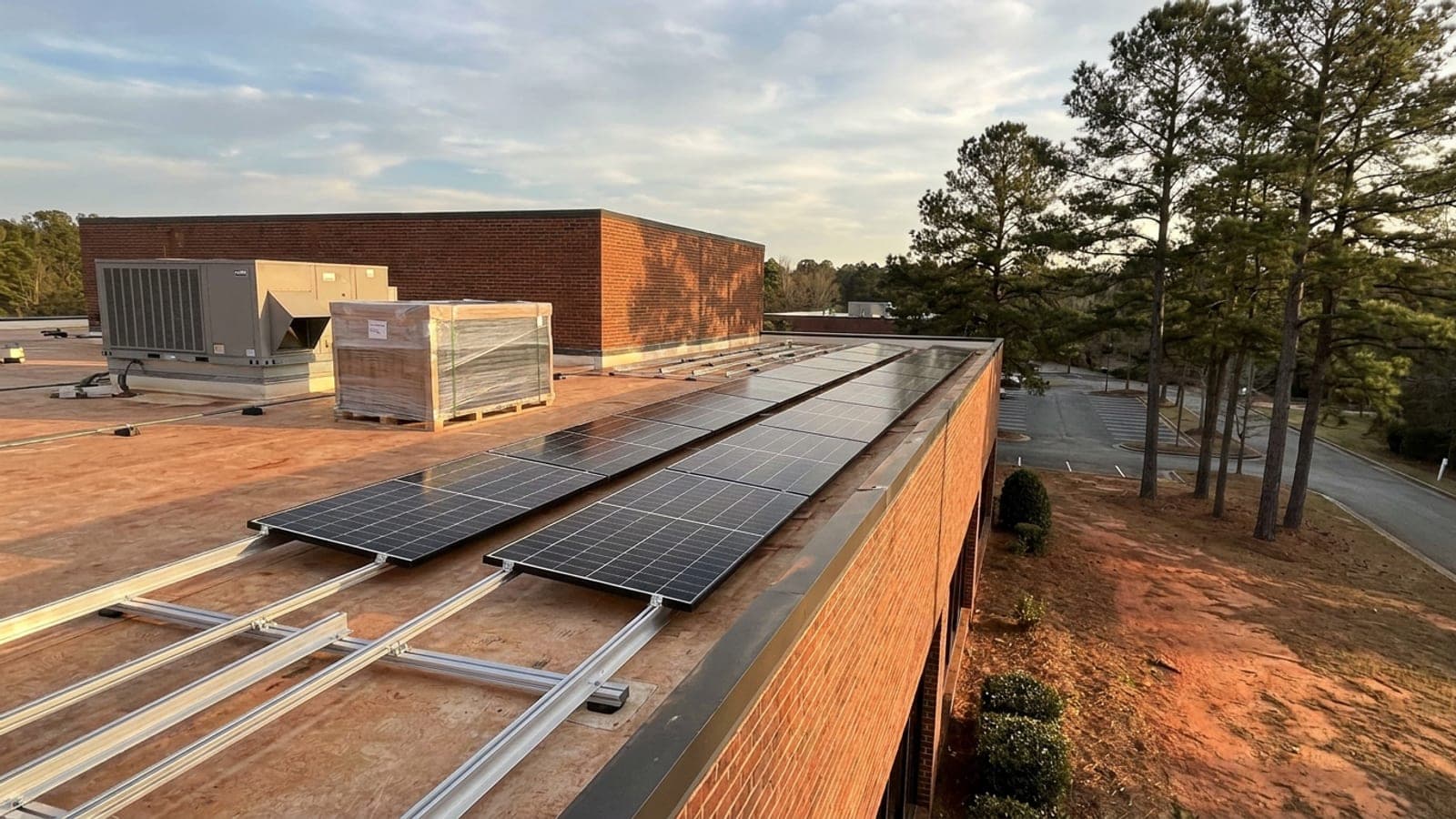
The commercial solar tax credit deadline 2027 is the part of the One Big Beautiful Bill Act that a business owner in the Southeast actually needs to write down. The law, signed on July 4, 2025, did not remove the federal credit for a business that builds solar or battery storage. It put a clock on it. According to IRS Notice 2025-42 and the analysis the AICPA's Tax Adviser published in February 2026, a solar facility that begins construction after July 4, 2026 must be placed in service by December 31, 2027 to claim the section 48E investment credit. A facility that began construction earlier keeps the older, more generous timeline.
That single sentence changes how a project should be planned, so it is worth setting out the rules in plain words, and then what they mean for a 200 kW dealership roof or a 1 MW poultry farm.
What credit are we talking about?
Section 48E is the clean electricity investment credit that replaced the old section 48 energy credit for property placed in service after 2024. The IRS describes its base rate as 6% of the qualified investment, multiplied by five, to 30%, when the project meets prevailing wage and apprenticeship requirements. Bonuses of up to 10 percentage points each are available for domestic content and for projects in an energy community. It applies to a qualified facility such as a solar array and, separately, to energy storage technology, which is the category a commercial battery falls into.
Nothing in the new law lowers that 30% for a business. What the law does is decide who can still reach it, and by when.
When does a solar project have to be in service?
Two dates decide it, and they hinge on when construction begins.
If construction begins after July 4, 2026, the solar property must be placed in service by December 31, 2027. Miss that date and, in the words of the Kirkland & Ellis summary of the law, the project loses eligibility for the credit entirely.
If construction began before July 5, 2026, the facility keeps the continuity safe harbor from earlier guidance. The Tax Adviser describes it as being placed in service by the end of a calendar year no more than four years after the year construction began, which puts a project that started in 2026 at December 31, 2030.
For anyone reading this in September 2026 who has not yet started, the first date is the one that applies. Sixteen months, from signing a contract to a utility witness test, is a real schedule for a commercial system. It is not a schedule that tolerates a slow interconnection application or a permit that sits on a desk, which is why the calendar has to be part of the design, not an afterthought.
Why does the 1.5 MW line matter so much?
Notice 2025-42 tightened how a project proves that construction has begun. For solar and wind facilities in general, effective for construction beginning on or after September 2, 2025, only the physical work test counts: actual, significant physical work on the facility, on site or on custom equipment built for it.
The exception is the one that covers most of our customers. A solar facility with a maximum net output of not more than 1.5 MW can still use the 5% safe harbor, meaning the owner pays or incurs at least 5% of the total cost and then makes continuous efforts to complete the facility. A 1.267 MW system, which is the size of our largest single rooftop, still sits under that threshold. So does every dealership, hotel and poultry array we have built.
In practice that means a business can lock in its beginning-of-construction date with a documented equipment deposit and a signed engineering scope, rather than waiting for racking to be bolted to a roof. It also means the paperwork behind that deposit has to be right, because it is the paperwork an accountant will examine.
What happens to battery storage?
Battery storage is on a different timeline, and a longer one. The termination dates above apply to wind and solar. Energy storage technology keeps its section 48E credit on the original schedule, which phases down only for construction beginning in 2034 (75% of the full credit), 2035 (50%) and 2036 or later (none).
For a facility deciding between solar alone and solar with storage, that asymmetry is useful. The array is the part with the near-term deadline; the battery that trims the demand charge is not. A battery sized from interval data, of the kind we build with our own BatteryCube® commercial battery energy storage system, can be planned on its own merits, and our page on commercial battery storage installation explains where those merits come from.
What are the foreign entity rules?
Two more provisions belong on the checklist. For tax years beginning after July 4, 2025, a taxpayer that is a prohibited foreign entity cannot claim the credit at all. And for any facility that begins construction after December 31, 2025, the credit is lost if construction includes material assistance from a prohibited foreign entity, a test based on the share of the facility's cost that comes from such entities, with a threshold that tightens year by year. The definition reaches entities owned by, controlled by, or headquartered in China, Russia, Iran or North Korea, and entities under their influence.
That rule sits on the procurement side of the job. Module, inverter and racking sourcing has to be documented against the thresholds from day one, which is one more reason to have a single commercial solar EPC contractor accountable for engineering, procurement and construction together rather than three vendors pointing at each other.
How does a Southeast business use these dates?
Start from the end. A project that will begin construction this fall needs to be in service by the end of 2027, so the sequence is: twelve months of bills and interval data now, a site walk and a design in weeks rather than months, an interconnection application filed early because the utility review is the step nobody controls, and an equipment deposit that establishes the beginning of construction under the 5% safe harbor for a system under 1.5 MW.
The credit then stacks with the depreciation rules we describe in stacking the solar tax credit and Section 179, and, for rural operations, with a USDA REAP grant for solar. Our page on the 30% commercial solar tax credit covers the basics of eligibility; the deadlines in this article are the part that is new.
One caution that we repeat on every proposal: none of this is a promise that the credit will be granted to your project. It is claimed on your return, it depends on your tax liability, and it must be validated by a Certified Tax Accountant. We prepare the schedule and the records that make that validation straightforward.
If you want to know whether a project on your roof can realistically be in service before the end of 2027, run the commercial solar savings calculator for the size and the savings, then send twelve months of bills through our proposal request form. We will come back with a design, an installed cost, a payback range and an honest read of the calendar.