
The Duke Energy Progress rate increase 2027 now has a shape. A settlement filed in the utility's North Carolina rate case would raise rates in two steps, the first on January 1, 2027 and the second in 2028, if the North Carolina Utilities Commission approves it. Hearings resumed in Raleigh on August 11, 2026, according to WRAL, and the Commission has yet to rule. For a business in eastern North Carolina or the Asheville area, the useful part of the story is that the size and the timing are now on the record, which is enough to plan against.
What is in the Duke Energy Progress settlement?
Duke Energy Progress opened the case asking for an 18.1% residential increase over two years, according to the North Carolina Department of Justice. The settlement it reached with the Public Staff, industrial and commercial customer groups and several other parties brings that to 6.8% over two years. WRAL puts the original request at a 15.1% cumulative increase in annual retail revenues and says the settlement cuts it by more than half.
In dollars, WRAL reports that a typical residential customer using 1,000 kWh a month would pay about $9.62 more a month from January 1, 2027 and another $5.89 a month from 2028, with similar percentage increases applied to other customer classes. The settlement also returns about $120 million a year in federal tax credits to customers, adds a refund mechanism for infrastructure upgrades that are not completed, and commits $10 million from Duke shareholders to bill assistance and weatherization.
Not everyone signed. Attorney General Jeff Jackson declined, saying the reduced figure "is still too high for families and still more than the company needs to cover its investments." By August 14 his office was also disputing the arithmetic, arguing that residential customers would see closer to 9.3% rather than 6.8%. Duke defended the agreement as a compromise among a broad group of parties. The Commission will decide whether the rates are just and reasonable, and it can approve, modify or reject the deal.
What does the case mean for a business in the Carolinas?
Two things are worth separating: what is settled and what is still moving.
What is settled is the direction. Duke Energy Progress serves eastern North Carolina and the Asheville area, so the case covers the poultry belt, the coastal plain's food processors and distribution centers, and the manufacturers along the I-40 corridor west of the Triangle. Every one of those accounts is on a schedule that the settlement would raise in two steps. The Department of Justice notes that Duke Energy Carolinas, which serves the rest of the state's Duke customers, has its own settlement before the Commission with a residential increase of about 9.5% over two years. Whichever Duke company bills you, the next two years are priced upward.
What is still moving is the exact percentage, and that matters less than it sounds. A commercial bill is driven by the demand charge on the highest measured interval of the month and by the energy charge on every kilowatt-hour, and both scale with the rate. Whether the residential figure ends at 6.8% or 9.3%, the way a facility keeps its own bill from following the tariff is the same: use less from the meter at the moments that cost the most.
The settlement carries one more signal for larger users. As part of the agreement, Duke Energy Progress joined Duke Energy Carolinas' fast-track process for new rules covering data centers and other large energy users, according to the Department of Justice. Regulators in the Carolinas are starting to price large, inflexible load differently from load that can bend. A facility that can shape its own peak is on the right side of that line.
How does a Carolina business get ahead of January 2027?
By treating the four months between now and the first rate step as the window they are. We have built commercial solar installations in North Carolina and across the Southeast since 2001, and the sequence is the same on every site.
Start with twelve months of Duke Energy Progress bills. Find the demand charge line and add up a year of it. Find the energy charge and do the same. If there is a power factor penalty, note it separately, because that one is usually the cheapest to remove. Those three numbers tell you which part of the coming increase you can do something about.
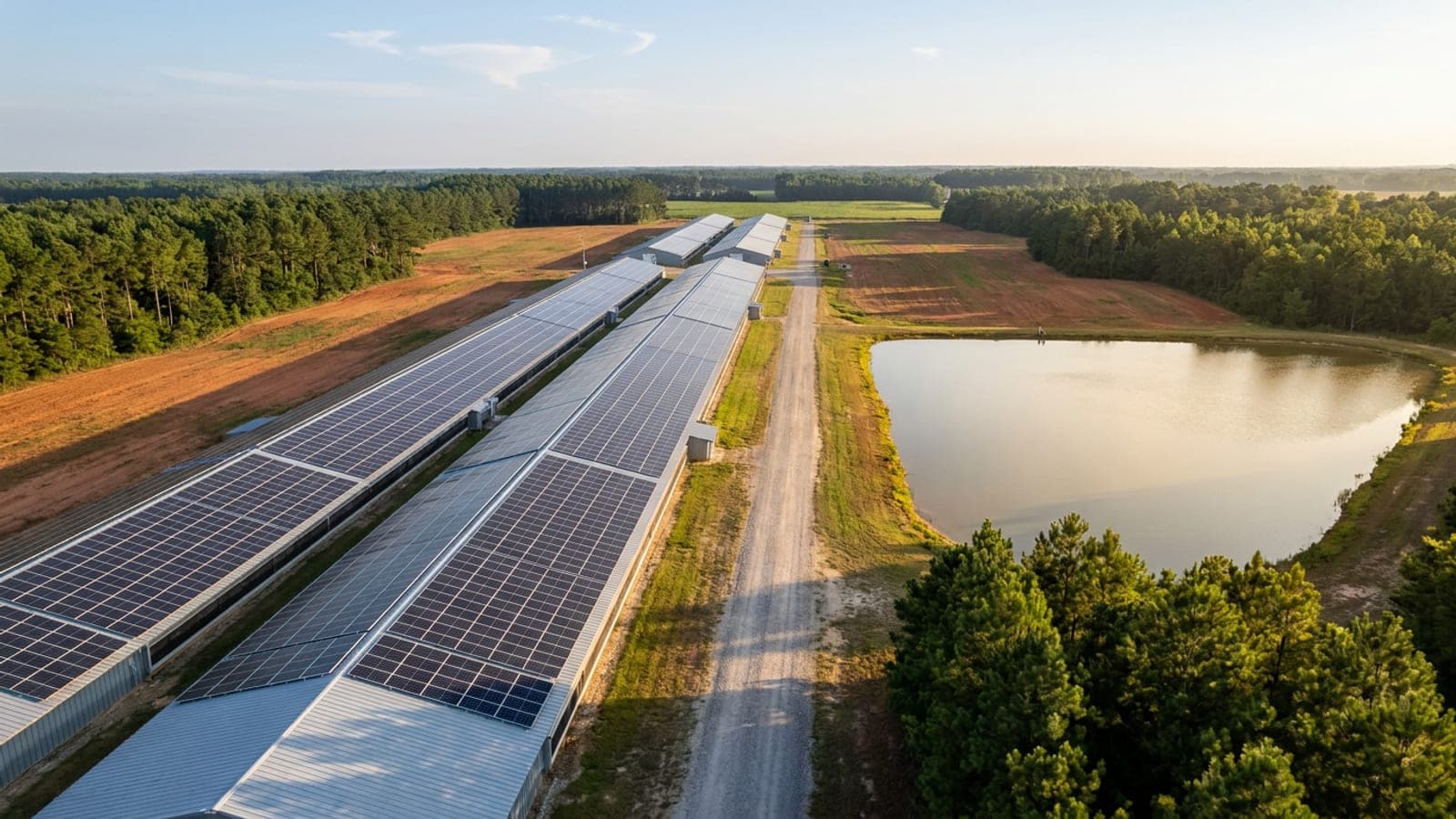
Solar addresses the energy charge. A rooftop or ground-mount array built under one commercial solar EPC contract replaces daytime kilowatt-hours at a cost that is fixed on the day the system is commissioned, which is precisely the property a rising tariff cannot offer. On a poultry farm, where ventilation and cooling load peaks with the afternoon sun, the match between generation and consumption is close; our page on solar panels for poultry farms and the 450 kW, 14-house broiler farm case study show what that looks like on a working operation.
The demand charge is a different problem, and solar alone does not reliably fix it, because the utility can set your billed peak on a cloudy afternoon or after dark. That is the job of commercial battery storage, sized from interval data rather than from a monthly total, discharging into the peaks so the meter never records them. Whether a battery pays for itself on your rate schedule is a question we answer before quoting one, and our article on commercial battery storage payback walks through how to read your own tariff for the answer.
On cost, both solar and paired storage have been eligible for the 30% federal solar tax credit under current rules, subject to conditions your accountant should confirm. The credit is claimed on your return and validated by a tax professional; we prepare the documentation that makes that straightforward.
What happens between now and the Commission's decision?
The Commission finishes hearing testimony, weighs the objections from the Attorney General and others, and issues an order. Duke has asked for year-one rates to be in place no later than January 1, 2027. A facility that starts its assessment now can be designed, permitted and interconnected inside that window, and the first rate step then lands on a bill that is already smaller.
Run the commercial solar savings calculator with your average monthly bill to see the order of magnitude for a site your size, or send us twelve months of Duke Energy Progress bills through our proposal request form. We will come back with a system size, an installed cost, the incentives that apply and a payback range, and if the numbers do not work on your schedule we will say so.