
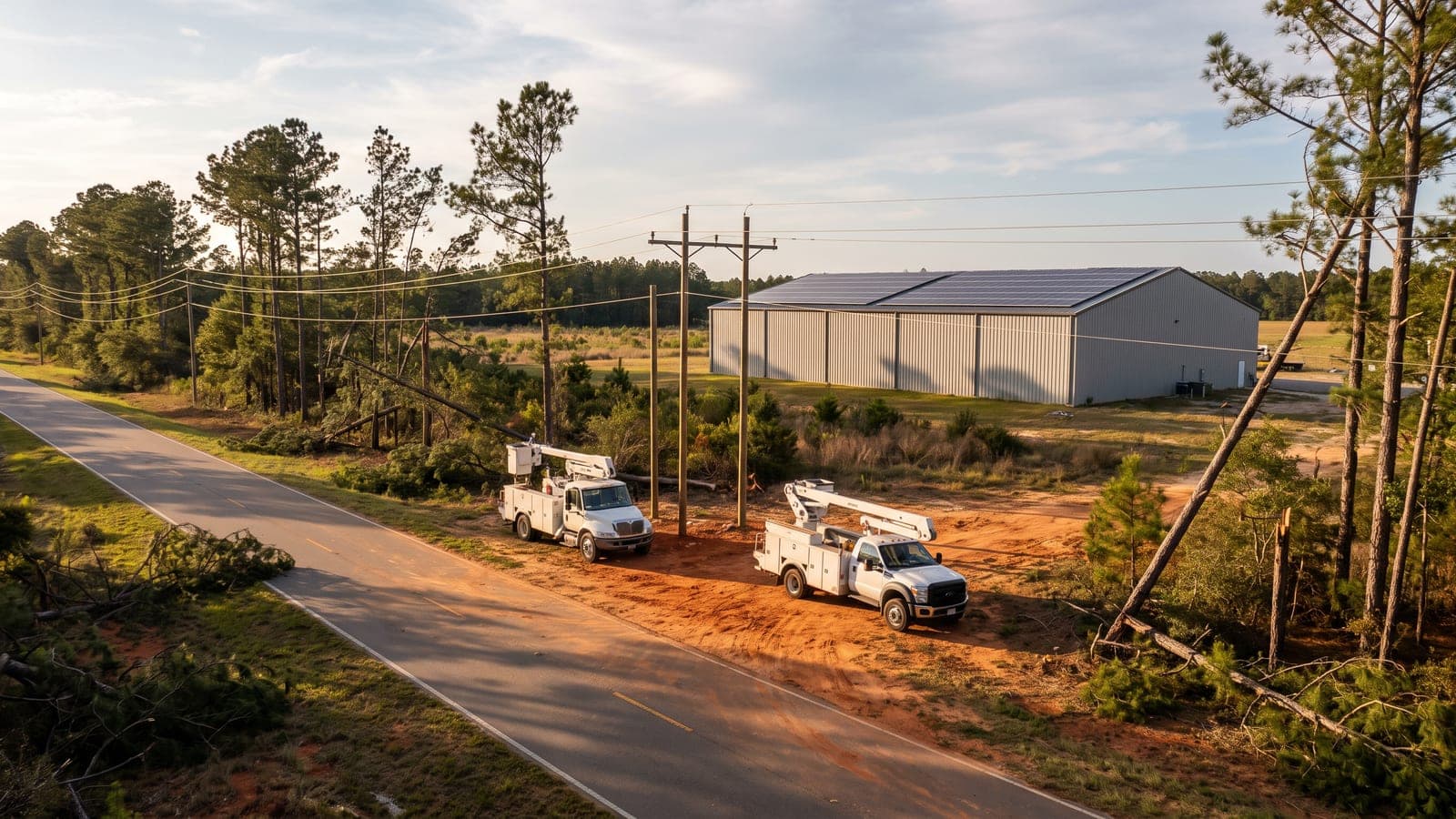
The Georgia Power fuel and storm cost settlement has been on customers' bills since June, and it is the best guide to what will and will not change on a Georgia business's power bill between now and 2028. Georgia Power's rate changes page puts the effect at $4.04 a month for the typical residential customer and about $285 million a year in savings across the state, and says business customers on the General Service rate also saw a decrease beginning in June, in amounts that vary with usage.
The decrease came out of two filings the company made on February 17, 2026, one for fuel cost recovery and one for storm cost recovery. The storm filing proposed recovering a $912 million under-recovered storm reserve over four years, nearly $800 million of it from Hurricane Helene in 2024, which the company describes as the most destructive storm in its history. "Delivering reliable and affordable electricity to millions of Georgia homes and businesses requires prudent management," said Tyler Cook, the company's chief financial officer and treasurer, in the release.
What did the settlement change from the original request?
The agreement was reached between Georgia Power and the Public Service Commission's staff, and the Commission approved it in the spring. The Southern Environmental Law Center, which intervened with Georgia Interfaith Power & Light and the Southface Institute, summarized the terms on May 12: the company's storm cost request was cut by roughly 60 percent, and the threshold above which it may earn a return on storm repair work rose from $50,000 to $500,000.
The same statement flagged the question the settlement left open. The Commission's staff, it says, found fuel prices rising 5 to 11 percent as large load customers such as data centers are added, and the settlement requires a new proceeding on the fuel cost contribution of real-time pricing customers by the end of 2026. That proceeding is the one we reported on in the Georgia Power real-time pricing docket, whose first hearing was held on September 1.
What is fixed until 2028, and what is not?
Base rates are frozen. Georgia Power's page says the freeze approved in July 2025 runs through 2028. It also says, in the same paragraph, that fuel and storm cost recovery filings remain separate from the freeze.
For a business that draws a clear line through the bill. The base energy and demand charges, the largest block, are stable for the next two years. The fuel rider moves with natural gas prices and with whatever the real-time pricing proceeding decides about who pays for the fuel that new large loads burn. The storm rider moves with hurricane seasons, and Helene's balance alone will take years to clear. We described what that storm did to farms in the region in the Hurricane Helene block grant for Georgia farms.
What this means for a business in Georgia
Riders are charged per kilowatt-hour. Every kilowatt-hour a facility generates on its own roof is one that carries no fuel rider and no storm rider, this year or in any later filing, and that is the simplest hedge available against the two lines the freeze does not cover. The demand charge, which the freeze holds in place, is the other half of the bill, and a battery that trims the monthly peak lowers it directly; the arithmetic is in when commercial battery storage pays off.
The utility is making the same bet at scale. We reported last week on Georgia Power's 1,137 MW of new solar and 3,000 MW of approved batteries, chosen because solar carries no fuel cost and four-hour storage moves it into the evening peak. A customer-owned system does the same thing behind one meter, on the owner's schedule, and what it costs to build is set out in commercial solar cost per kW in Georgia. The federal credit for a system the business owns is claimed on its own return, under the conditions on our federal solar tax credit page, and is never assured in advance.
What we build in Georgia Power territory
Georgia Power is one of our customers: we built 1.2 MW of ground-mounted solar across four of its facilities, and the interconnection standards we met there are the ones a business in its territory has to meet. Our commercial solar installation in Georgia work runs from poultry complexes to the 1.267 MW Samsonite and TUMI roof in Vidalia, each sized from the customer's own bills.
If your business is on Georgia Power, send us twelve months of utility bills. We will separate the frozen part of your bill from the part that moves, and show you how much of each a system on your own site would take off.