
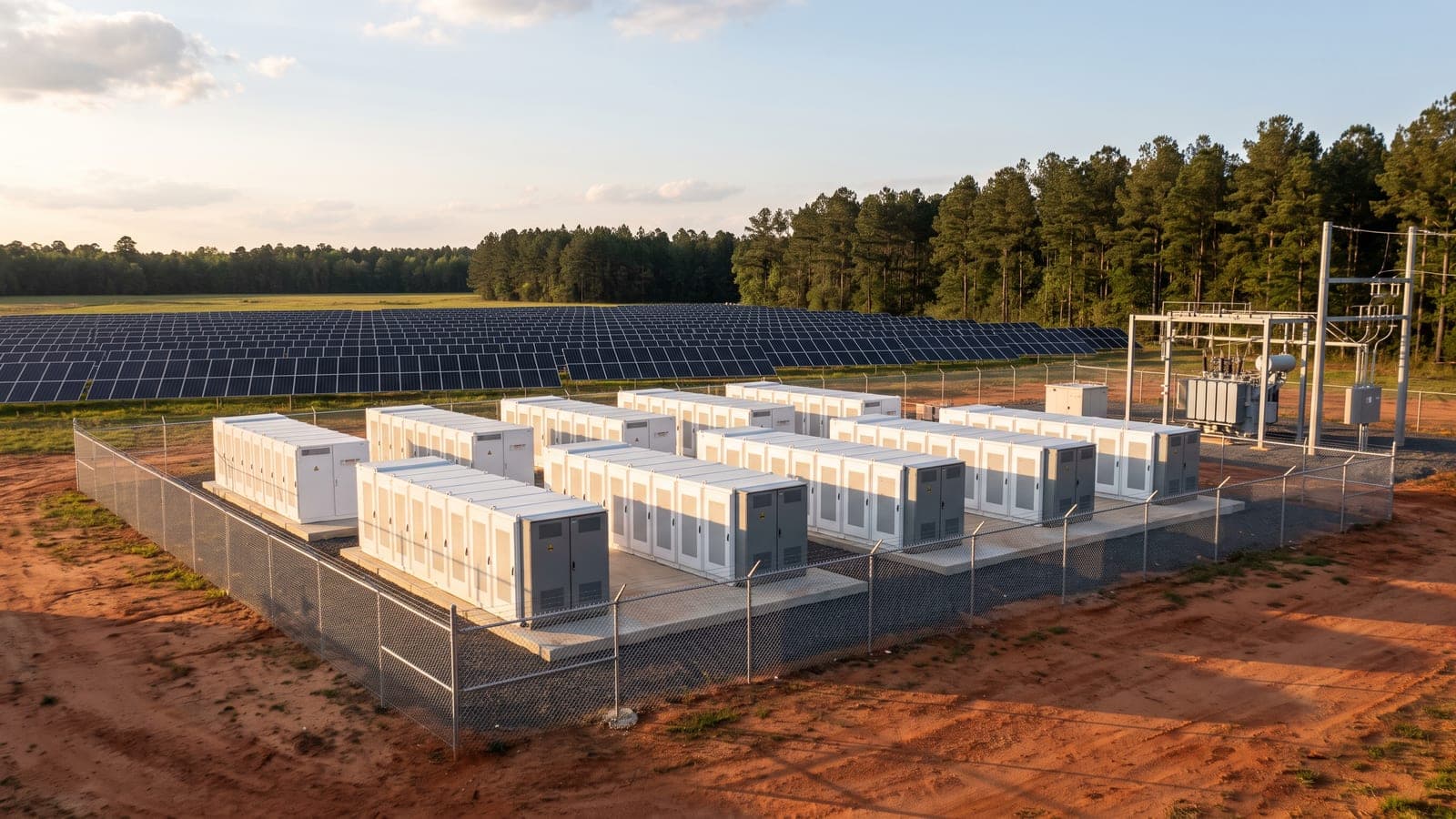
The Georgia Power solar and battery approvals of the past week set out, in the utility's own numbers, what the next Georgia grid will be made of. On September 10, 2026, Georgia Power announced that the Georgia Public Service Commission had approved seven solar power purchase agreements totaling 1,137 MW under its CARES 2023 and CARES 2025 requests for proposals, a procurement the company calls the largest single solar purchase in its history. On September 15 it announced that the 128 MW Robins battery energy storage system near Warner Robins had entered commercial operation, with nine further storage facilities approved for more than 3,000 MW.
The seven solar projects sit in Sumter (200 MW), Irwin (200 MW), Jefferson (194 MW), Emanuel (185 MW), Warren (150 MW), Decatur (130 MW) and Appling (78 MW) counties, and WSB-TV reports they are scheduled to begin operation by 2029. They follow 1,068 MW approved in September 2025 across Coffee, Jefferson, Laurens, Mitchell and Wilkinson counties. Wilson Mallard, Georgia Power's director of renewable development, said in the release that the new resources will "deliver affordable and reliable energy at a fixed price."
What is Georgia Power building on the storage side?
The Robins battery is paired with the Robins solar facility and can deliver stored energy for up to four hours. It joins the Cherokee and Lowndes County systems, complete at a combined 579.5 MW, and the 57.5 MW Floyd County system, which the release says is nearing completion. The nine newly approved facilities span eight sites: Plants Bowen, Hammond, McIntosh, Wansley and Yates, and stand-alone locations in Hall and McDuffie counties. Two further solar-plus-storage plants, 350 MW combined, are approved in Laurens and Mitchell counties.
Rick Anderson, the company's senior vice president and senior production officer, put the reasoning in one sentence: "By pairing battery storage with solar generation, we're creating a more flexible and resilient grid."
What this means for a business in Georgia
None of these plants lowers a commercial bill next year. The solar contracts begin in 2029, the storage is recovered through rates over its life, and the "fixed price" in the release is a hedge against fuel costs rather than a reduction. We covered how the costs of Georgia Power's large-customer growth are allocated in large load tariffs in the Southeast.
What a business can take from the announcements is the design. A utility with the whole state's load to balance is choosing to put four-hour batteries beside solar because that is the combination that turns midday generation into evening capacity. A distribution center, a poultry complex or a plant in Georgia faces the same curve on its own meter: solar output peaks around noon, the demand charge is set by the late-afternoon peak, and storage is what connects the two. The arithmetic of that pairing on a commercial tariff is set out in when commercial battery storage pays off.
There is a timing point as well. The utility's projects are dated 2029; a customer-owned system is dated by its own construction schedule, and the federal credit's conditions, which we explain on our federal solar tax credit page, reward a project that begins sooner rather than later.
What we build in Georgia Power territory
Georgia Power is one of our customers. We built 1.2 MW of ground-mounted solar across four Georgia Power facilities, and the interconnection and construction standards we learned on those sites are the ones a business in the utility's territory has to meet. The largest example of solar and storage together in our portfolio is the 1.267 MW rooftop system with 55,000 pounds of batteries at Samsonite and TUMI in Vidalia, built under one contract.
For the storage itself we use BatteryCube®, our own line of pad-mounted cabinets built around CATL cells, sized to the hours that set a facility's demand charge rather than to the whole load. Array, storage and interconnection are delivered under a single commercial solar EPC contract, so the utility's requirements are handled by the people who designed the system.
If your business is in Georgia and you want to know what four hours of storage beside a solar array would do to your own bill, send us twelve months of utility bills. We will size both to your load and show you the result before the utility's 2029 projects are built.