
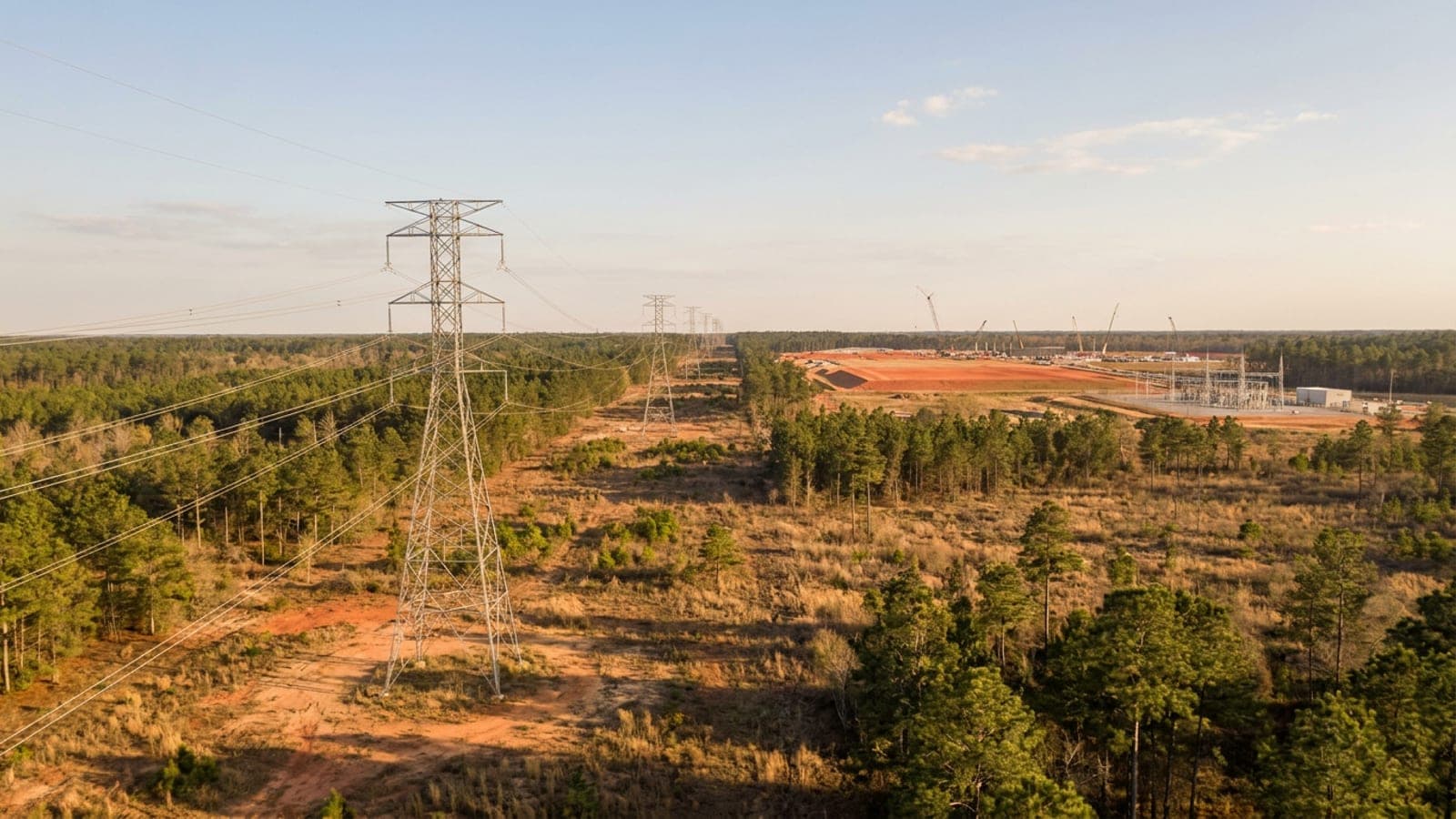
Large load tariffs in the Southeast are now a category of their own, and a catalog published by the Edison Electric Institute in August 2026 sets them out utility by utility. The document, Large Load Projects and Tariffs, updated August 28, lists the special rate schedules that state commissions have approved or are reviewing for data centers and large manufacturers, with the stated purpose of ensuring that "large load customers pay their fair share." For a business drawing 500 kW rather than 500 MW, the schedules do not apply. What they decide is who pays for the plants and lines that the new load requires, and that reaches every bill in the territory.
The catalog counts more than $1.03 trillion of publicly announced projects and more than 70 gigawatts of connected load across the association's member utilities, covering projects of roughly 20 MW and larger. Three Southeast entries are the ones that matter for a Georgia or Florida business.
What do the Florida and Georgia large load tariffs require?
In Florida, docket 20250011 approved two new Florida Power & Light schedules, Large Load Contract Service 1 and Large Load Contract Service 2, for future customers with projected new or incremental load of 50 MW or more and a load factor of 85 percent or more. The catalog says the tariffs took effect on January 1, 2026 and "contain minimum terms, take or pay requirements, exit fees, and collateral requirements." In docket 20260064, Duke Energy Florida has filed an updated large load proposal in response to Senate Bill 484.
In Georgia, docket 44280 approved Georgia Power's amendment of its rules to provide minimum billing requirements and longer contract terms for customers with expected peak demand of 100 MW or more. The amended rules specify that contracts for transmission or distribution line extensions and service connections run as long as the rate schedule or longer, so that the utility recovers its cost and a large customer that terminates pays whatever the utility incurred in serving it. A separate docket, 44847, approved the Customer Identified Resource program, under which large customers pay for clean energy resources in exchange for renewable energy certificates and credit for the energy value.
The load behind those rules is real. The catalog records that Georgia Power has signed 29 customer commitments with new data center and industrial projects and holds regulatory approval to add 10 gigawatts of generation capacity over the next six years "while supporting rate stability for existing customers." Its list includes a 3.2 gigawatt data center project outside Savannah and the $12.6 billion vehicle plant near the same city. In North Carolina it lists a $10 billion data center campus in Richmond County, with the note that Duke Energy "expects each 1,000 MW data center to save existing customers almost $1 billion over the life of a 15-year contract."
What this means for a business in Georgia or Florida
Take the tariffs at their word and they are protective. Minimum terms, take-or-pay clauses and exit fees exist so that a 50 MW customer cannot commission a substation and a share of a power plant and then leave the cost with everyone else. A well-drafted large load tariff is good news for the general service customer, and the Georgia Power language about rate stability for existing customers is the intent.
The mechanics still run through the rate base. Ten gigawatts of new generation is recovered over decades in rate cases, and the share that reaches a mid-sized business depends on how each docket allocates it. We reported the terms of the Savannah data center contract in what the Georgia Power and OpenAI deal means for business bills, and the same logic applied to a state-owned utility in Santee Cooper's large load rate. In every case the ordinary business is a bystander to the docket and a participant in the outcome.
There is one part of the outcome a business controls. Demand charges and energy charges are set by what the meter records, and a site that generates part of its own power and shifts consumption off the peak window lowers both, whatever the commission decides about the next plant. That lever does not require a docket number, a 15-year contract or collateral. It requires twelve months of bills and an engineer.
How we approach it
Our commercial solar installation in Georgia work runs on that logic, and it includes the utility itself as a customer: we built 1.2 MW of ground-mounted solar across four Georgia Power facilities. In Florida the same design questions apply under a different set of schedules, covered on our commercial solar installation in Florida page.
Where a tariff has a demand charge worth attacking, we add commercial battery storage sized to the peak window rather than to the whole load, and we explain the arithmetic in when commercial battery storage pays off. The array, the storage and the interconnection are delivered under one commercial solar EPC contract, which keeps the schedule in our hands rather than the utility's queue.
If your business is in Georgia or Florida and your bill has grown faster than your consumption, the large load dockets are part of the reason and none of the remedy. Run our calculator for a first estimate, then send us twelve months of utility bills and we will show you how much of the bill a system on your own site would take off the table.