
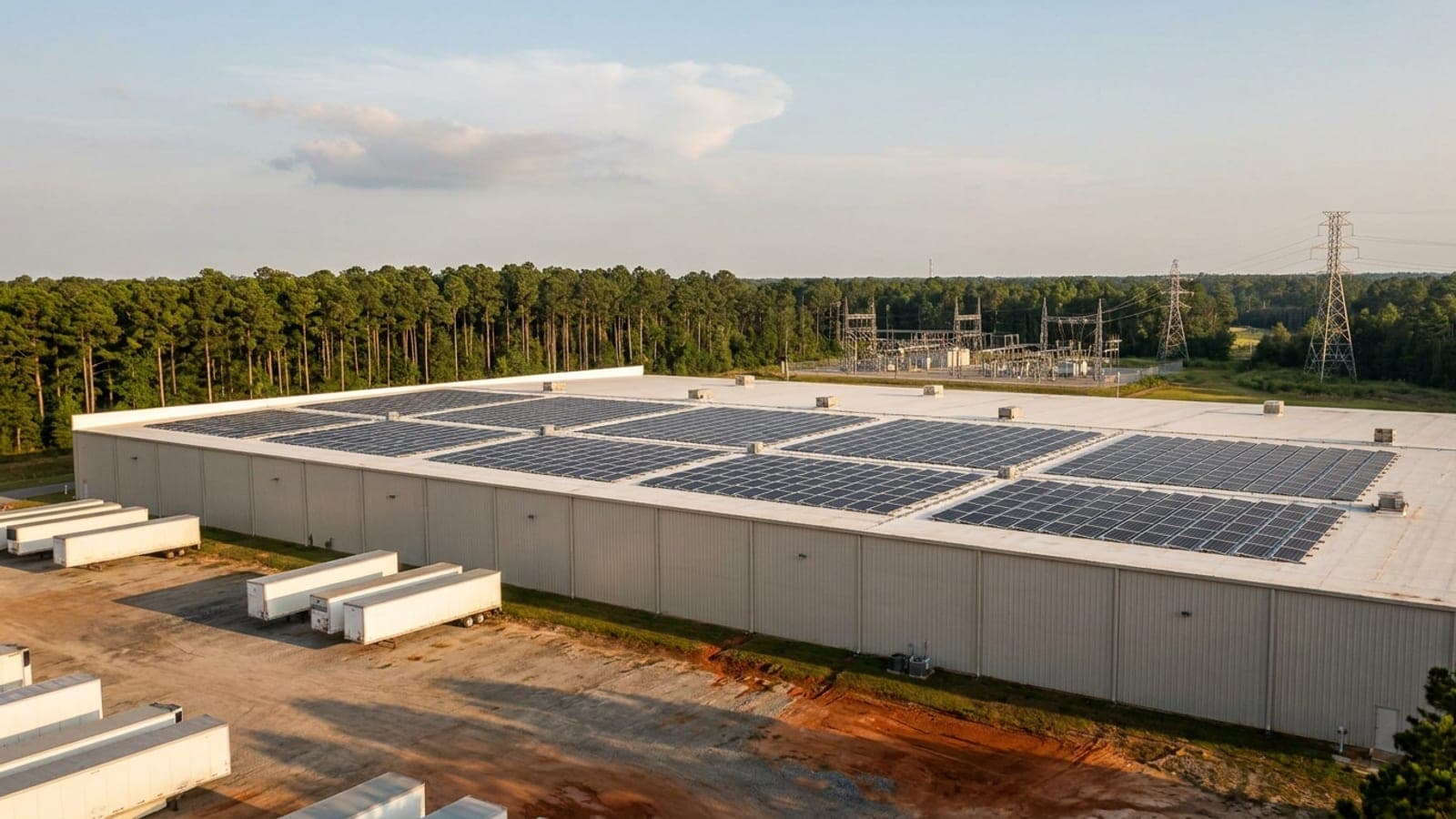
The Santee Cooper large load rate is now part of the utility's published rate book, and it draws a line worth understanding even if your business will never cross it. Santee Cooper's rate schedules include Schedule L-25-LL, an "Experimental Large Load Schedule" attached to the Large Light and Power rate, which is mandatory for customers that operate a large load. The schedule defines that as a data center facility with an aggregate monthly maximum demand greater than 50,000 kW, or a "Mobile Large Load," including cryptocurrency mining, with demand greater than 1,000 kW and equipment that can be moved.
The purpose is plain from the structure. The generation and lines built to serve a 50 MW customer are recovered from that customer, on that schedule, rather than spread across the general service and industrial classes. For the ordinary South Carolina business, the effect is protective. The number on its own bill is unchanged, and that number deserves a closer look.
What does a business on Santee Cooper's general service rate pay?
Santee Cooper's published GA-25 General Service schedule lists an energy charge of 7.05 cents per kWh on peak and 6.05 cents per kWh off peak, and a demand charge of $12.21 per kW. The on-peak hours are 5 to 9 a.m. from November through March and 3 to 7 p.m. from April through October. A smaller experimental schedule, GA-LL-25, is offered to customers with no more than 50 kW of demand in any three months of the year, trading the demand charge for a higher energy rate of 19.73 cents on peak and 17.73 off peak.
Tariffs change and the current schedule should be confirmed with the utility before any decision, but the shape of GA-25 is what matters. For a facility with 300 kW of peak demand, the demand charge alone comes to about $3,660 a month at the published rate, set by the highest interval of the month rather than by how much energy the plant used. That is the part of the bill an owner can engineer.
What the Canadys plant adds to the picture
The large load schedule is one response to load growth in the state. The other is new generation. Utility Dive reported in June 2026 that the South Carolina Public Service Commission approved a 2,180 MW gas-fired plant at Canadys, about 40 miles from Charleston, jointly owned by Dominion Energy South Carolina and Santee Cooper at 50 percent each, with a project cost of $5 billion and service expected in mid-2033. The Commission found the project more cost-effective than the alternatives presented and declined to impose a cost cap, noting that the prudency of the spending would be reviewed in a future rate case.
That is the customary path for a large plant, and it means the cost reaches bills over years through rate proceedings. A business that buys less from the grid during the hours that set its demand charge, and less energy overall, reduces its share of whatever those proceedings decide.
What this means for a facility in Santee Cooper or co-op territory
The summer peak window on GA-25, 3 to 7 p.m. from April through October, overlaps the afternoon output of a solar array. An array sized to the facility's load lowers the demand the meter records in those hours, and with it the charge that the month's highest interval sets. The winter window, 5 to 9 a.m., falls mostly before sunrise, and that is where a battery charged overnight and discharged into the morning peak does the work the array cannot. We explain the arithmetic of that pairing in when commercial battery storage pays off, and the equipment in commercial battery storage installations.
The same reasoning applies across the state. Our commercial solar installation in South Carolina page covers the Dominion, Duke, Santee Cooper and cooperative territories, each with its own demand windows, and the design differs from one to the next. Santee Cooper is among the utilities we have worked with, and the 15 kW roof-mounted system at Coastal Carolina University in Conway sits in the coastal part of the state the utility serves.
A system that trims demand is also a system that earns the federal investment tax credit and first-year depreciation on the owner's return, subject to the owner's tax position, and the conditions are on our federal solar tax credit page. Where a plant's power factor is pulling the demand reading up, power factor correction is often the cheapest first step, and we check it before sizing anything else.
If your business is in South Carolina and your bill has a demand line you have never been able to move, run the calculator for a first estimate, then send us twelve months of bills. We will tell you which hours are setting your charge, what an array and a battery would do to them, and what that is worth at the published rate.