
A commercial battery is a machine for moving energy in time. That is all it does. So commercial battery storage payback is a simple question with an unglamorous answer: it pays off when your utility bill is charging you for something that moving energy in time can change, and it does not pay off when your bill is not.
The fastest way to end a storage conversation honestly is to read the customer's rate schedule. Most of the decision is on that document. If there is no demand charge and no time-of-use spread, the calculation is over before it starts, and no amount of enthusiasm about resilience turns that into a return.
This article covers the three things a battery can be paid for, how to find out from your own bill whether any of them apply to you, why a battery sized for demand shaving is usually much smaller than people assume, and when the answer is simply no.
What can a commercial battery actually be paid for?
Three things, and only three. It is worth separating them clearly because two of them show up in a payback calculation and one of them does not.
Demand-charge reduction. Your bill likely contains a charge based not on how much energy you used but on your highest rate of draw during the month, measured over a short interval. A battery discharges into those peaks so the meter never sees them. This is the workhorse of commercial storage economics.
Energy arbitrage on a time-of-use tariff. If your utility charges more per kWh at some hours than others, a battery can charge when energy is cheap and discharge when it is expensive. The value is the spread multiplied by the energy moved, minus round-trip losses. On a flat tariff this value is exactly zero.
Backup and resilience. If the grid goes down, a battery, or a battery configured as part of a commercial microgrid, keeps chosen loads alive. This is real value. It is not payback value. It is insurance, and it should sit in its own column of the business case, sized against what an outage costs you per hour rather than against a savings rate.
| What your bill is charging you for | Does a battery help? |
|---|---|
| Demand charge (kW or kVA, measured peak) | Yes — this is the primary payback driver |
| Time-of-use energy rates with a real price spread | Yes — arbitrage, limited by spread and round-trip efficiency |
| Flat energy rate, all hours the same | No |
| Fixed monthly customer charge | No |
| Power factor penalty | No — see power factor correction services |
| Outage risk on a critical load | Yes, but as insurance, not as payback |
How do you read your own utility bill to find out?
Pull twelve months of bills and your current rate schedule, then look for three things.
Find the demand charge line. It will be expressed in dollars per kW (sometimes per kVA) and multiplied by a measured peak, not by your kWh total. Add up twelve months of it. That annual number is the ceiling on what demand shaving can save you, and in our experience it surprises people. On some commercial accounts it is a small line. On others it is a third of the bill.
Look for the ratchet clause. Many commercial tariffs set your billed demand at a percentage of your highest peak over a defined lookback period (verify the ratchet percentage and lookback window on your own rate schedule). Where a ratchet applies, one bad measurement interval on one hot afternoon can inflate your bills for months afterward. That changes the value of avoiding a single peak dramatically.
Check whether the tariff is time-of-use. If energy is priced differently by hour or by season, note the spread between the highest and lowest rate. If every kWh costs the same regardless of when you use it, cross arbitrage off the list.
The honest limit of solar on its own
Solar power generates during daylight hours and will not have an impact on evening usage. Utilities may set a customer's peak demand during times when solar is not effective, or during a cloudy or rainy day. While solar power will reduce your overall kWh usage, it cannot be expected to mitigate your peak demand. That is not a caveat we add reluctantly. It is the exact reason storage exists, and it is why we look at the demand side of the bill before recommending either.
Why is a demand-shaving battery smaller than people expect?
Because demand charges are billed on a measured interval, not on your daily energy total. The battery does not have to run your building. It has to cover the height and the duration of your peaks.
A plant with a large annual consumption may have peaks that last a few minutes each: a compressor bank starting, a chiller cycling on, a shift change where several large loads coincide. Sizing that battery is a question of kilowatts for a short window, not kilowatt-hours for a day. Two facilities with identical monthly kWh totals can need very differently sized systems, or one might need none at all.
This is why we ask for interval data rather than monthly summaries. A monthly bill tells you what you were charged. Interval data tells you when the peak happened, how tall it was, how long it lasted, and how often it repeats. Without that, a storage proposal is a guess. We will not size a system from a monthly kWh figure and an average rate.
When is a battery not worth it?
Say it plainly: when the bill has nothing for it to earn.
If your tariff has no demand charge, no meaningful time-of-use spread, and your operation can tolerate an outage, a battery will not pay for itself and we will tell you that rather than quote one. There are also sites where the real problem is a power factor penalty, an oversized service, or simply the wrong rate schedule. Correcting any of those can be far cheaper than storage, and it may be worth doing first regardless.
There is a second category worth naming: sites where a battery would pay back, but only just, and where the payback rests entirely on a tariff structure that the utility could revise. Tariffs change, and neither we nor you control that. Where a case is marginal, we would rather you knew it was marginal.
When is resilience the reason, regardless of payback?
Some facilities cannot go dark. Cold storage with product on the floor. A process line where an unplanned stop means scrapping work in progress and hours of restart. A site whose customers are contractually promised uptime.
For those buildings the question is not payback at all. It is: what does an hour of downtime cost, how many hours per year are you exposed, and what is it worth to remove that exposure? Answer that honestly and the storage decision usually answers itself, with any demand-charge savings treated as a partial offset rather than the justification. Where whole-site islanding is the requirement rather than load-specific backup, that is microgrid territory.
What is the storage at Samsonite and TUMI doing?
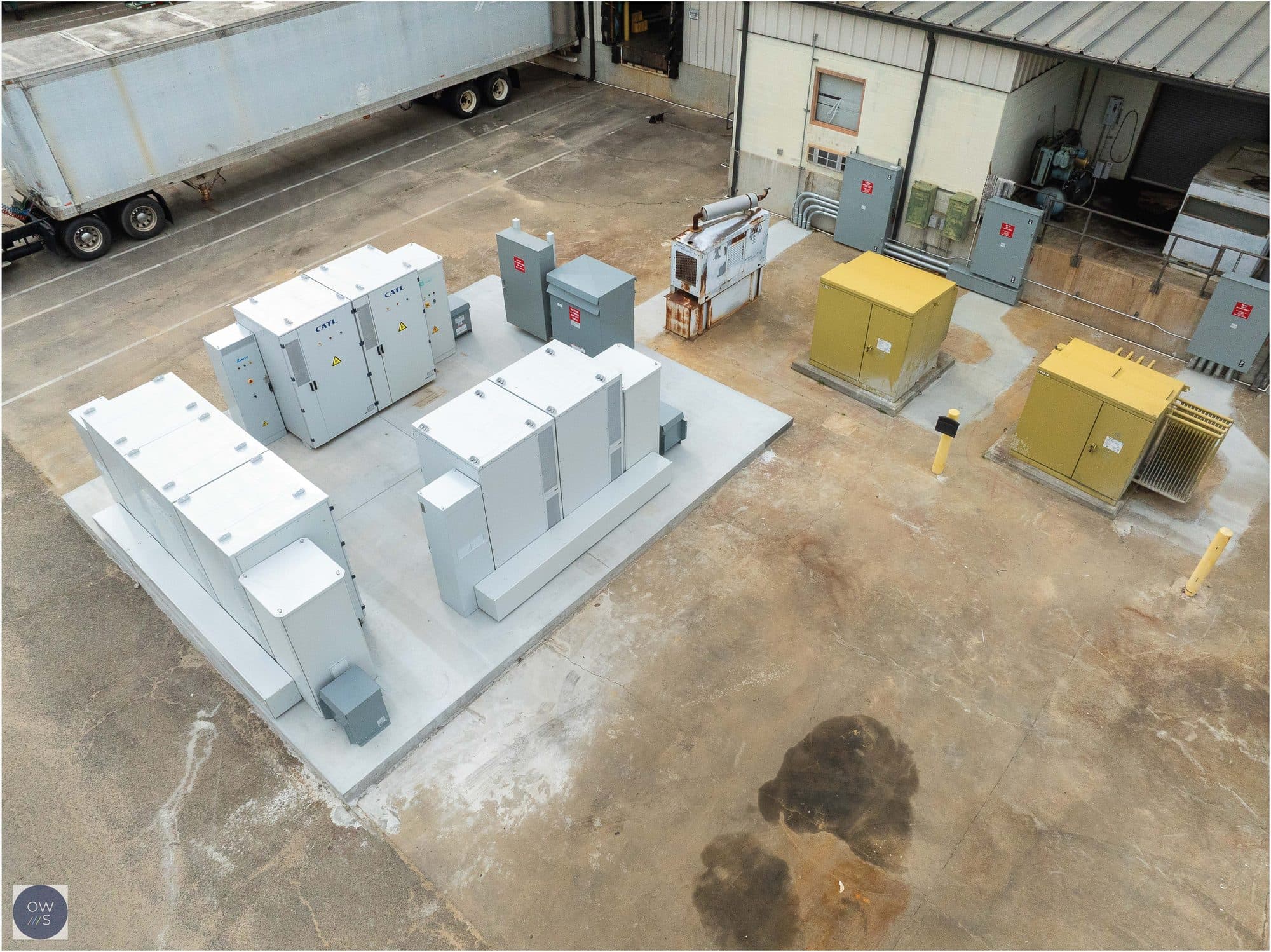
Our largest single site pairs a 1.267 MW rooftop array with 55,000 lb of batteries, using CATL cells in OneWorld Solar BatteryCube® cabinets, at the Samsonite and TUMI facility in Vidalia, Georgia. The full build is documented in the Samsonite and TUMI 1.267 MW rooftop solar and battery case study.
What that storage is doing is the two jobs described above. It sits between the facility's load and the utility meter so the billed peak is shaped by the battery rather than by the raw draw of the plant, and it stands behind loads the site would rather not lose. The solar array cuts energy consumption across daylight hours; the batteries address the part of the bill that solar alone cannot reach. That division of labor is the entire argument for pairing them, and it applies well beyond this one building. (Specific measured demand reduction and usable capacity figures for this site should be confirmed against monitoring data before publication.)
If you want to see how the equipment is put together, the BatteryCube commercial battery energy storage system page has the product detail, commercial battery storage installation covers our scope of work, and solar for manufacturing facilities covers the load profiles we see most often. On the incentive side, storage has been eligible for the federal solar investment tax credit under current rules, subject to conditions your accountant should verify.
Send us twelve months of bills and interval data if your utility will release it. If the numbers are not there, that is the answer, and it costs you nothing to find out.