
OneWorld Solar is a commercial solar EPC contractor working across Georgia, Florida, South Carolina, North Carolina and the Caribbean. We take a single contract for the whole job — feasibility, engineering, procurement, construction, interconnection and commissioning — so there is one company accountable for the number on the proposal and one company to call when something needs answering.
The business was founded in 2001, which makes it the oldest solar company in the Southeast. Our CEO acquired it in October 2017 and rebuilt it around large commercial and agricultural clients. Since then we have installed more than 7.8 MW for commercial solar and battery customers, and we hold patents on our own solar racking awarded in 2020 and 2025.
What is included in a OneWorld Solar EPC contract?
Split-responsibility solar projects fail in the gaps between the parties. Ours does not have gaps, because the scope below is one contract with one price.
- Feasibility and energy analysis. We read twelve months of your utility bills — not just the total, but the rate schedule, the demand charges, the power factor penalty and the time-of-use structure. That determines whether solar alone, solar plus battery storage, or power factor correction first is actually the right investment.
- Engineering and stamped drawings. Structural, electrical and civil design, sealed by a Professional Engineer licensed in your state.
- Utility interconnection. Application package, single-line diagram, technical data, the study process, and the witness test at the end.
- Procurement. Modules, inverters, racking, combiners, transformers and switchgear, bought and warranted through us.
- Construction. Our crews and our own patented racking, with the roof penetration details and flashing done to the roof manufacturer's warranty requirements.
- Commissioning and monitoring. Performance testing, as-builts, O&M documentation and production monitoring handed over at the end.
- Incentive documentation. The evidence packages your accountant needs for the 30% federal investment tax credit, Section 179 and bonus depreciation, and — for rural and agricultural sites — the USDA REAP grant.
How much does commercial solar cost?
Installed cost per watt falls as system size rises, and the difference between a 150 kW array and a 1 MW array is substantial. The variables that actually move the number on a commercial project are roof condition and attachment method, the distance from the array to the point of interconnection, whether the utility requires a transformer or protective relaying upgrade, and whether storage is included.
We publish real per-kW ranges and the assumptions behind them in how much commercial solar costs per kW in Georgia, and the commercial solar savings calculator will give you a system size, an annual saving and a payback range from your monthly bill in about a minute.
What we will not do
We will not quote a system from a satellite photo and an average bill. If the utility tariff, the roof and the interconnection point have not been looked at, the payback number is a guess — and a guess that is wrong by eighteen months is worse than no number at all.
Who does the engineering?
Our VP of Engineering has been building medium- and high-voltage interconnections for utility-scale renewable generation since 1992. He is a Professional Engineer licensed in South Carolina, North Carolina, Florida, Georgia, Virginia and Texas, a NABCEP board-certified Photovoltaic System Inspector, and a North Carolina Licensed Electrical Contractor with the Unlimited Classification.
That matters for two reasons. Engineering is done in-house rather than farmed out to whoever is cheapest that month, so the person who sealed the drawing is the person who answers the utility's review comments. And a PE who vets sites for interconnection compatibility and congestion constraints before the design starts will tell you early if a site is going to be a problem — which is far cheaper than finding out during the utility study.
What does the process look like?
- Bill analysis and site walk — usually one to two weeks. You send twelve months of bills; we walk the roof or the ground area and check the service entrance.
- Proposal — system size, production model, installed cost, applicable incentives, cash-flow model and payback range.
- Contract and engineering — stamped drawings and the permit set.
- Interconnection application — filed as soon as the design supports it, because the utility queue is usually the longest pole in the schedule.
- Procurement and construction.
- Inspection, witness test, energization.
- Monitoring and O&M — with the production data available to you, not just to us.
Where we have built
1.267 MW
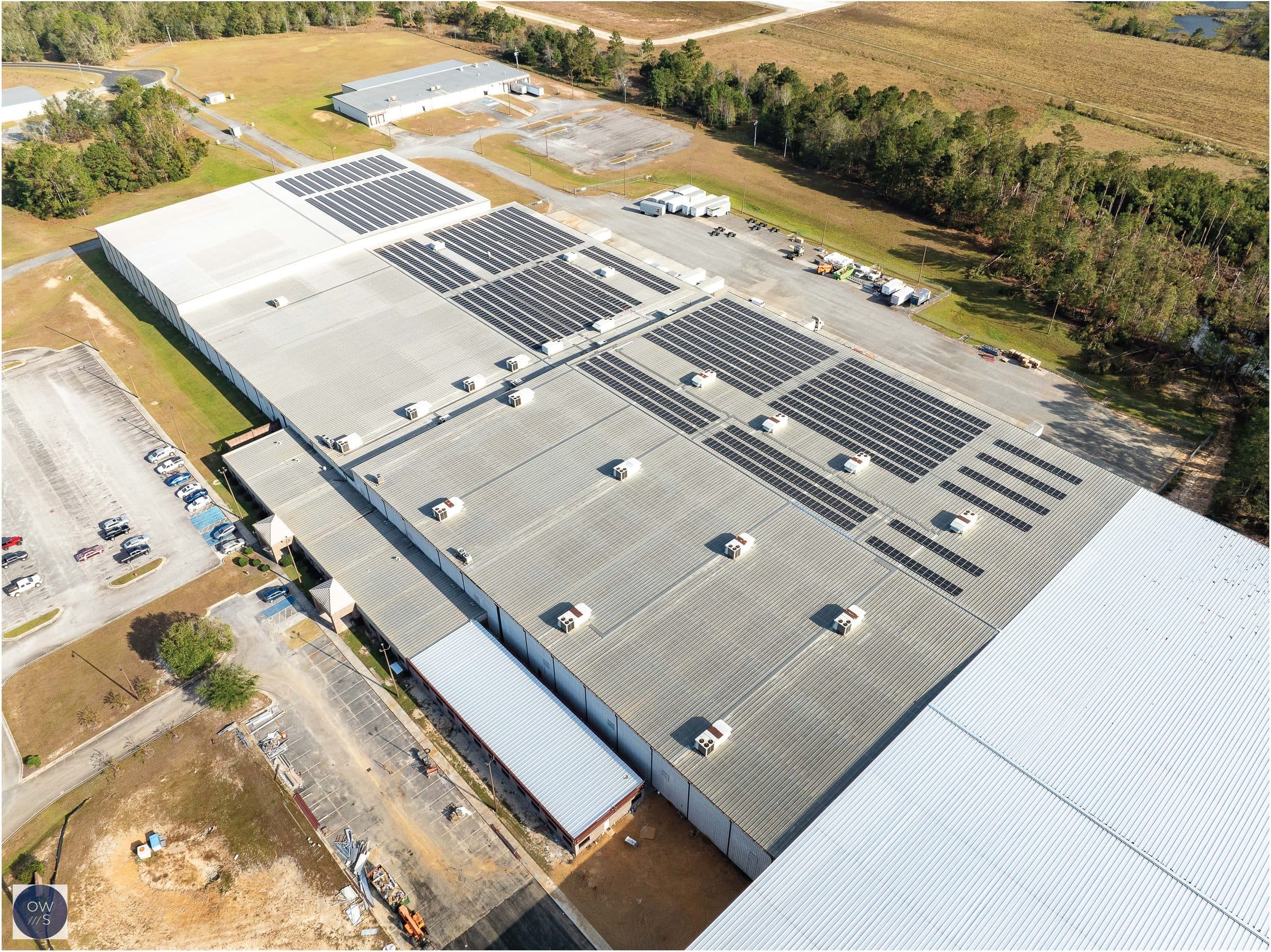
Samsonite / TUMI, Vidalia GA
Rooftop solar plus 55,000 lb of battery storage — our largest single site.
4.8+ MW
U.S. poultry installations
Breeder and broiler houses across the Southeast.
1 MW+
Woody Folsom Automotive
Chevrolet, Ford and Chrysler Dodge dealerships.
Beyond those we have built for the Westin Dawn Beach Resort in St. Maarten (800 kW), the Virgin Islands Port Authority (451.5 kW), Valencia College in Orlando (102 kW), Swainsboro Supply Company (117 kW) and the Orlando Utilities Commission. Browse all commercial solar projects or start with the industry closest to yours: poultry and agriculture, car dealerships, hotels and resorts, or manufacturing and warehousing.
Do you work in my state?
We are headquartered in Vidalia, Georgia and build across the Southeast and the Caribbean: