
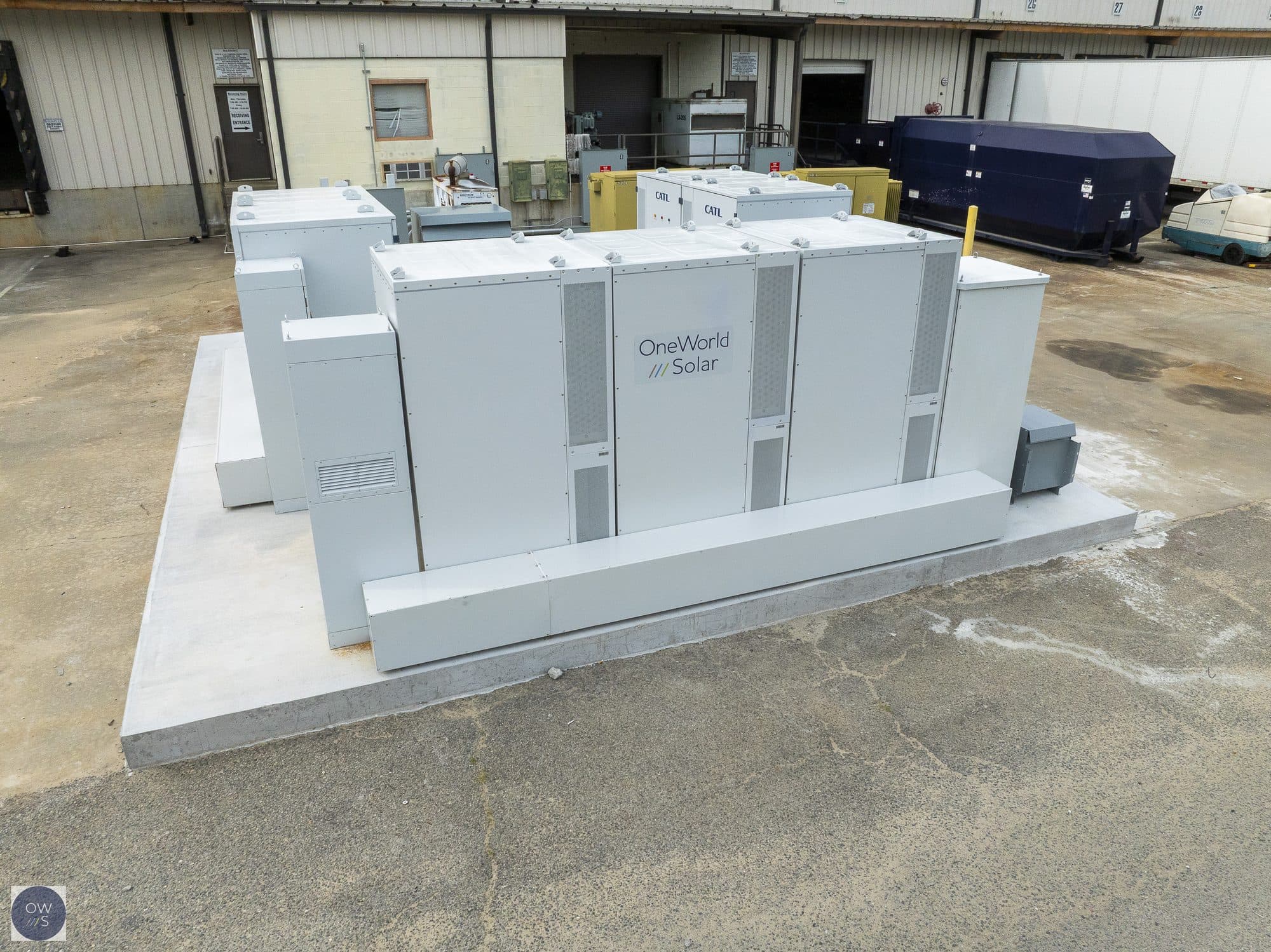

BatteryCube is OneWorld Solar's own line of outdoor battery cabinets, and it is the commercial battery energy storage system we install on our own projects. The cabinets are pad-mounted on a concrete pad outside the building, typically close to the service entrance and the utility transformers, and they hold CATL cells. The name is a registered trademark of OneWorld Solar, with its own logo and product identity.
The largest BatteryCube deployment to date is at the Samsonite and TUMI distribution center in Vidalia, Georgia: 55,000 lb of batteries in BatteryCube cabinets, paired with a 1.267 MW rooftop array on the same building.
What are we willing to publish about BatteryCube?
Less than most product pages, deliberately.
We can tell you what the cabinets contain, where they go and what is in service today. We are not going to publish per-cabinet energy ratings, C-rates, cycle life, round-trip efficiency, enclosure ratings or warranty terms on a web page until there is a current datasheet behind them. Battery specifications are exactly the numbers a buyer builds a financial model on, and a number that turns out to be optimistic eighteen months later is worse than no number at all.
Specifications are still being confirmed
Every entry in the specification table on this page is marked as pending verification. If you are sizing a system, comparing bids or preparing a financing package, ask us for the datasheet covering the configuration we are quoting. You will get real figures for that configuration rather than a marketing range.
What is inside a BatteryCube cabinet?
CATL cells. CATL is one of the largest lithium cell manufacturers in the world, and using their cells means the part of the system with the longest service life and the most demanding quality requirements comes from a manufacturer with real volume behind it.
What the cabinet adds around those cells is the part that makes it a product rather than a pallet of batteries: the enclosure, the thermal management, the battery management system, the internal protection and the interface to the power conversion equipment outside it. That integration is what we take responsibility for when we deliver a system.
Where is BatteryCube in service?
55,000 lb
Batteries at Samsonite / TUMI
BatteryCube cabinets holding CATL cells, Vidalia, Georgia.
1.267 MW
Paired rooftop solar
Our largest single site to date.
7.8+ MW
Installed since 2017
Commercial solar and battery customers across the Southeast.
The Samsonite and TUMI build is the reference project for the product line. A distribution center of that size has a load profile that solar alone cannot flatten, which is the case that storage exists to answer. The full build is written up in the Samsonite and TUMI 1.267 MW solar and battery case study, and the wider pattern for that kind of building is on our solar for manufacturing facilities page.
How is BatteryCube sited and installed?
Outdoors, on a pad, next to the transformers. That choice avoids most of the argument that comes with putting energy storage inside an occupied building: fire separation, ventilation, floor loading and the fire marshal's view of all three. What it needs instead is:
- A concrete pad with the right bearing capacity and drainage.
- Clearances and setbacks that satisfy the local fire code and the utility.
- A conduit route to the service entrance and the power conversion equipment.
- Access for delivery and for future service, which is easy to forget when the pad location is chosen for looks rather than for a truck.
We do the civil work, the pad, the switchgear interface and the interconnection package as one scope, so there is no gap between the battery supplier and the electrical contractor. There is only one of us.
What does BatteryCube do on a commercial site?
Three jobs, and the design differs for each:
- Demand-charge reduction. Discharging against your billed kilowatt peak, which is the part of a bill that solar cannot be relied on to touch. This is the usual reason a site buys a commercial battery energy storage system, and it is covered in detail on our commercial battery storage installation page.
- Critical-load backup. Carrying ventilation, refrigeration or a process line through an outage instead of shutting the site down.
- Micro-grid operation. Islanding a defined section of the site and running it independently until the utility returns. See commercial micro-grid design and installation.
Which of the three you need is decided by your rate schedule and by what an outage costs you per hour, not by the cabinet.
Does BatteryCube qualify for the federal tax credit?
Battery storage is eligible property under the 30% federal investment tax credit, including, in many cases, when it is installed without solar. We supply the itemized cost basis, commissioning records and in-service dates your accountant needs. We do not promise you the credit. Eligibility and the amount you can claim depend on your tax position, and verifying that is the responsibility of you and a Certified Tax Accountant.
How do you specify a BatteryCube system?
Not by picking a cabinet count. A commercial battery energy storage system is specified from a load shape, so start there. Send us twelve months of utility bills and, if the utility will release it, the interval data behind them. From the load shape we size power and energy separately, work out how many kilowatts you need to shave and for how long, and quote the configuration that meets it. Then you get the datasheet for that configuration.