
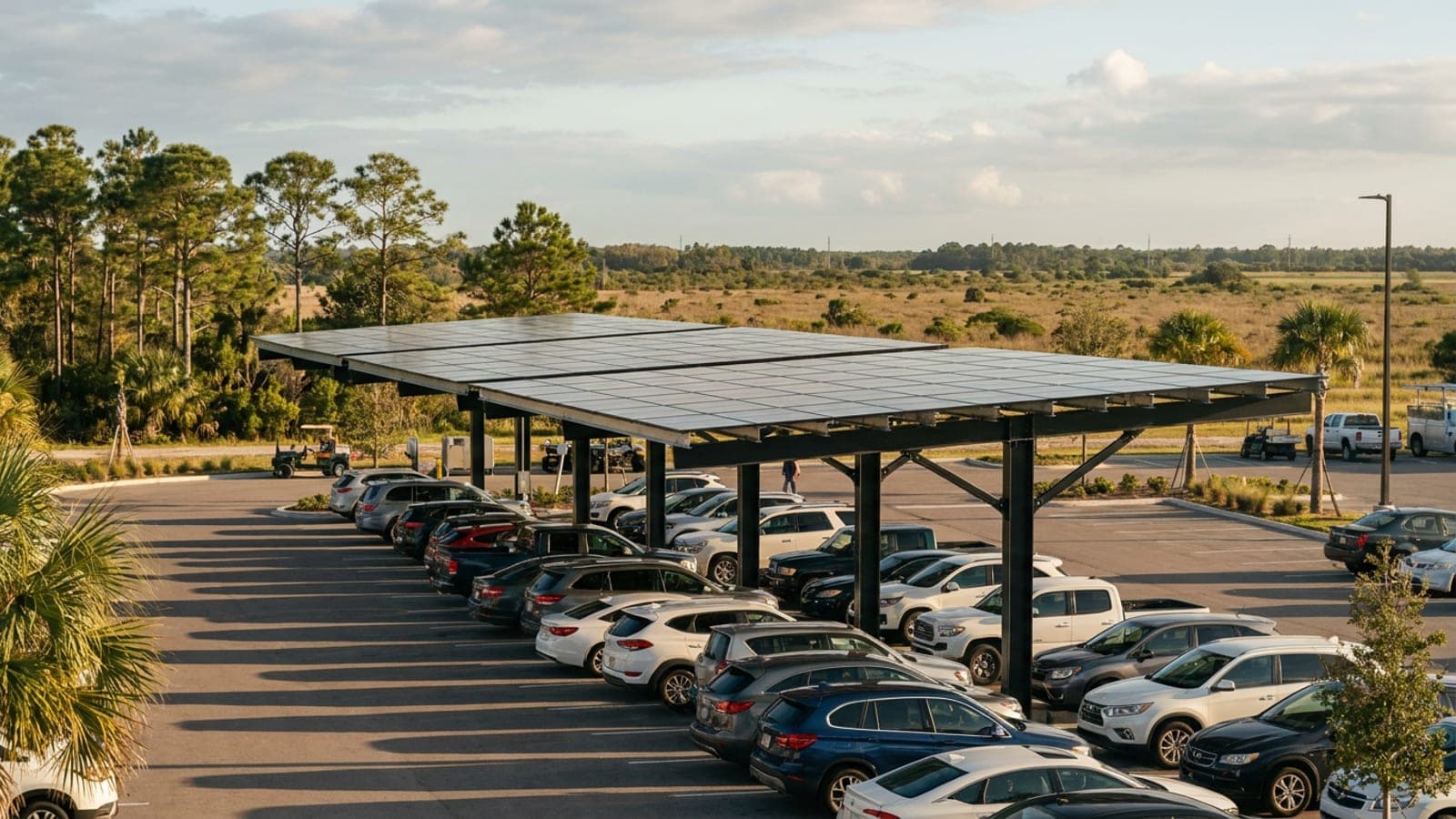
Two things decide whether a commercial solar installation Florida side of the Georgia line still looks like a good decision in year ten, and neither of them appears on a module datasheet. The first is whether the attachment was engineered for real hurricane wind uplift on your roof, in your exposure category. The second is whether the hardware holding it down was specified for salt air. Get those wrong and you have a liability bolted to your building.
OneWorld Solar has been building in Florida for years from our base in Vidalia, Georgia, including work for two Florida utilities on their own property. We were founded in 2001, have installed more than 7.8 MW for commercial and agricultural customers, and hold patents on our own solar racking awarded in 2020 and 2025 — which matters more in Florida than anywhere else we work, because racking is where wind loads are resolved.
How does wind-load engineering change a Florida solar design?
Everywhere else in the Southeast, structural design is a check performed on a layout that already exists. In Florida it is an input that changes the layout.
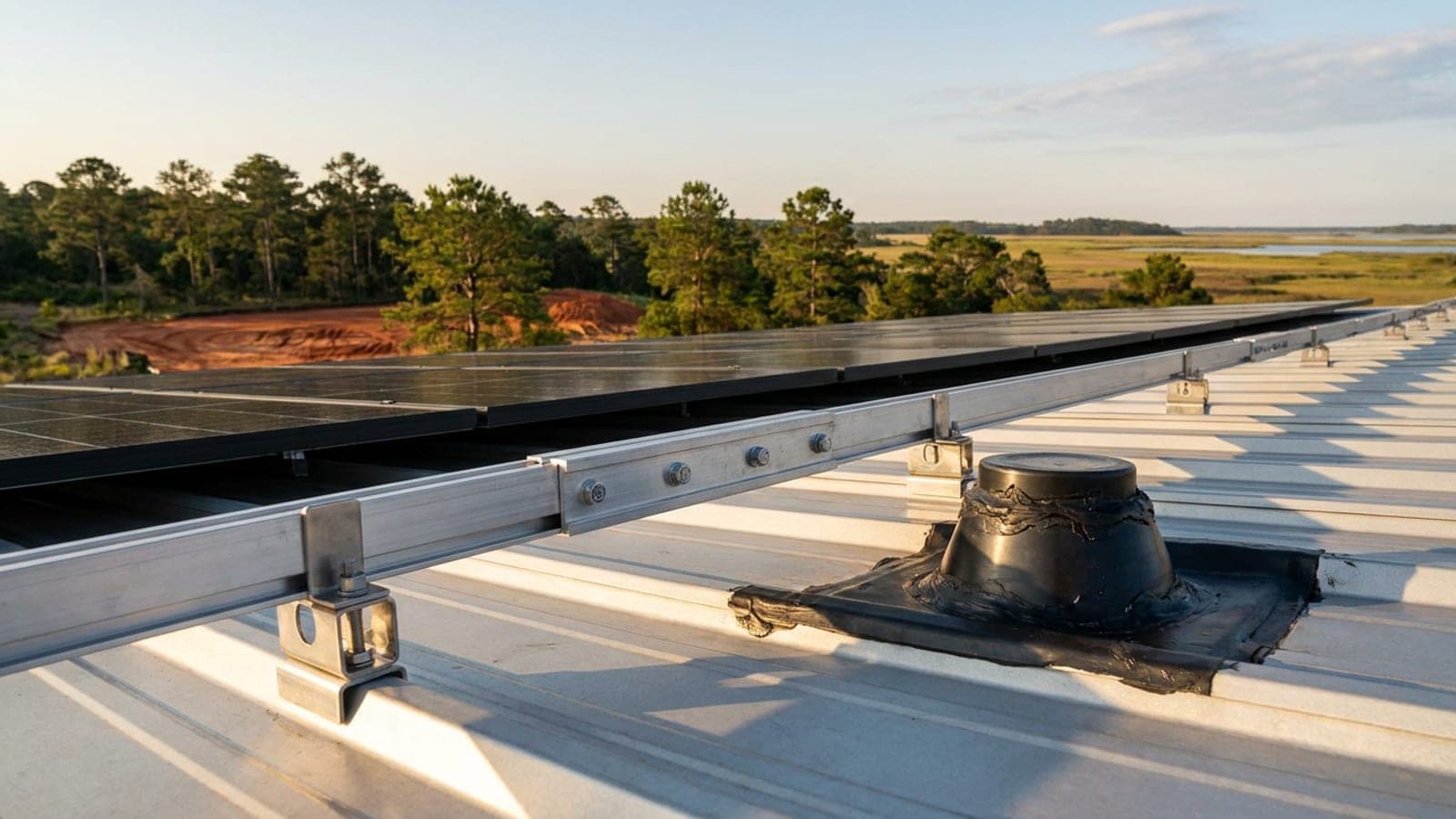
Design wind speeds under the Florida Building Code vary by county, exposure and risk category, and the high-velocity hurricane zone in the south-east of the state is stricter again. Corner and edge zones of a roof see far higher uplift pressures than the field, so a compliant array often has denser attachment at the perimeter, a larger setback from the roof edge, or fewer modules than a back-of-envelope layout promised. Ballasted systems that are perfectly normal in Georgia are frequently the wrong answer in Florida.
None of that is optional, and it is checkable. Your plan reviewer will ask for the calculations, your insurer may ask for them, and after a named storm your carrier will certainly ask what the array was designed to. Requirements are revised between code cycles, so confirm the currently adopted Florida Building Code edition and design wind speed for your address with the building department rather than relying on a prior project.
What we will not do
We will not sign off a rooftop array in Florida on a manufacturer's generic attachment table. Uplift is calculated for your building, your roof height and your exposure, and if the roof structure cannot take it we will say so and price a ground mount or a canopy instead. A cheap layout that fails the wind calculation is not cheap.
Who is your Florida utility, and why does it change the answer?
Florida Power & Light, Duke Energy Florida and Tampa Electric are investor-owned utilities regulated by the Florida Public Service Commission, which approves their rate schedules and interconnection tariffs in public dockets. Orlando Utilities Commission and JEA in Jacksonville are municipal utilities owned by their communities. They set their own commercial rates, interconnection requirements and any local programs — and they behave differently enough that we treat them as separate markets.
Whatever the utility, the design driver is usually the demand charge rather than the energy rate. Customers on Florida commercial demand-based schedules often find that shaving the afternoon peak is worth more than raw kilowatt-hours, which pushes the conversation toward commercial battery storage alongside the array. Any credit for exported energy sits under each utility's current net metering or net billing terms — verify those in writing with the utility before you sign, because they have been revised more than once.
Which incentives apply in Florida?
The federal stack is the core: the 30% federal solar investment tax credit and Section 179 and bonus depreciation. Florida has no state corporate income tax credit for solar, though sales and property tax treatment for renewable equipment has historically been favorable — confirm current Florida sales and property tax exemptions for solar with your tax advisor. Agricultural and rural operations, including packing houses and groves, should also look at the USDA REAP grant for solar.
What has OneWorld Solar built in Florida?
102 kW
Valencia College, Orlando
Rooftop array on a working college campus.
127 kW
Headquarter Honda, Clermont
Roof mount over a dealership sales and service building.
32 kW
TECO Manatee Viewing Center
Pole-top array built for Tampa Electric itself.
Also in Florida: the Orlando Utilities Commission 32 kW solar canopy, the TECO Manatee Viewing Center 32 kW array, 25 kW on First Presbyterian Church in Tallahassee, and 20 kW at First Green Bank in Mount Dora. Two of those clients are utilities. Utilities are the least forgiving customers in this business on documentation, workmanship and interconnection compliance, and they do not hand that work to contractors who improvise. The Valencia College 102 kW rooftop solar case study walks through how we sequenced construction around an occupied campus.
Does this work for Florida hotels and resorts?
A commercial solar installation Florida hotel owners can insure and finance is one of the better fits in the state. Hotels run heavy, predictable daytime loads — air conditioning, laundry, kitchens, pool plant — with large flat roofs and parking areas, and Florida's tourism economy means those loads run year-round. Our 800 kW array at the Westin Dawn Beach Resort informs how we approach solar for hotels and resorts, and the same logic applies to dealerships under solar for car dealerships.
The full scope — feasibility, engineering, procurement, construction, interconnection and commissioning under one contract — is on our commercial solar EPC contractor page. We take on commercial solar installation Florida wide, from Tallahassee and Mount Dora to Orlando, Clermont and Tampa. To get a first number, use the commercial solar savings calculator or send us twelve months of bills and the service address.