
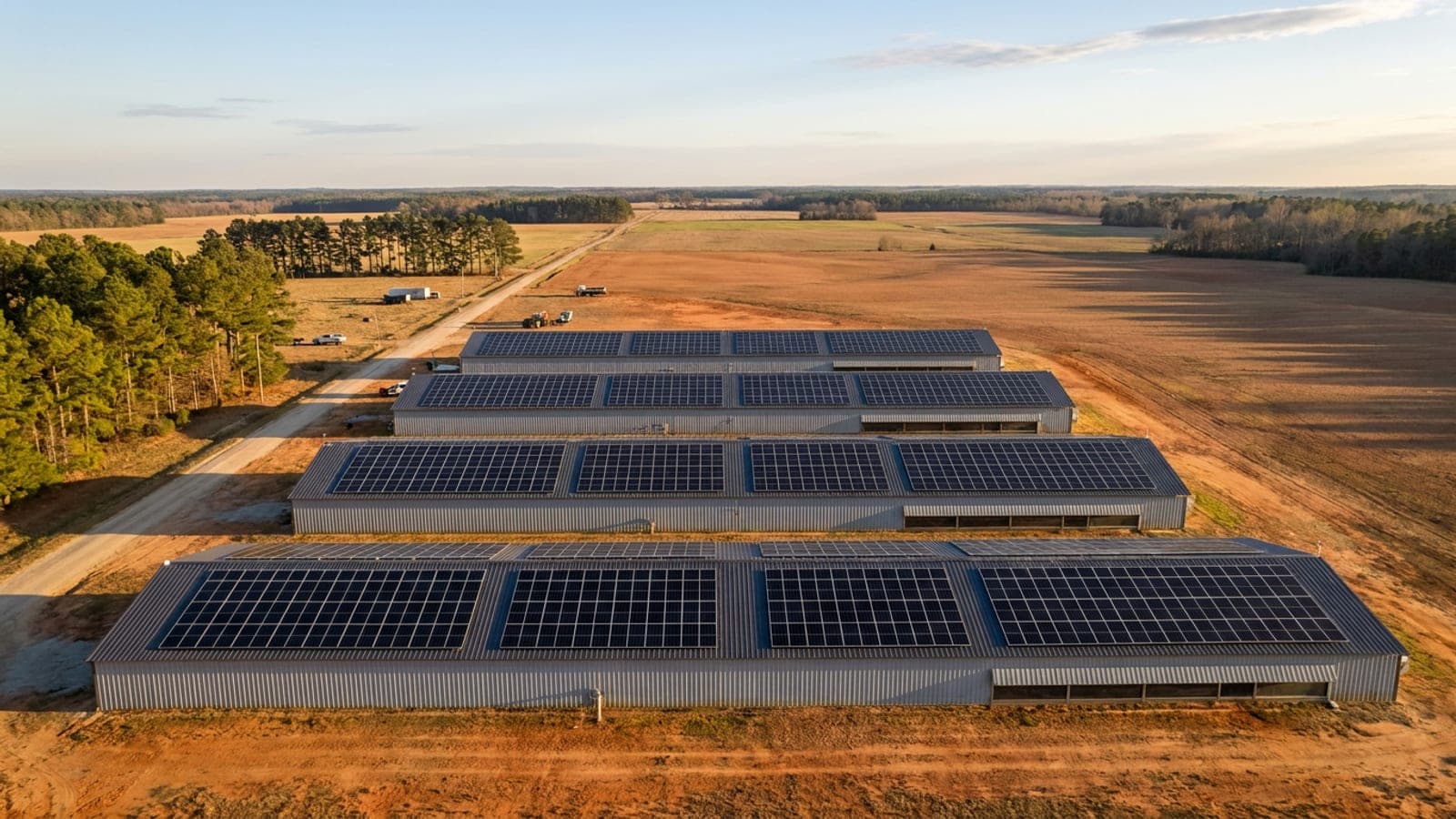
A commercial solar installation North Carolina project succeeds or stalls on two things: whether the design clears the utility's interconnection process, and whether the people signing for it are licensed in this state to do so. North Carolina takes both seriously, and so do we.
OneWorld Solar is a commercial solar EPC contractor founded in 2001 and based in Vidalia, Georgia, with more than 7.8 MW installed for commercial and agricultural customers. Our completed project portfolio is concentrated in Georgia, Florida and the Caribbean rather than North Carolina — we would rather say that than pad a list. What we bring across the state line is the licensure and the interconnection experience the work actually requires.
Who is licensed to do this work in North Carolina?
Our VP of Engineering has held a North Carolina Licensed Electrical Contractor certificate with the Unlimited Classification since 1992 and is a Professional Engineer licensed in North Carolina, as well as in South Carolina, Florida, Georgia, Virginia and Texas. He is also a NABCEP board-certified Photovoltaic System Inspector.
Since 1992 his work has been the medium- and high-voltage interconnection of utility-scale renewable generators — photovoltaic, hydroelectric and landfill gas — much of it in the Carolinas. In practice that means vetting a site for interconnection compatibility and congestion constraints before a layout is committed, producing the preliminary site layout, the interconnection application technical data and the single-line diagram, and then defending that package through the utility's review.
That is the sequence that goes wrong on badly run projects. A layout gets drawn, a price gets quoted, and only then does anyone check whether the point of interconnection can absorb the generation. By that stage the customer has a number in their head that the engineering cannot support.
What does the North Carolina utility landscape look like?
Duke Energy Carolinas and Duke Energy Progress are separate operating companies under the same parent, with separate service territories, separate rate schedules and separate interconnection queues. Knowing which one serves your meter is the first question, not a detail. Commercial customers on Duke's North Carolina demand-based commercial schedules generally find the demand charge is what a solar and storage design has to attack, not the energy rate alone.
Dominion Energy North Carolina serves the northeastern part of the state and operates under its own approved schedules.
Electric membership corporations serve much of rural North Carolina. They are member-owned cooperatives with elected boards, and each sets its own interconnection policy, size thresholds and any local program. If you farm, you are probably on one of these, and the answer your neighbor got in Duke territory may not apply to you.
The North Carolina Utilities Commission regulates the investor-owned utilities and approves their tariffs and the state's interconnection procedures. Those procedures and any rebate or incentive program capacity have been revised repeatedly, and some earlier programs have closed. Verify current terms with the utility rather than trusting an article — including this one — to still be accurate on the day you apply.
Where the schedule really goes
On commercial projects the utility queue, not construction, is usually the longest item in the calendar. We file the interconnection application as soon as the design supports it and treat any study timeline or queue position as something the utility confirms, not something we promise.
1992
NC Unlimited electrical contractor since
Held continuously by our VP of Engineering.
4.8+ MW
US poultry solar installed
Breeder and broiler houses across the Southeast.
7.8+ MW
Total installed since 2017
Commercial and agricultural solar and battery projects.
Why does poultry keep coming up in North Carolina?
Because North Carolina has one of the largest poultry and agriculture sectors in the country, and poultry houses have close to an ideal load profile for solar. Tunnel ventilation fans, lighting and heating draw hard and year-round on rural three-phase service, with wide clear-span roofs and open land beside them.
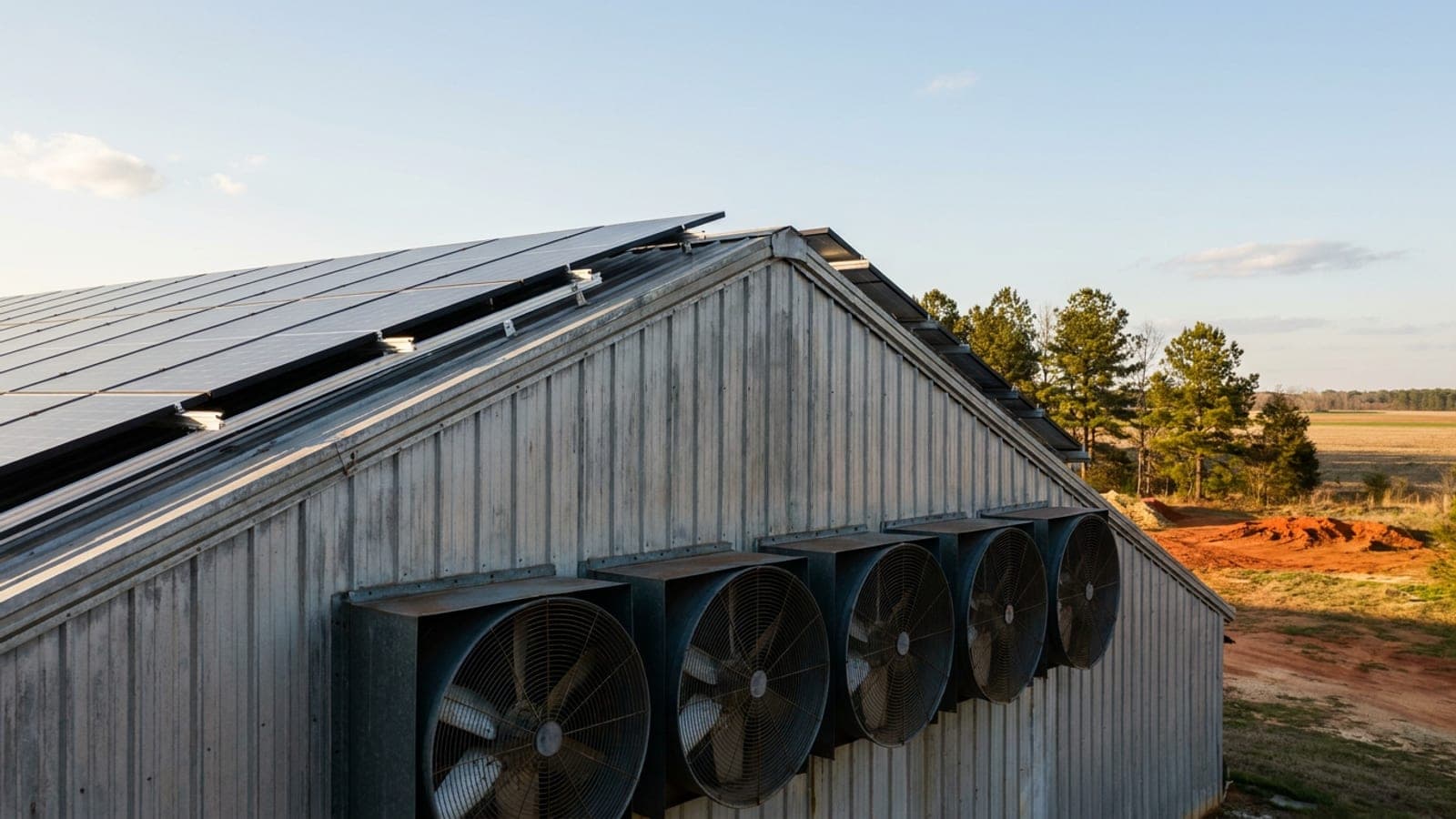
We have installed more than 4.8 MW on US poultry operations, including named systems of 210 kW on a six-house breeder farm, 450 kW on a 14-house broiler farm and 410 kW on a 16-house broiler farm. The commercial solar installation North Carolina growers ask us about most often is exactly that: a house-by-house array sized to the ventilation load. Those are the reference designs to look at — start with the 450 kW 14-house broiler farm solar case study, then read solar panels for poultry farms for house-by-house sizing and what the equipment actually costs.
Rural operations are also the strongest candidates for the USDA REAP grant for solar, which can fund a significant share of an eligible project. Stack that with the 30% federal solar investment tax credit and Section 179 and bonus depreciation and the capital picture changes materially. USDA and the IRS decide those outcomes, not us, and your accountant must validate them.
What about North Carolina manufacturing and distribution?
The state's furniture, textile, food processing, pharmaceutical and distribution facilities have the three things that make commercial solar work: large uninterrupted roof or land area, three-phase service already sized for the plant, and a daytime load that lines up with production. Our largest project of that type is the 1.267 MW rooftop array and 55,000 lb of battery storage at the Samsonite and TUMI distribution center — the Samsonite and TUMI rooftop solar and battery case study shows how the array and the BatteryCube® bank were sized against the plant's demand profile. The same approach is described under solar for manufacturing facilities.
How do we start a North Carolina project?
We take on commercial solar installation North Carolina wide, from the coastal plain to the Piedmont. Send twelve months of bills and the service address. We identify the operating company and rate schedule, look at the point of interconnection before we look at the roof, and tell you whether the site is worth engineering. The full scope sits on our commercial solar EPC contractor page. Run a first pass with the commercial solar savings calculator or ask us for a North Carolina site assessment.