
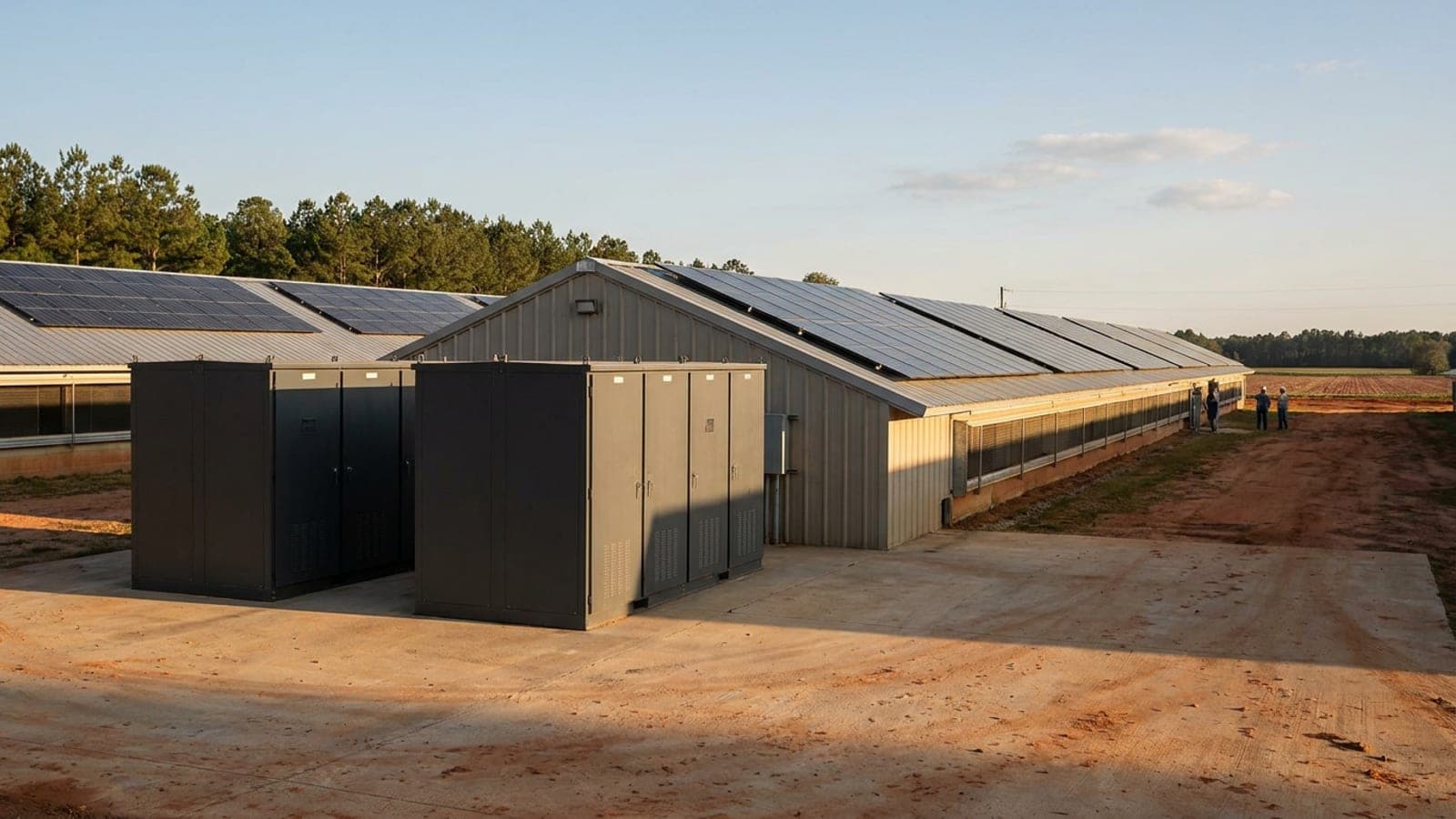
OneWorld Solar is a commercial microgrid installer working across Georgia, Florida, South Carolina, North Carolina and the Caribbean. A micro-grid is what you build when losing power costs you more than money: livestock, product, guests or a production line that does not restart cleanly. It combines solar, commercial battery storage and control equipment that can deliberately separate your site from the utility and keep the loads inside its boundary running.
The company was founded in 2001 and has installed more than 7.8 MW for commercial and battery customers since our CEO acquired it in October 2017. Our storage sits in our own BatteryCube® cabinets, pad-mounted outdoors alongside the utility transformers.
What is a micro-grid, and how is it different from what you already have?
Three things are commonly confused. They solve different problems.
| Standby generator | Grid-tied solar | Solar micro-grid | |
|---|---|---|---|
| Cuts your bill day to day | No | Yes | Yes |
| Works during an outage | Yes | No | Yes |
| Depends on fuel delivery | Yes | No | No |
| Run time | While fuel lasts | Not applicable | Battery plus daily solar |
| Cost when nothing goes wrong | Maintenance only | Savings | Savings |
Grid-tied solar shuts down in an outage by design. Anti-islanding protection stops an inverter energizing a line that a utility crew has been told is dead. That protection is not negotiable, so a micro-grid works around it instead: it opens a defined point of separation, and only then do the inverters form their own grid on the isolated side.
What actually happens when the grid drops?
- The controller sees the utility fail and opens the point of common coupling.
- The battery's power conversion system switches from following the grid to forming one, setting voltage and frequency itself.
- The critical-load panel is now the whole electrical world. Everything outside it stays dark.
- Solar restarts against the micro-grid it now sees and recharges the battery while it discharges.
- When the utility returns and stays stable, the controller resynchronizes and closes back in.
The engineering that matters is in steps one and three. Transfer has to be fast enough for the equipment you are protecting, and the critical-load panel has to be drawn deliberately. Trying to island an entire facility is how micro-grid budgets get out of hand.
Which loads justify a micro-grid?
Three kinds of site account for most of the work we are asked to do as a commercial microgrid installer.
Poultry houses
Tunnel-ventilated houses depend on fans. In a Southeast summer, an outage stops being an inconvenience and becomes a mortality event in a matter of hours. That risk is why so many growers already own generators and pay to maintain them. A micro-grid covers the same failure while paying something back every day the grid stays up. We have installed over 4.8 MW on solar for poultry farms, including 450 kW on a 14-house broiler operation.
Hotels and resorts
A resort loses revenue the moment the guest experience stops, and on an island grid the outages are neither rare nor short. Kitchens, cold storage, water pumping, elevators and enough lighting to keep a property safe are the usual critical-load list for solar for hotels and resorts.
Cold storage and process loads
Refrigerated inventory has a clock on it, and some manufacturing lines cost more to restart than to run. Both justify carrying a narrow set of loads rather than a whole building.
Draw the boundary first
The most expensive mistake in micro-grid design is deciding the critical-load list after the equipment is priced. Every load you add raises both the power rating and the battery size. We ask you to rank loads before we size anything.
Why is the Caribbean a different problem?
Island grids are small, fuel-dependent and exposed. A hurricane season does not just threaten a long outage; it changes what a building has to survive structurally, and a poorly attached array becomes a liability to the roof it sits on. We have built through that: the 800 kW solar installation at the Westin Dawn Beach Resort in St. Maarten, 451.5 kW of ground mount for the Virgin Islands Port Authority in St. Thomas, and 157 kW at Divi Little Bay Beach Resort. More on how we work in the region is on our commercial solar installation in the Caribbean page.
Who engineers the interconnection?
Our VP of Engineering has worked on medium- and high-voltage interconnections of utility-scale renewable generators since 1992 — photovoltaic, hydroelectric and landfill gas. He is a Professional Engineer licensed in South Carolina, North Carolina, Florida, Georgia, Virginia and Texas, a North Carolina Licensed Electrical Contractor with the Unlimited Classification, and a NABCEP board-certified Photovoltaic System Inspector.
Micro-grids are where that background earns its money. A system that can operate islanded has to satisfy the utility that it will never energize their lines unintentionally, and the protection scheme, relaying and single-line diagram are what prove it. Chris produces those in-house, so the person who sealed the drawing is the person who answers the utility's review comments. That is the practical difference between a commercial microgrid installer and a solar contractor who has added a battery to the price list.
Where should you start?
Start with the outage you are actually afraid of, and what it costs per hour. If that number is large, a micro-grid is worth designing. If it is small, a battery sized purely for demand-charge reduction is the cheaper and better purchase.
Send us twelve months of utility bills and a ranked list of the loads you cannot lose. We will come back with a critical-load panel, a battery size and a straight answer about whether the outage risk justifies the equipment.