
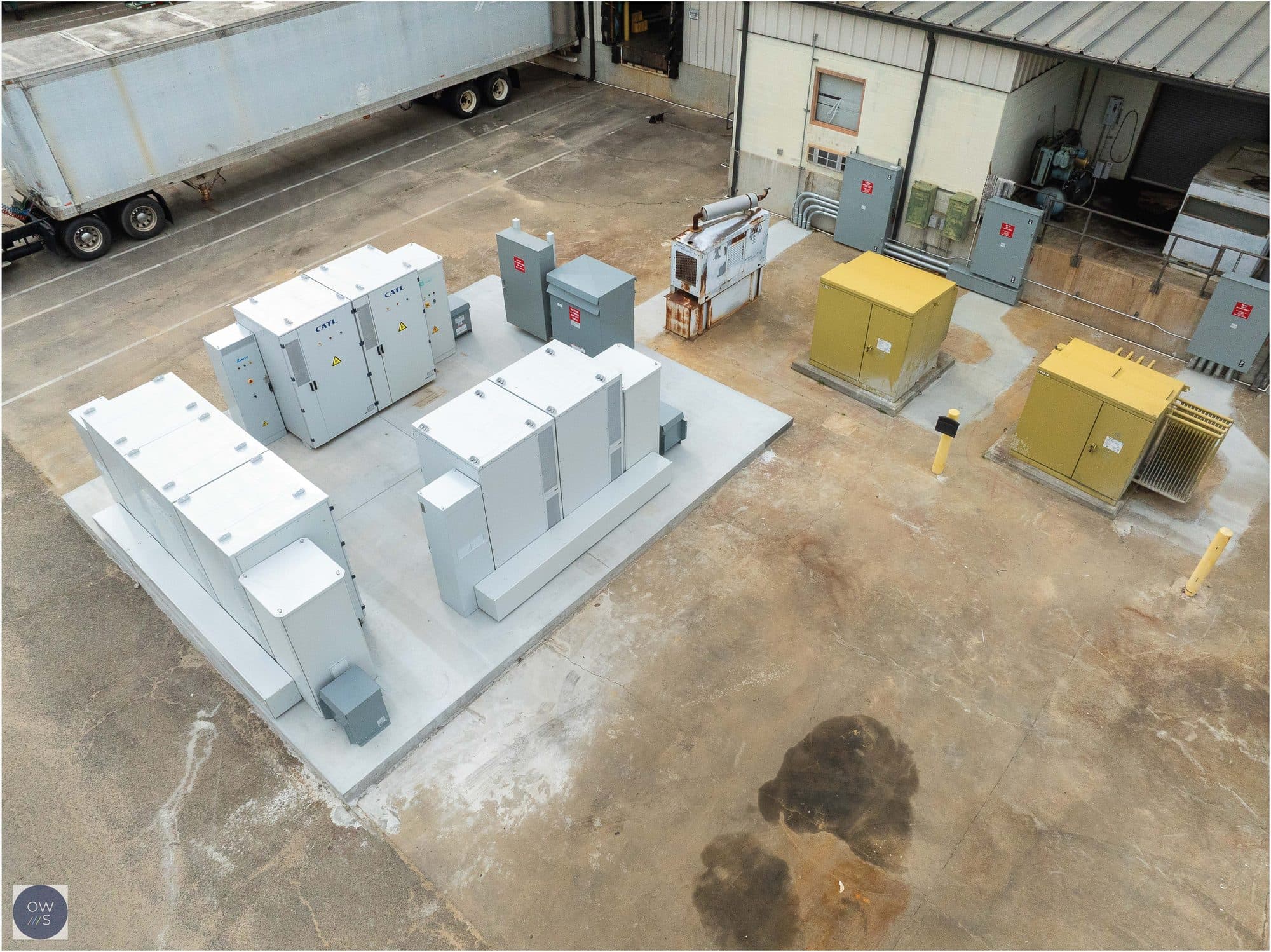
Three different machines get sold against the same sentence: keep my site running. A standby generator, a battery backup and a microgrid are not three brands of the same thing. They fail differently, they cost differently, and only one of them earns anything on the 360 days a year when the grid behaves perfectly.
The conversation almost always improves once we stop comparing products and start comparing three specific properties: how fast the thing picks up your load, how long it can hold it, and what it does for you when nothing is wrong.
The three properties that decide it
How fast it picks up
A standby generator has to crank, reach speed, stabilize and then accept load through a transfer switch. Several seconds is normal and entirely fine for lighting, most HVAC and most motors.
It is not fine for everything. Control boards drop out. Servers reboot. Some process equipment faults and needs a manual reset that takes far longer than the outage did. If any part of your operation behaves that way, the transfer gap is not a detail — it is the whole specification.
A battery inverter is already running and synchronized. It carries the load through a transfer measured in milliseconds, which most equipment never registers as an event at all.
How long it can hold
This is where the ranking reverses.
A battery sized to shave a demand peak — which is how most commercial storage is sized, and for good reason, as covered in when commercial battery storage pays off — holds a facility for minutes to a couple of hours. That is a design choice, not a limitation of the technology, but every additional hour of runtime costs real money and takes real space.
A generator holds for as long as you keep fuel in it. For a multi-day event, buying hours from a fuel tank is dramatically cheaper than buying them from cells.
What it does when nothing is wrong
A generator does nothing. It sits there, it consumes maintenance and periodic test runs, and it depreciates. That is not a criticism — insurance is supposed to do nothing most of the time — but it belongs in the comparison.
A battery, on a tariff with a demand charge or a time-of-use spread, is working every single day. That is the asymmetry people miss: one of these assets has a job on ordinary Tuesdays.
So what is a microgrid?
A microgrid is not a fourth kind of generator. It is the control layer that lets a defined part of your electrical system disconnect from the utility and run on whatever local sources you have — solar, storage, a generator, or all three — and then reconnect cleanly.
That disconnection is called islanding, and it is the part customers most often assume they already have.
Solar alone does not survive an outage
A standard grid-tied array is required to shut down when the grid goes down, so it cannot energize conductors that a line crew believes are dead. A facility with a megawatt on the roof and no islanding capability goes just as dark as its neighbor. Finding this out during an outage is a bad afternoon; it is worth establishing before you need it.
Where each one is the right answer
A generator alone is the right answer more often than a solar contractor is supposed to admit. If outages are your only concern, your loads tolerate a transfer gap, and your tariff has no demand charge worth attacking, then a generator is cheaper, simpler and well understood by every electrician in your county.
A battery alone suits the site whose real problem is the bill rather than reliability, with a short, sharp peak to shave and no load that must survive a long outage. The backup capability comes along as a bonus rather than as the justification.
A microgrid earns its complexity in two situations. The first is when the same capital has to do two jobs — protect the operation and work on the bill — because neither alone justifies the spend. The second is when part of your load genuinely cannot tolerate a transfer gap and also cannot be allowed to go down for a long event, which usually means solar plus storage plus a generator, coordinated.
The load that decides it
In practice one load usually settles the design.
On a poultry operation it is ventilation. A full house without air movement is a mortality event measured in minutes, which is why solar for poultry farms so often turns into a resilience conversation partway through. On a hotel it is more often elevators, life safety and the property management system — see solar for hotels and resorts. In manufacturing it is whichever piece of the line is most expensive to restart.
Find that load, size around it, and the argument about product categories mostly resolves itself.
How we approach it
We size from interval data rather than from nameplate figures, because the question is not how much power your site could theoretically draw but how much it actually draws, when, and for how long. That data also tells us whether there is a demand charge worth attacking, which decides whether storage has a second job or only the one.
If the answer is that you need a generator and nothing else, that is what the analysis will say. There is more detail on how we build the islanding side in commercial microgrid installation, and on the storage side in commercial battery storage.
If you want this worked through against your own facility, send us twelve months of bills and interval data and we will tell you which of the three you are actually looking for.