
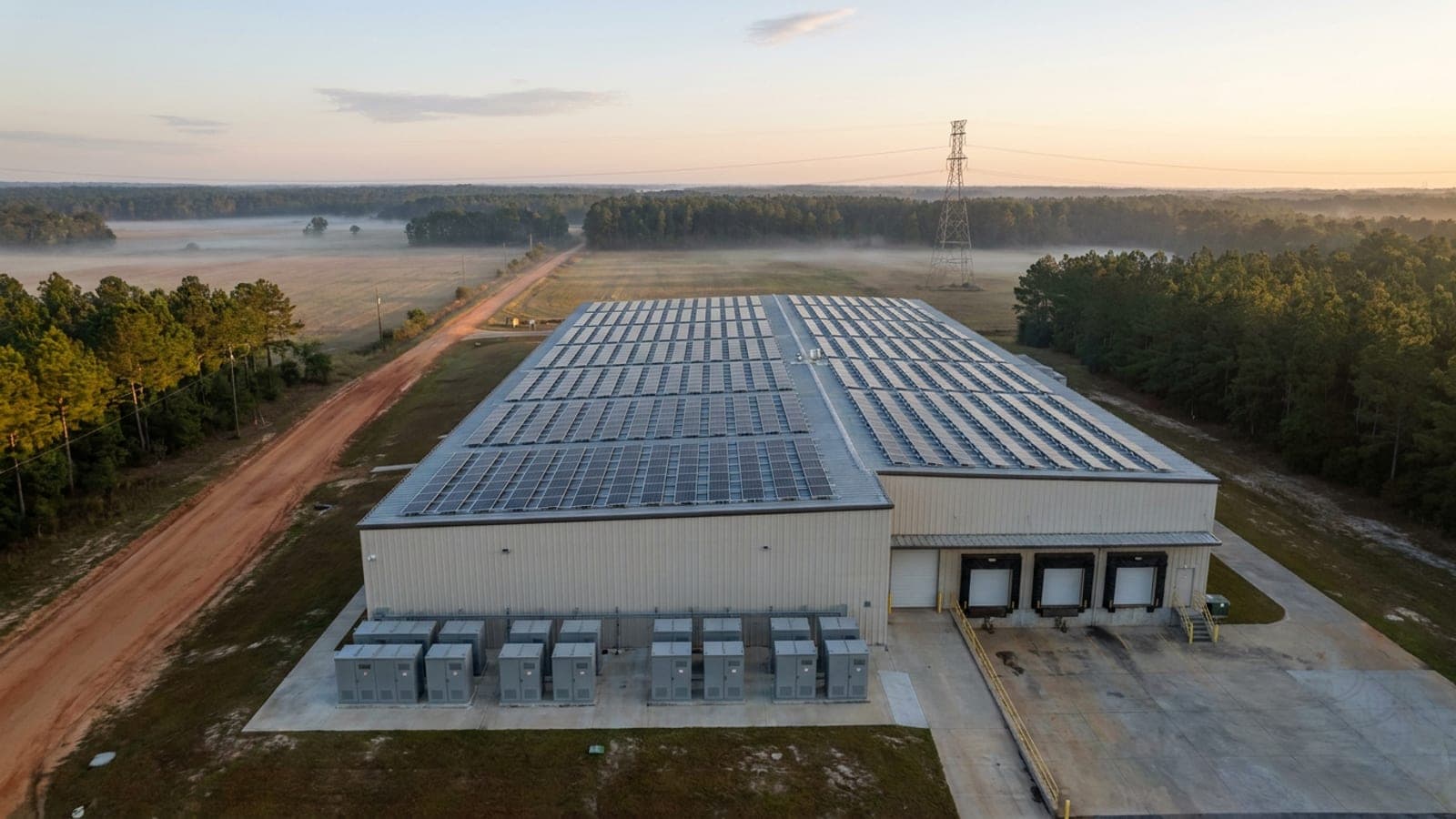
The Georgia Power OpenAI data center deal cleared its last hurdle on August 27, 2026, when the Georgia Public Service Commission approved a long-term service contract for a 3.2 gigawatt hyperscale campus at the Savannah Gateway Industrial Hub in Effingham County. That is a single customer whose demand, according to The Current's report on the order, is equivalent to more than two million homes. For a business anywhere on the Georgia Power system, the interesting part is not the size. It is what the contract promises, what it protects, and what it leaves for you to do yourself.
What did Georgia Power actually commit to?
Two things, and they are worth separating. The first is a bill figure. Under the approved order, Georgia Power raised its expected downward pressure on a typical residential bill of 1,000 kWh a month from at least $8.50 to at least $15 a month for the years 2029 through 2031. In its own statement the utility put that at roughly $180 a year per household and about $950 million a year across the system from 2029, with OpenAI funding the infrastructure needed to connect the site. Kim Greene, Georgia Power's chairman, president and CEO, summed up the intent in one line: data centers are paying more so families and small businesses can pay less.
The second commitment is a set of safeguards the commission added. Georgia Power agreed not to recover lost revenues from customers outside the large-load class, which the order describes as residents and the vast majority of the state's business owners. If a large-load customer ends its contract early, the utility will not seek the resulting shortfall from residential and small business customers in a future rate case. A public summary of the contract is due within ten days, and the utility will report publicly twice a year on how its data center portfolio is performing.
Both reports carry the same caveat, and it belongs in any honest reading of the deal. The $15 figure is downward pressure, not a guaranteed bill. Fuel costs and storm recovery can move a bill the other way, and the order says so.
What does the deal mean for a commercial account?
Read the safeguards first. They are good news for a Georgia business, because they draw a line around the cost of serving this one customer and keep it off your bill. That matters in a state where a July 2025 base rate freeze and a May 2026 rate reduction plan already set the direction of travel, and the commission has now added a written backstop.
Then read what the promise covers, because it is specific. The $15 a month is measured against a residential customer using 1,000 kWh. A poultry farm, a dealership or a plant does not have that bill. A commercial account is decided by the demand charge on the highest measured interval of the month, by the fuel rider, and on some schedules by a ratchet that carries one bad peak forward for months. None of those lines is named in the commitment, and none of them is what a data center's contract is designed to change.
There is a detail in the contract that tells you where the value on this grid now sits. OpenAI committed up to 1,000 megawatts of flexible demand response, meaning it can cut its draw when the system is tight. The utility negotiated for that flexibility because peak capacity is the scarce thing, and it will keep pricing peaks accordingly. For a business, the lesson is that flexibility is worth money, and you can own it rather than wait for it to show up in a tariff.
How does a business capture the same value on its own meter?
The same way the data center did, at a smaller scale: generate part of your own energy and control your own peak. We have been building exactly that for Georgia customers since 2001, and the approach is documented on our page on commercial solar installation in Georgia.
Solar takes the energy portion of the bill across daylight hours, which is where a dealership, a warehouse or a broiler house does most of its consuming. It does not reliably reduce a demand charge, because the utility can set your billed peak on a cloudy afternoon or after dark. That gap is what commercial battery storage installation exists to close. A battery sized from interval data discharges into the peaks so the meter never records them, and it does that whether or not the next rate case moves the residential baseline. If you want to know what the equipment looks like, our own BatteryCube® commercial battery energy storage system is built around CATL cells and assembled here in Vidalia.
Our largest single site is the clearest example. At the Samsonite and TUMI facility in Vidalia we paired 1.267 MW of rooftop solar with 55,000 lb of battery storage, so the plant's billed peak is shaped by the battery rather than by the raw draw of the production floor. The full build is in the Samsonite and TUMI 1.267 MW rooftop solar and battery case study. Whether a battery earns its keep at your site is a question your rate schedule answers, and we walk through how to read it in our article on commercial battery storage payback. Some sites turn out to have a cheaper problem, such as a power factor penalty, which is why we check for that first through power factor correction services before quoting storage.
On the incentive side, both solar and paired storage have been eligible for the 30% commercial solar tax credit under current federal rules. The credit is claimed on your return and validated by your accountant, and we prepare the documentation that makes that straightforward.
What should a Georgia business do this month?
Pull twelve months of Georgia Power bills and, if the utility will release it, your interval data. Find the demand charge line and add up a year of it. That number is the ceiling on what a battery can save you, and it is the part of your bill that the data center deal does not touch. If the number is small, you have your answer and it cost you nothing. If it is a third of the bill, as it is at some of the plants we visit, the deal that matters most to you is the one you sign for your own roof.
Send us those bills through our commercial solar proposal request, or start with the commercial solar savings calculator to see the order of magnitude for a facility your size. We will come back with a system size, an installed cost, the incentives that apply and a payback range, and we will tell you plainly if the numbers are not there.