
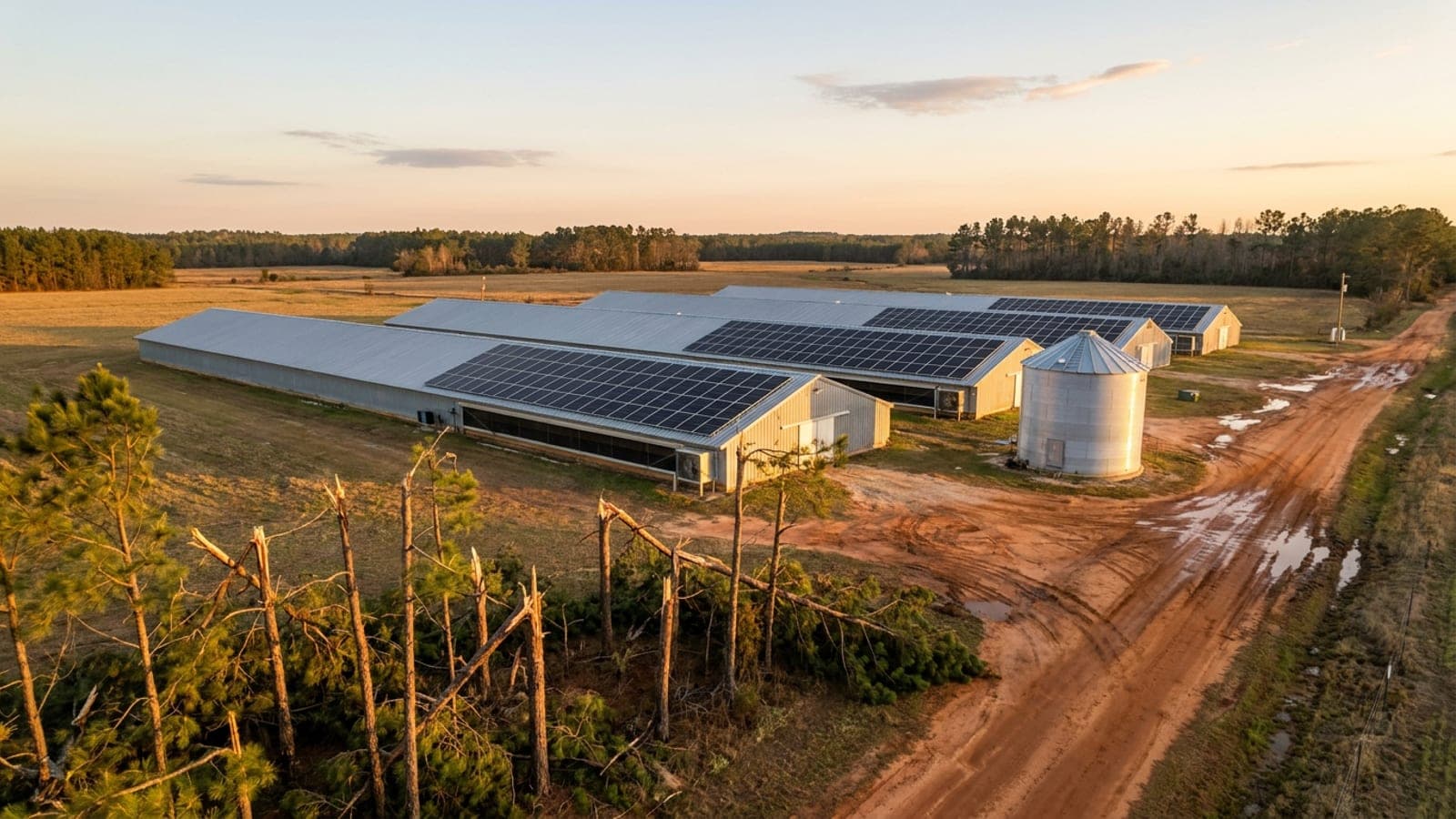
The Hurricane Helene block grant for Georgia farms is moving from paperwork to payments. According to the Georgia Farm Bureau, the Georgia Department of Agriculture expects to disburse the state's $531.236 million in USDA block grant funds by the end of fall 2026, to farmers, ranchers and timber producers whose Helene losses were not covered by existing federal programs. That is a large sum landing in rural Georgia inside a few months, and for the poultry and row-crop operations that took the worst of the storm it settles the first question, which is what was lost. The second question is what to rebuild differently, and that one has a calendar attached.
What the block grant covers and how it will be paid
The numbers come from the Farm Bureau's August 19 report. Georgia asked USDA for more than $1 billion and was awarded $531.236 million. Applications closed on May 11 and about 5,900 were received; more than 4,200 were deemed eligible for full review, while roughly 1,700 were set aside as incomplete, duplicate or fraudulent. Of the applications, around 3,200 concerned timber losses, 1,400 agricultural losses and 630 both.
The Department of Agriculture and the Georgia Forestry Commission are running the review with a team of about 35 employees and contractors. Because eligible requests add up to roughly $900 million against the funds available, payments will be prorated. Commissioner Tyler Harper put it plainly: "every eligible applicant receives the same proportional share of what they were approved for based on the available funding."
There is a second window still open. The USDA Farm Service Agency has extended both Stage 1 and Stage 2 applications under the Supplemental Disaster Relief Program for qualifying 2023 and 2024 losses to September 30, 2026, according to the Ag Information Network, and is letting producers with quality-related discounts prove those losses with verifiable documentation. It is a separate program with its own rules, and it closes in a month.
What a poultry farm learned from the outage
Helene's lasting damage on many Georgia farms went beyond structures. It reached the power supply. A broiler house without ventilation on a September afternoon is a loss measured in birds, and the farms that came through best were the ones with backup power that started and kept running for as long as the lines were down. That experience is now part of how growers in south Georgia think about their operation, and it is why we keep hearing the same question on site walks: if we are rebuilding anyway, what should the power look like?
Our answer starts with what we have built. Across more than 4.8 MW on poultry houses in the Southeast, the pattern is consistent: roof-mounted arrays sized to the farm's daytime load, which on a broiler operation is driven by ventilation and cooling in the hours when the sun is highest. The 450 kW system on a 14-house broiler farm is a working example, and our page on solar panels for poultry farms sets out the economics in detail.
Solar on its own does not keep the fans running when the utility feed is gone. That job belongs to a battery sized from the farm's interval data and designed to carry the critical loads, which on a poultry farm means ventilation, controls and water, for the number of hours the last outage actually lasted. Our page on commercial battery storage installation explains how that sizing works, and for an operation that cannot tolerate any interruption, the battery becomes the core of a commercial microgrid that islands the farm from the grid automatically.
Why the REAP calendar matters now
A farm that rebuilds its power infrastructure this year has one federal program that fits the job precisely. The USDA REAP grant for solar, the Rural Energy for America Program, funds renewable energy systems and energy efficiency improvements for agricultural producers and rural small businesses. It is competitive, it is applied for through USDA Rural Development, and a grant is never guaranteed, which is why we describe the process step by step in our guide to applying for a USDA REAP grant for solar rather than promising an outcome.
The reason to think about it now rather than after the block grant arrives is sequencing. A REAP application needs a technical report, a design and a cost estimate, and the program's application windows do not wait for a farm's cash flow. A grower who knows in September what a resilient power system for the farm would cost can decide in the fall, with the block grant payment in hand, how much of the rebuild to direct toward equipment that pays back every month rather than only during the next storm. The block grant itself compensates for losses; what a farm does with its rebuilt operation is the farm's decision, and it is worth making with numbers on the table.
What to do this month
Pull twelve months of Georgia Power or EMC bills for the farm and, if the utility will release it, the interval data. Note how many hours the last outage lasted and what it cost. Those three things are enough for us to size an array and a battery, price them, and tell you what REAP and the federal tax credit could do to the net cost, with the usual caveat that the grant is awarded by USDA and the credit is claimed on your return and validated by a tax professional.
We have been building on Georgia farms since 2001, and our commercial solar installation in Georgia page covers the utilities, the interconnection process and the incentives that apply here. Send the bills through our proposal request form and we will come back with a system size, an installed cost and a payback range before the block grant payment is scheduled, so the decision is yours to make on your own timeline.