
Farm production expenses in 2026 will reach $492.8 billion, with fuel costs up 28.8 percent, according to the American Farm Bureau Federation's September 3 analysis of USDA's latest forecast. Economists Faith Parum and Daniel Munch report total expenses up $21.2 billion, or 4.5 percent, from 2025, about 1.5 percent higher after inflation, and $15.1 billion above what USDA projected in February. Fuel and oil rise to $21.6 billion, fertilizer, lime and soil conditioners rise 15.3 percent to $39.6 billion, and livestock and poultry purchases climb $7.4 billion, or 11.4 percent, to $71.9 billion.
Revenue is not keeping pace. Net farm income is forecast at $158.4 billion, down 2.6 percent in nominal terms and 5.5 percent after inflation. For the poultry sector that carries much of rural Georgia's economy, the analysis shows broiler receipts down $1.3 billion, or 2.8 percent, and egg receipts falling steeply from the 2025 peak, while turkey receipts rise $2 billion, or 35.1 percent.
Which of these costs can a farm actually change?
Most of the lines in USDA's table are set somewhere else. Diesel is priced by the refinery, fertilizer by the plant, chicks and feed by the integrator's contract. A grower reads those numbers and adjusts the margin, because there is nothing on the farm that changes them.
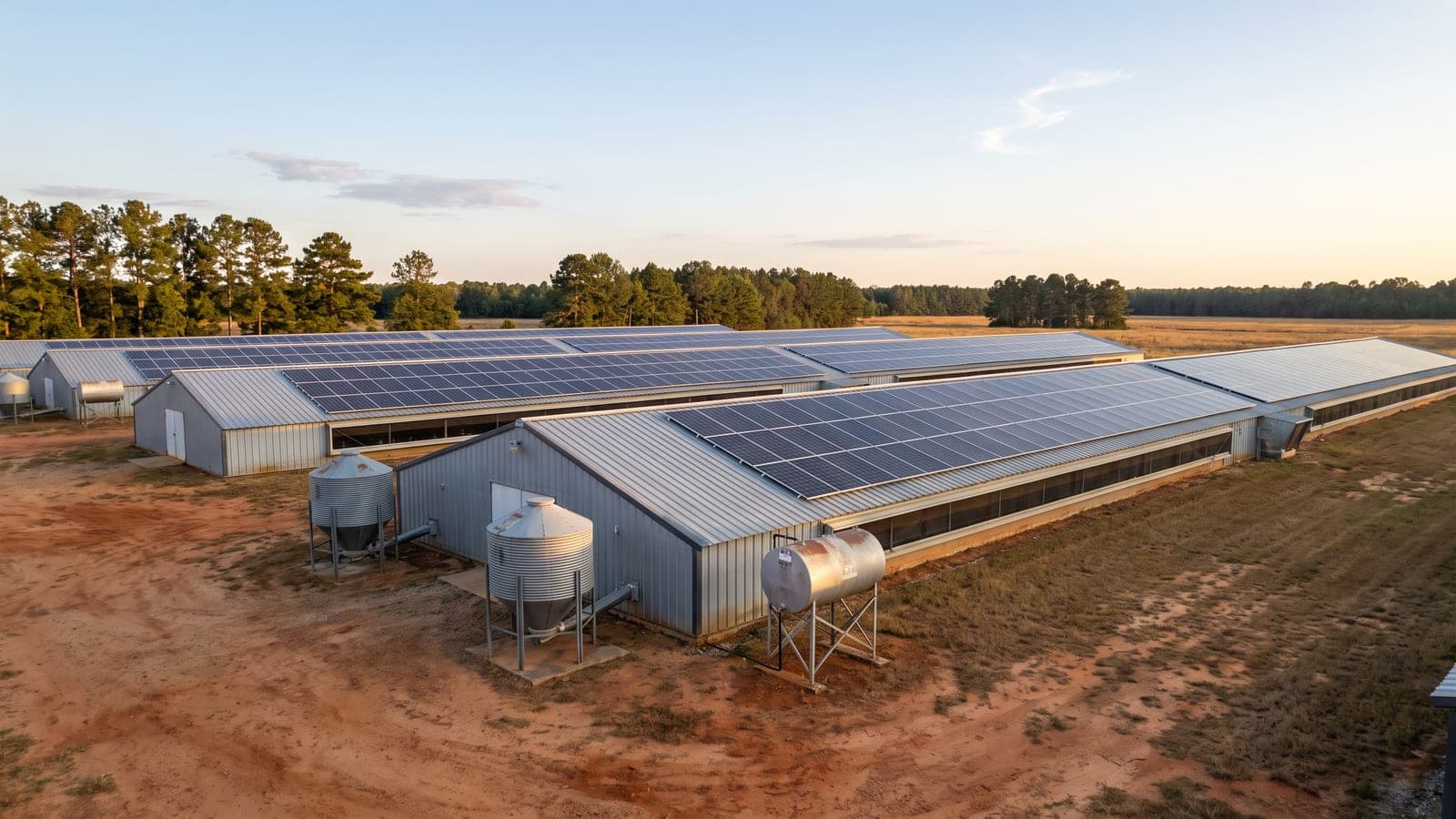
The power bill is different. The Farm Bureau analysis does not break electricity out, but on a tunnel-ventilated poultry complex it is one of the largest steady costs a grower carries directly: fans, lighting, feed lines, controllers and well pumps run every day of a flock, and the summer afternoons that set the demand charge are the hours when every fan in every house is at full speed. That load has two properties the other cost lines do not. It is highest when the sun is highest, and it sits under a long, unshaded metal roof.
The numbers behind the forecast also explain why the timing matters. When fuel rises 28.8 percent in a year, the diesel that runs generators and the propane that heats houses in winter follow it, and a grower who has fixed the electric side of the ledger has one fewer line moving against the margin.
What this means for a poultry farm in the Southeast
A solar array on poultry houses replaces a share of the annual kilowatt-hours at a fixed cost for the life of the system, which is the one hedge against rising expenses that a farm can build itself. Across more than 4.8 MW of poultry installations in Georgia we have found the practical size lands between 26 and 35 kW per house, which covers most of a complex's consumption without tipping into export. The reasoning is in what 4.8 MW of poultry solar taught us, and the sector page, solar for poultry farms, sets out how the roof, the load and the tariff fit together.
The projects look like the 450 kW system across fourteen broiler houses and the 210 kW system across six breeder houses. Both were sized from the farm's own bills, and both do their heaviest work in the same July afternoons that USDA's fuel and utility lines are counting.
Financing is in a strange season. The USDA REAP grant window is closed while the agency rewrites the rule, and the guaranteed loan side runs under a separate regulation, so a grower who wants to be first in the next window should have the energy assessment and the design ready now. The federal investment tax credit and first-year depreciation still apply to a system the farm owns, claimed on the farm's own return, subject to its tax position, and never assured in advance.
How we work with growers
We have built poultry solar for years under one commercial solar EPC contract, from the energy assessment through the interconnection with the local EMC or Georgia Power to commissioning between flocks, so the houses are never down during a grow-out. Where a complex has a generator, we design the array to work with it; where it needs the fans to keep turning through an outage, we add storage sized to that load.
If you grow in Georgia, Florida or the Carolinas and the expense forecast reads like your own ledger, send us twelve months of power bills. We will show you how much of the bill a system on your houses would replace, at what fixed cost, and what to have ready for the next REAP window.