
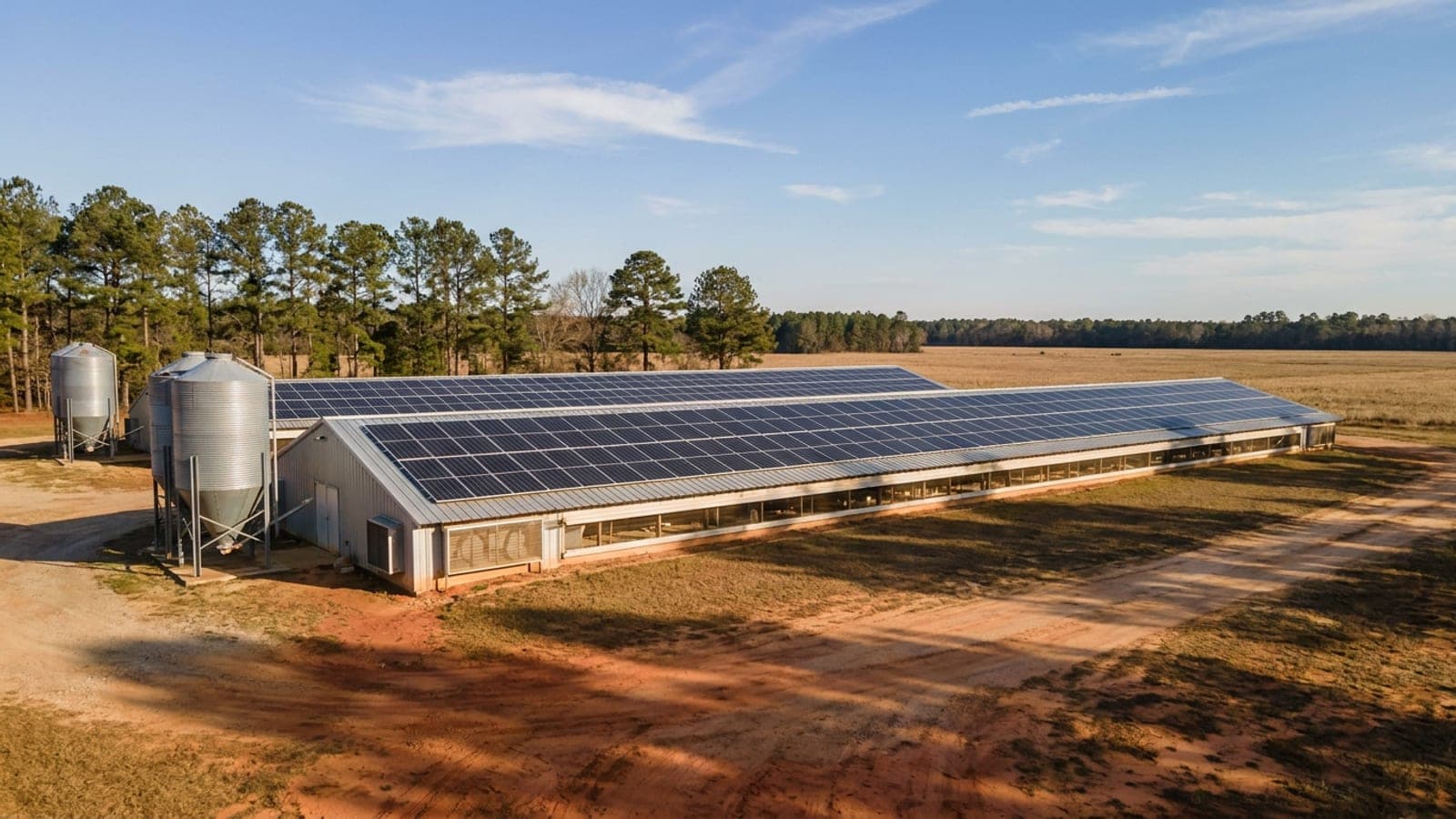
The REAP grant scoring criteria are public, precise and mostly ignored until an application is already written. They are set out in 7 CFR 4280.121, which gives a renewable energy system application a maximum score of 100 points spread across seven categories, and they reward decisions that are made when a solar system is sized, long before the forms are filled in. With USDA rewriting the program regulation after rescinding the 2025 to 2027 funding notice in April, the current scoring rule is the clearest statement available of what the agency has valued, and the best guide to how to design a project for the next window.
The largest category is energy. Up to 25 points go to the energy a project generates, replaces or saves, split two ways. Ten points depend on quantity per grant dollar, with the full ten awarded at 50,000 BTUs of average annual energy generated or replaced per dollar requested, and a proportional share below that. Fifteen points depend on the share of the site's historical energy use the system replaces: more than 50 percent earns 15, more than 25 percent and up to 50 percent earns 10, and 25 percent or less earns 5.
How does sizing change a REAP score?
The replacement band is where a design decision turns into points. A system that covers just over half of a farm's annual consumption earns the full 15. A system sized to cover a third earns 10. And the rule sets a ceiling: a project that would produce more than 150 percent of the site's historical use is scored as an energy generation project instead, which carries a fixed 10 points rather than the 15 available for replacement. The best-scoring band therefore runs from roughly half of annual use to one and a half times it.
Simple payback is the second category that sizing decides, worth another 15 points. A renewable energy system with a payback under 10 years earns the full 15, 10 to 15 years earns 10, 15 to 25 years earns 5, and beyond 25 years nothing. Payback here is project cost divided by annual energy savings, before the grant. A roof with good orientation on a site with a heavy bill pays back faster than a ground mount on a site with a light one, and the score follows.
The size of the request adds a tenth category. A renewable energy system application asking for $250,000 or less is eligible for 10 additional points, which is why the maximum is 100 for smaller requests and 90 for larger ones. For many single-site farm projects that threshold is reachable, and the ten points are worth the arithmetic.
What the rest of the 100 points reward
Commitment of funds is worth up to 15. An applicant with written commitments for 100 percent of the matching funds earns all 15, one with commitments for between 50 and 100 percent earns a proportional share, and one at 50 percent or less earns nothing. A signed loan commitment or a bank letter is worth points as well as certainty.
Previous grantees and borrowers is worth 15 for an applicant that has never received a REAP grant or guaranteed loan, 5 for one that has not received one in the previous two fiscal years, and nothing for one that has. First-time applicants start with a 15-point head start over repeat ones.
Environmental benefits carry up to 5 points, awarded as 1, 3 or 5 for positive effects in one, two or all three of resource conservation, public health and the environment. Being an existing agricultural producer or rural small business is worth 5. And the state director and the administrator hold up to 10 discretionary points between them for priorities such as under-represented technologies, geographic diversity, under-served populations, disaster areas and areas of persistent poverty or economic decline.
What this means for a farm or rural business in the Southeast
Read as a design brief, the rule says: size the system to replace more than half of the site's annual use and less than one and a half times it, keep the request at or under $250,000 where the project allows, line up the matching funds in writing before filing, and document the payback from twelve months of real bills. A poultry operation that has never applied, with a system in that band on a roof that pays back inside ten years and funds committed, can reach 75 points before environmental benefits and the state director's points are counted. Where the funding line falls varies by state and by year, but a file built that way leaves very little on the table.
The window is closed while USDA rewrites the regulation, as we reported in what to prepare while USDA rewrites the REAP rules, and the new rule may move the weights. The questions behind the points are unlikely to change. How much energy the system replaces, how fast it pays back and how much of the money is real are the questions any scoring system for this program has to ask, and a project engineered to answer them well will score under the next rule too.
How we design to the score
Our solar for poultry farms work, over 4.8 MW installed, has followed the replacement band for years: the sizing we describe in what 4.8 MW of poultry solar taught us lands between 26 and 35 kW per house because that is where a system covers most of a complex's consumption without tipping into generation. The 210 kW system across six breeder houses is a typical example of a project scoped to the site's bills rather than to its roof area.
The scoring document itself is described section by section in our REAP application guide, and the program's terms, as they have run in past cycles, on our REAP grant for solar page. A grant reduces the basis on which the federal tax credit and depreciation are calculated, so the payback figure in the application and the after-tax figure on the owner's return are different numbers; we set out that interaction in Section 179 solar depreciation, and the arithmetic belongs to the owner's accountant. A grant is competitive and is never assured.
If you run a farm or a rural business in Georgia, Florida or the Carolinas and want to know what your site would score under the current rule, send us twelve months of utility bills. We will size a system inside the replacement band, calculate the payback and the energy per grant dollar, and give you the points before the window opens.