
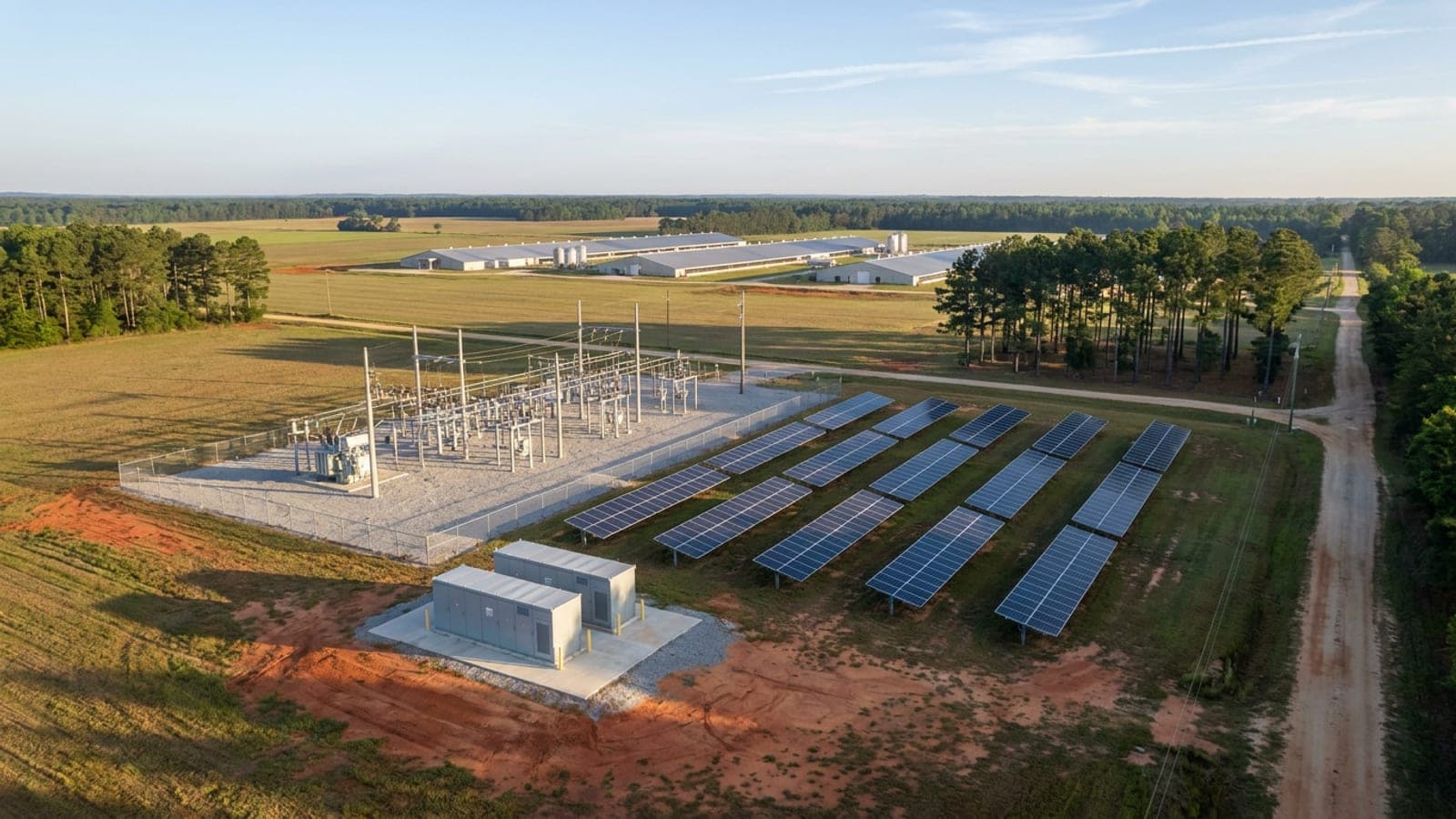
The USDA PART Energy Program loans opened to letters of interest on September 8, 2026, and the window closes on October 9. The Rural Utilities Service, a Rural Development agency of the U.S. Department of Agriculture, published its notice of funding opportunity for the Powering Affordable Reliable Technology Energy Program in the Federal Register on August 4, 2026, soliciting letters of interest for fiscal year 2026 loans under docket RUS-26-ELECTRIC-0232. According to GovMarketNews's report on the program, $410 million is available in loans of $1 million to $100 million per project, covering up to 75 percent of total project costs, with a portion of each loan forgivable.
The list of what the money can build is the reason a business owner in rural Georgia or the Carolinas should read past the headline. The report names renewable energy infrastructure, energy storage systems, microgrids, power lines, transformers and grid modernization, and it names for-profit organizations among the eligible applicants, alongside state and local governments, tribes, nonprofits, electric cooperatives and certificated utilities.
What is the PART Energy Program?
It is a loan program run by the Rural Utilities Service, the same agency that has financed rural electric cooperatives for decades under 7 U.S.C. 901, the statute the Federal Register notice cites. The notice itself is short: it announces that the agency is soliciting letters of interest, sets out the application process and deadlines, and points to the full notice of funding opportunity on the agency website and grants.gov. It also carries a line worth noting for anyone planning ahead: in future years this opportunity will be announced only on the agency website and on grants.gov, without a Federal Register notice.
The terms reported for this round are a $1 million floor and a $100 million ceiling per project, a loan covering up to 75 percent of total cost with the recipient supplying 25 percent in cash or equity, and, for operating utilities, system loans of up to 100 percent where the agency finds that feasible. Once a letter of interest is accepted, the applicant receives an invitation to proceed and has 60 days to file the full application.
Is this the same as a REAP grant?
No, and the difference is the useful part. The USDA REAP grant for solar is the program most farm and rural small-business owners already know: grants and guaranteed loans for projects at the scale of a poultry complex roof or a rural plant, with an application we have walked through in our REAP application guide. PART sits above it. The $1 million floor rules out the typical single-farm array and rules in the projects that a growing rural facility, a cooperative or a group of operations might build together: storage sized for a substation, a microgrid around a processing plant, generation and grid work that improve reliability for a whole feeder.
A 450 kW rooftop on a broiler farm is REAP territory, and what three installed poultry systems cost and produced shows the scale that program is written for. A multi-megawatt storage and generation project serving a rural industrial site, or a cooperative building storage and microgrid capability for its members, is the kind of work the PART list describes.
What this means for a facility in the Southeast
Rural does not mean small in the Southeast. Poultry complexes, food processing plants, distribution centers off the interstate and the cooperatives that serve them carry loads that run into the megawatts, and they sit in exactly the counties this program is written for. Two routes are open. A for-profit company with a rural project large enough to clear the floor can file its own letter of interest. A business served by an electric membership cooperative can raise the project with the cooperative, since distribution and generation-and-transmission cooperatives are on the eligible list and a storage or microgrid project that improves reliability on a feeder serves both the cooperative and the member.
Either way the constraint is the same. These are loans, awarded competitively by the agency under its own criteria, and a letter of interest is a first step rather than an approval. The financial sections belong to the applicant and its lender. The technical sections are where a project is won or lost on paper, and they are the part that can be started today.
The reliability angle is not incidental. A rural facility that loses power in a storm loses production, and the commercial microgrid installation and commercial battery storage work we do is built around keeping defined critical loads running when the grid does not. Those are the project types the program names, and they are the ones a lender understands once the load data is on the table.
How we support a letter of interest
We prepare the technical package: the load analysis from interval data, the generation and storage sizing, the interconnection detail and single-line diagram, the microgrid design where one applies, and an energy estimate that a reviewer can check. That is the same discipline we bring to a REAP application, applied at a larger scale. Our solar for poultry farms work and the 1.2 MW of ground-mount solar we built across four Georgia Power sites are the two ends of the size range this program spans, and the engineering is the same at both.
The window is one month wide. If your facility or your cooperative has a rural energy, storage or microgrid project in mind, send us twelve months of utility bills and any interval data you have, and we will tell you within days whether the project is PART-sized, REAP-sized or both, and what the technical package for a letter of interest would contain.