
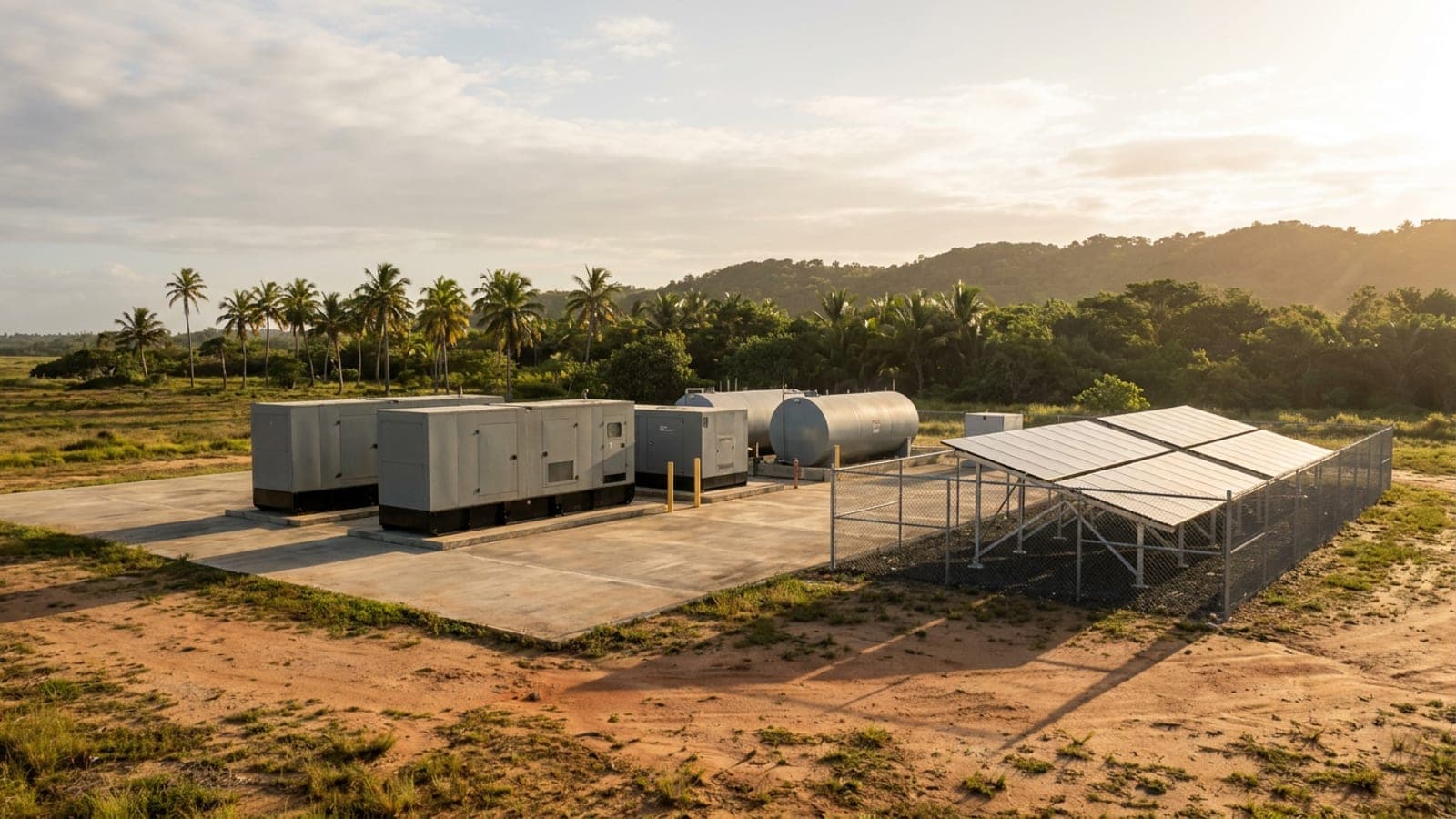
The microgrid runtime for critical loads at a US Army post in Puerto Rico has been set at 14 days, and that number is worth more to a hotel or a port operator than the dollar figure attached to it. According to a September 1 report by MGRID, the U.S. Army Corps of Engineers awarded a $45,001,324 contract on August 20, 2026 for a microgrid at Fort Buchanan in Guaynabo, the only Army installation in the Caribbean. The system must sustain the base's critical operations for 14 days without the commercial grid. Four firms bid, and the award came in about $7 million under the Army's 2025 estimate of $52 million.
The reason for 14 days is not abstract. Hurricane Maria left parts of Puerto Rico dark for months in 2017, and the Army wrote its requirement against that memory rather than against a typical outage.
What is inside a 14-day microgrid?
The design is a mix, and the mix is the lesson. The contract adds 8 MW of new diesel generation and integrates what the post already owns: a 4.65 MW solar array and two 275 kW wind turbines. Fuel is stored in twelve above-ground, ballistic-resistant tanks of 12,000 gallons each, 144,000 gallons in total, with a fuel polishing system so that diesel sitting for months is still usable when the day comes. A 4 MWh battery is listed as an option outside the base scope. Completion is due by October 5, 2029, which the report notes is three to four hurricane seasons away.
Read that list as an engineer would. Solar and wind carry the daytime and reduce the fuel burned. Generators carry the load when the weather does not cooperate and through the night. Fuel storage sets the duration. A battery, if added, smooths the transitions and covers the seconds a generator needs to start. Each element is there for a specific job, and none of them is asked to do the others' work.
How long should a commercial microgrid run?
Almost no business needs 14 days, and the Army's number should not become anyone else's default. What transfers from Fort Buchanan is the order of the questions, not the answer.
The first question is which loads are critical, drawn as a list and then cut in half. On a resort it is usually the property management system, refrigeration, life safety and some fraction of the guest rooms rather than the whole building. On a poultry operation it is ventilation. On a port it is cranes, lighting and communications. The second question is how long those loads must run, measured against your utility's actual restoration history rather than a guess. The third is which sources cover which hours, which is where solar, storage and a generator each earn their place. We set out that comparison in microgrid, generator or battery, and the way the answers drive the budget in what a commercial microgrid costs.
What this means for a facility in the Southeast and the Caribbean
The Army's fuel arithmetic is the part most commercial buyers skip. Fourteen days of generation for a base needs 144,000 gallons and a system to keep it fresh. A business that writes "72 hours" into a specification without checking what fuel delivery looks like in the week after a storm is designing for a shorter event than it thinks. Solar on the roof changes that arithmetic directly, because every daytime kilowatt-hour from the array is a gallon that stays in the tank for the night.
In the Caribbean the case is sharper. Island grids take longer to restore, fuel arrives by sea, and a property that can island its critical loads keeps trading while its neighbors wait. That is the premise behind our work on commercial solar installation in the Caribbean, including the 451.5 kW system for the Virgin Islands Port Authority on St. Thomas. On the mainland the same logic applies to any hotel or resort on the Florida or Georgia coast that has watched a storm season take a week of bookings.
How we design for runtime
We start from interval data and a walk of the electrical rooms, not from a product list. The critical-load panel is drawn first, because trying to island an entire facility is how microgrid budgets get away from their owners. Then we size storage for the transitions and for the demand peaks it can earn against on ordinary days, size the array for the daytime load, and only then decide whether a generator belongs in the design and how much fuel it needs. Our commercial microgrid installation work follows that sequence, and our BatteryCube® cabinets are built for the outdoor pad next to the transformers where an islanded system's storage usually sits.
The Army bought 14 days because it must operate through the worst week Puerto Rico has seen. Your number will be smaller, and it should be yours, derived from your loads and your utility. If you want it worked out, send us twelve months of utility bills and any interval data you have, and we will tell you how many hours your critical loads actually need and what it takes to cover them.