
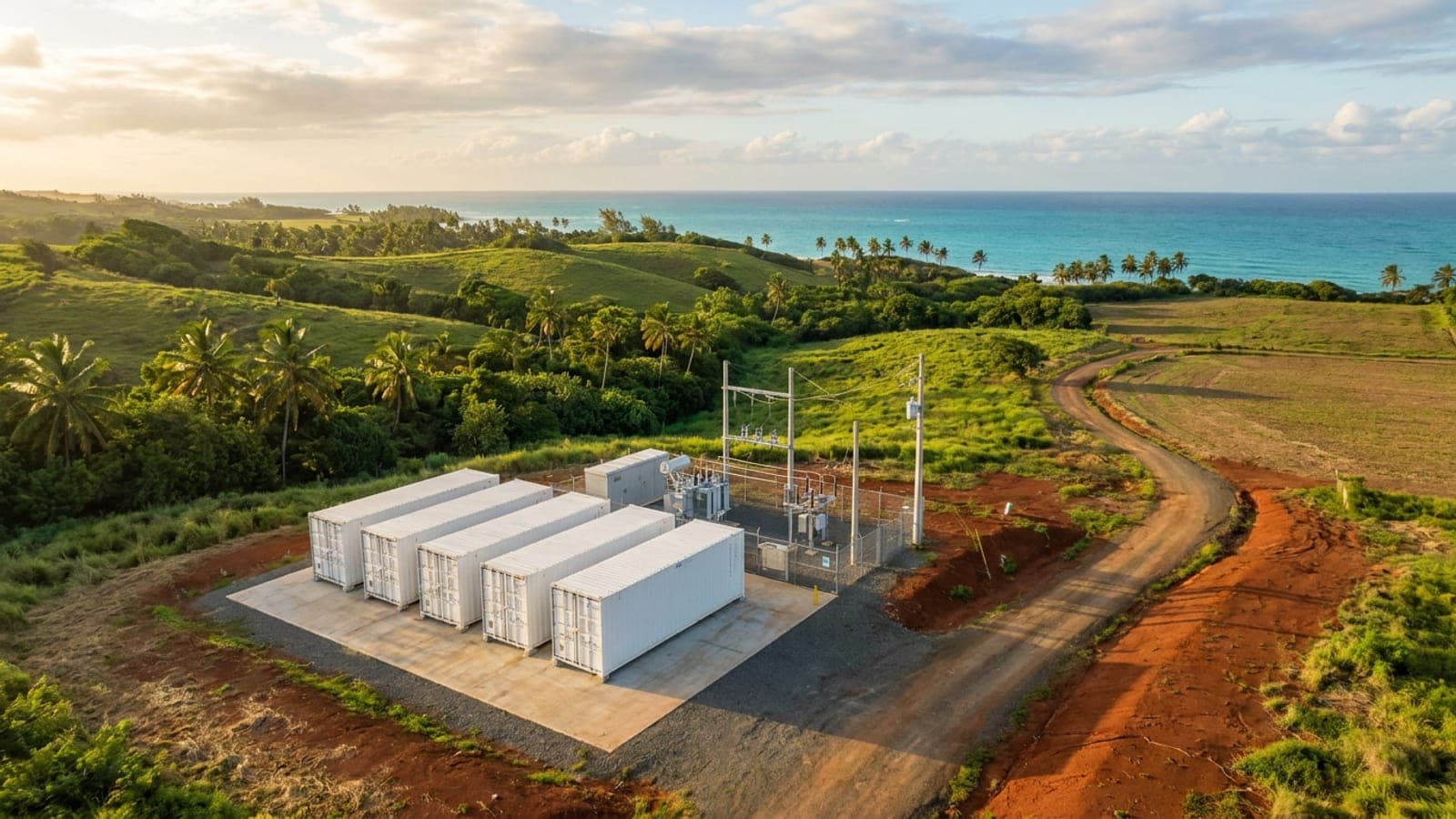
The Puerto Rico battery storage loan that the U.S. Department of Energy closed on August 5, 2026 is worth reading for what it prices as much as for what it builds. The Office of Energy Dominance Financing lent $489.4 million to finance 220 MW of battery energy storage at Arecibo and Santa Isabel, built with American-manufactured batteries. The department expects the two sites to save Puerto Rican families and businesses about $312.5 million on electricity over 25 years and to provide backup power to more than 100,000 customers, avoiding roughly 13 million customer interruption hours a year based on 2025 data. That last figure is the interesting one, because it is reliability expressed as a number, and reliability is what every island business is buying when it puts a battery behind its own meter.
What is in the loan?
The facts come from the department's own announcement. Two battery sites, 220 MW between them, financed by a federal loan rather than a grant, to a developer that operates on the island. EDF Director Gregory A. Beard said the investment "will strengthen Puerto Rico's electric grid, lower electricity costs, support American manufacturing." The announcement also describes a pathway for future dispatchable natural gas generation to support grid stability, which tells you the department sees storage as the near-term fix and firm generation as the longer one.
The trade outlet mGrid noted a change from the conditional commitment announced in January 2025, which had covered 180 MW of storage plus a 70 MW solar plant. The closed loan covers storage only, and the announcement does not explain the difference. Storage does not add generation; it moves energy in time. On a grid with frequent interruptions, that is the capability the utility needs first, and the federal lender agreed.
Why does a mainland lender care about island batteries?
Because the arithmetic on an island is unusually clear. Generation is expensive, the grid is exposed to weather, and every hour a customer is without power has a cost that can be counted. Thirteen million customer interruption hours a year is the kind of number that turns a battery from an energy asset into an insurance policy with a stated premium and a stated payout.
That is the same reasoning we walk a resort operator or a port authority through, at a smaller scale, when we size a system for them. The value of a commercial battery on an island has three parts: the demand charge it shaves on an ordinary day, the energy it shifts where the tariff rewards that, and the loads it keeps alive when the grid goes down. The third part is not payback in the usual sense. It is the cost of an evening without air conditioning in a full hotel, or of a refrigerated container that cannot wait, and on an island it is the part that usually decides the project.
What does this mean for a resort, a port or a plant in the Caribbean?
It means the direction of public money confirms what private buyers on the islands already knew: flexibility is worth paying for. A more reliable Puerto Rico grid is good news for everyone connected to it, and the loan's projected savings will show up over decades in system costs. It does not change the reliability of the feeder that serves one particular hotel next hurricane season. A facility that wants power on its own schedule still has to own the equipment that provides it.
We have built that equipment across the region. Our commercial solar installation in the Caribbean page sets out how island projects differ from mainland ones, from salt-air corrosion to shipping logistics. The 800 kW system at the Westin Dawn Beach Resort in St. Maarten and the 451 kW ground mount for the Virgin Islands Port Authority are the two largest, and both were designed around the reality that grid power on an island is neither cheap nor guaranteed.
The battery side is where the Puerto Rico announcement and a private project meet. Our BatteryCube® commercial battery energy storage system is built around CATL cells in outdoor cabinets, and 55,000 lb of it runs today beside our largest solar array in Georgia. For a site that cannot go dark, the same cabinets become the core of a commercial microgrid that islands itself from the utility and carries the loads you choose. For a site whose problem is the monthly peak rather than outages, commercial battery storage installation on its own is often the right size of answer.
How do you size resilience instead of guessing at it?
The federal lender priced reliability from interruption data. A facility does the same thing from its own records. Twelve months of bills show the demand charge and any time-of-use spread. Interval data, where the utility will release it, shows how tall the peaks are and how long they last. An outage log, even a rough one, shows how many hours a year the site was without power and what each hour cost in refunds, spoiled stock or idle staff.
From those three inputs a battery can be sized honestly: enough capacity to carry the critical loads for the outage duration the site actually experiences, enough power to shave the peaks that drive the bill, and solar on the roof to recharge it during the day. Oversizing is expensive and undersizing is disappointing, and the data is what keeps a design between the two.
If your facility is on an island, or on a mainland feeder that behaves like one, send us those records through our proposal request form. We will come back with a system size, an installed cost, the incentives that apply, and a plain statement of what the equipment will and will not do during the next long outage.