
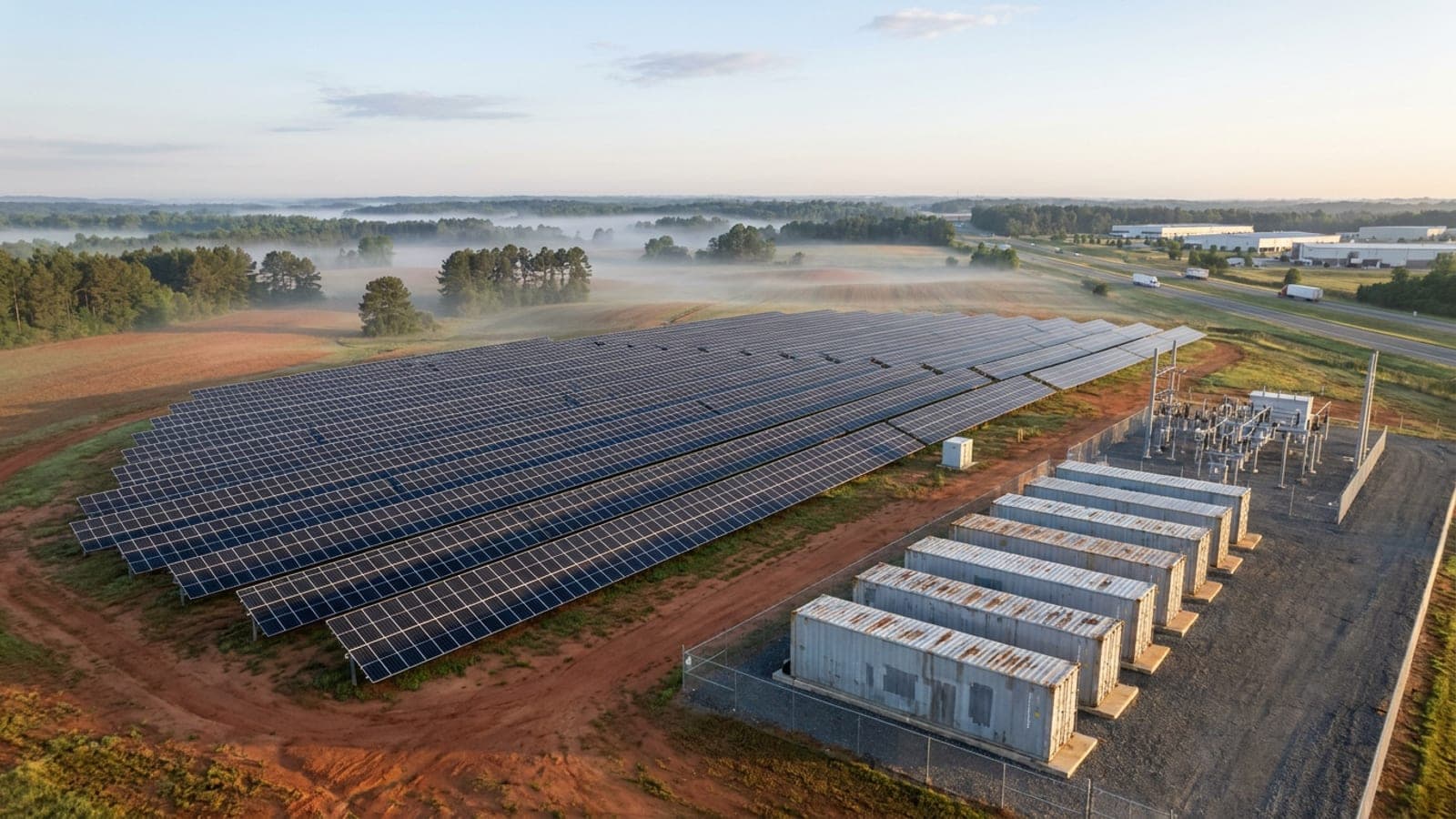
The Duke Energy Carolinas resource plan filed in August 2026 is the longest look ahead a business in North or South Carolina will get at the grid it buys power from. According to Duke Energy's August 17 release, the 2026 Carolinas Resource Plan went to the Public Service Commission of South Carolina, which plans a hearing in April 2027 and an order by June 2027. Industrial Info Resources reports the targets by 2041: about 18.5 GW of solar, roughly 13 GW of battery storage, 8.2 GW of combined-cycle gas, 5.8 GW of combustion turbines, 4.5 GW of nuclear and 300 MW of onshore wind. Behind those numbers sits a five-year, company-wide capital plan of about $103 billion for 2026 to 2030, which Duke describes as more than $1 billion a month.
The plan is a utility document about utility-scale plants, and its effects on a commercial bill will arrive through rate cases and interconnection queues over many years. What it says today is nonetheless useful, because a utility that plans 13 GW of batteries has done the arithmetic on what flexibility is worth.
What the plan builds, and when
Duke frames the filing as continuity. Tim Pearson, the company's South Carolina president, said in the release that "we've made significant progress executing the strategy outlined in previous resource plans" and that the updated plan "details the additional actions we need to take now." The concrete items the release lists are already moving: a 1,400 MW combined-cycle plant approved for Anderson County, turbine supply agreements with deliveries beginning from a Greenville facility, a request for proposals for 400 MW of standalone battery storage in South Carolina, and active procurement and construction of solar, including RFPs for solar paired with storage.
The filing is aligned with South Carolina's 2025 Energy Security Act, and the company points to more than $5 billion in cumulative cost-saving benefits it attributes to the completion of its merger and to tax credit optimization, plus potential customer savings from federal loan applications. Nuclear appears both as license renewals and uprates at existing plants and as two sites under evaluation for new units, in Cherokee County, South Carolina and Stokes County, North Carolina.
Industrial Info Resources, which tracks projects rather than plans, notes that of the $33 billion of Carolinas projects it follows, most are still pre-construction, and that publicly tracked solar and storage activity in the two states is so far sparse relative to the targets. In other words, the 18.5 GW and the 13 GW are a direction, not a construction schedule.
Why 13 GW of batteries is the number to notice
Solar at 18.5 GW is the headline, and it makes sense in a region with the load growth Duke describes: the company says the Carolinas continue to rank among the fastest-growing states in the country. The storage figure is the more telling one for a commercial customer. A utility adds batteries for one reason: they let it meet peaks without building generation that runs only a few hundred hours a year. Every megawatt of storage in the plan is a statement that shifting energy in time is cheaper than producing it at the moment of peak demand.
That is exactly the calculation a facility makes when it looks at its own demand charge. The utility's peak and a plant's peak are set by the same physics and priced by the same tariff logic. The difference is scale, and who owns the battery. On the utility side the value shows up, eventually, as system costs spread across all customers. On the customer side it shows up next month, on the demand charge line, for the facility that installed it.
What a Carolina business can take from it now
Three things, none of which require waiting for the June 2027 order.
First, the direction of the grid in both states is toward more solar, more storage and more firm generation, all of which cost money that rate cases will eventually recover. We wrote recently about the Duke Energy Progress settlement in North Carolina and the Pee Dee appeal in South Carolina; this plan is the long-run version of the same story. Our pages on commercial solar installation in North Carolina and commercial solar installation in South Carolina cover the utilities, the interconnection procedures and the incentives that apply in each state.
Second, the flexibility the utility is buying at grid scale is available at facility scale, and it is available now. A battery sized from a plant's interval data discharges into its highest peaks so the billed demand is shaped by the battery rather than by the raw draw of the production floor. Our page on commercial battery storage installation explains the sizing, and our own BatteryCube® commercial battery energy storage system, built around CATL cells, is the equipment we use to do it; 55,000 lb of it runs beside our largest solar array today. Whether a battery pays for itself on a given rate schedule is a question our article on commercial battery storage payback shows how to answer from the bill itself.
Third, for a site that cannot go dark, the same battery becomes the core of a commercial microgrid that islands from the utility and carries the loads you choose. The resource plan is, among other things, a fifteen-year construction program on the grid around you, and a facility with its own islandable supply is indifferent to most of what that program does to a feeder on any given afternoon.
What to do before the Commission rules
Pull twelve months of Duke Energy bills and the interval data behind them. Find the demand charge and add up a year of it; that is the ceiling on what a battery can save. Find the energy charge and do the same; that is what solar addresses. Send both through our proposal request form and we will come back with a system size, an installed cost, the incentives that apply and a payback range, with the usual note that tax credits are claimed on your return and validated by your accountant. If the numbers on your schedule do not work, we will say so plainly, and you will still know more about your own peak than the plan will ever tell you.