
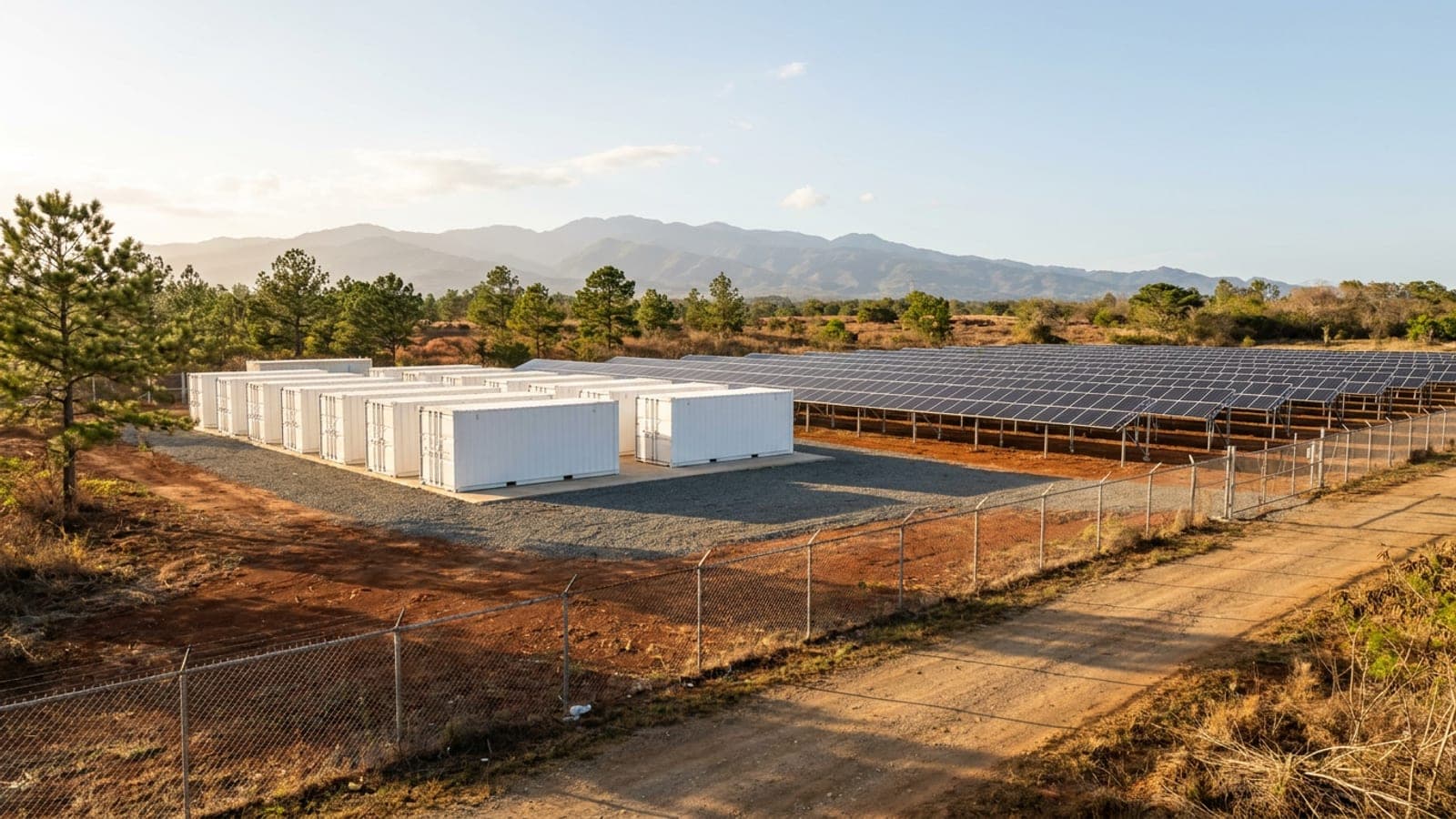
Puerto Rico utility-scale battery storage has moved from plan to hardware. LUMA announced on September 4 that the Jobos solar and battery energy storage project in Guayama, on the island's south coast, has been energized. The project pairs 80 MW of solar generation with a battery rated at 110 MW and 440 MWh, a four-hour system, and LUMA describes it as Puerto Rico's first utility-scale battery storage project. Testing is under way and commercial operation is targeted for the fourth quarter of 2026.
LUMA operates the transmission and distribution system the plant connects to; the generation and storage were built by a utility-scale developer. The announcement describes the battery's job in plain terms: store the solar energy produced during the day and deliver it in the evening peak, and in doing so reduce the load shedding that occurs when available generation cannot cover demand. LUMA puts the supported consumption at roughly 25,000 homes, rising to about 40,000 at midday.
What does a four-hour battery change for Puerto Rico's grid?
The island's shortfalls have often been generation shortfalls, hours in which demand exceeded what the plants could deliver, and a battery that shifts four hours of afternoon solar into the evening addresses that hour by hour. Esther Serra, LUMA's Senior Director of Renewable Energy Projects, is quoted in the announcement: "This new capacity helps ensure available generation can be transmitted reliably, strengthening operational stability."
The design choice worth noticing is the ratio. The battery's 110 MW is larger than the 80 MW solar plant beside it, and its 440 MWh means it can discharge at full power for four hours. That is a system built to move energy across the day rather than to smooth a few minutes of cloud, and it is the same logic, at a different scale, that governs a commercial storage project.
What this means for a business on an island grid
A utility battery reduces one kind of outage. It does not reach the others. A feeder taken down by wind, a substation fault, a line lost in a storm, none of these are solved by capacity at Guayama, and a hotel, a port or a cold-storage facility that must keep operating through them still needs generation and storage on its own side of the meter. What the utility battery does is make the grid a steadier partner for that system: fewer generation-driven interruptions to ride through, and a cleaner evening profile to plan around.
The economics that make storage worthwhile for the island utility apply on a smaller scale to its commercial customers. Electricity produced on a roof at midday is worth most when it is used in the evening, and a battery sized to the site's critical loads, recharged daily by the array, turns a solar system into a resilience asset. We set out how we specify that combination in our page on commercial microgrid installation, what sets the price in what drives the cost of a commercial microgrid, and the way runtime is calculated from critical loads rather than from the whole property in commercial battery storage installations.
Financing has been moving as well. We reported in late August on a Puerto Rico battery storage loan for island resilience, and the arrival of the first utility-scale system is the other half of that picture.
What we have built in the Caribbean
Our island work goes back to the fuel economics that made solar pay in the Caribbean before it paid on the mainland. The 800 kW rooftop system at the Westin Dawn Beach Resort and Spa in St. Maarten remains our largest island installation, and the 451.5 kW ground-mounted array for the Virgin Islands Port Authority in St. Thomas was built for a facility that cannot close when the weather turns. Both were engineered for hurricane wind loads, and both are described on our commercial solar installation in the Caribbean page.
What has changed since those projects is storage. BatteryCube®, our own line of pad-mounted cabinets built around CATL cells, lets us give a resort or a port the same daytime-to-evening shift the Jobos battery gives the island, sized to the circuits that matter. For hotels in particular, the case is set out in solar for hotels and resorts, where guest comfort during an outage is a revenue question as much as a safety one.
If you operate a property in Puerto Rico, the Virgin Islands or elsewhere in the Caribbean and want to know what four hours of storage would mean for your own site, send us twelve months of utility bills and a list of the loads that must stay on. We will size the array and the battery to those loads and show you the runtime, the savings and the cost side by side.