
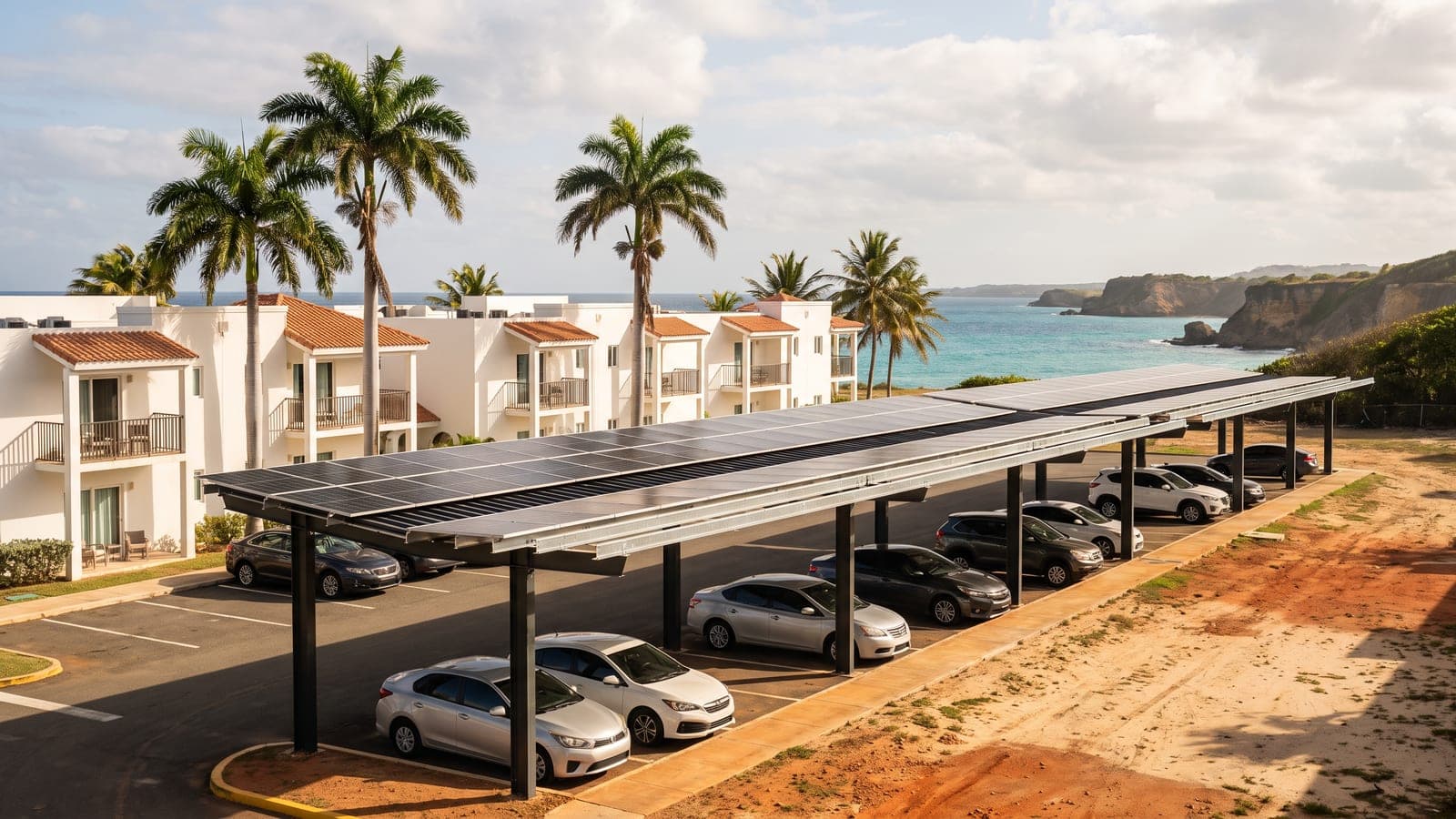
A hotel solar carport in Puerto Rico is taking shape over the parking lots of two Aguadilla properties. El Nuevo Día reported on September 5, 2026 that the renewable energy project serving the Courtyard by Marriott and the Punta Borinquen hotels, on the island's northwest coast, is 40 percent complete: 2,805 solar panels on carport-style structures, 1.26 MW in total, with completion projected for February 2027. The first phase is already producing savings on the electricity bill, the newspaper reports, and the hotel operator changed its installation method to speed up the remaining work.
Two things about the project are worth a hotel owner's attention anywhere in the Southeast or the Caribbean. The first is where the panels went. The second is who is building them.
Why is the parking lot often a hotel's best roof?
Hotel roofs are difficult real estate. Air handling units, elevator machine rooms, pool and laundry equipment, pitched sections, parapets and the setbacks the fire code requires leave far less clear, structurally simple area than a warehouse of the same footprint. A parking lot is flat, unshaded and frequently larger than the building it serves. A carport structure turns it into a high, clean racking surface, shades the cars, which guests notice in a Caribbean summer, and keeps the electrical work away from roof penetrations and guest floors.
The Aguadilla project puts 1.26 MW over parking that would otherwise produce nothing. For scale, our largest island installation is the 800 kW rooftop system at the Westin Dawn Beach Resort and Spa in St. Maarten, and a limited-service property such as the Homewood Suites in Savannah carries 23 kW. Two hotels sharing 1.26 MW sit at the upper end of what a pair of properties consumes, which suggests a full-service load with restaurants, laundry and pools running around the clock.
What this means for a hotel or resort in the Southeast
The economics that make the Aguadilla project work are the ones every island and coastal hotel shares: a high tariff, a load that runs day and night, and a guest experience that depends on power staying on. We set them out for the sector in solar for hotels and resorts, and the island specifics, from hurricane wind loads to the cost of imported fuel, in commercial solar installation in the Caribbean.
The half of the design the newspaper does not mention is storage. A grid-tied array, on a roof or a carport, shuts down when the grid drops, whatever its size. What keeps a hotel operating through an outage is a battery sized to the loads that cannot stop, kitchens and refrigeration, communications, water pumps, a share of the guest floors, recharged from the array each day. On Puerto Rico's grid, where the first utility-scale battery only came online this month, as we reported in Puerto Rico's first utility-scale battery storage, that resilience sits with the property. For a hotel the value is measured in room nights kept, and it belongs in the same drawing set as the panels; the arithmetic is in when commercial battery storage pays off.
The second lesson is procurement. The Aguadilla operator is running the project itself and adjusted its method mid-way to move faster, which is what an owner who understands the schedule does. A hotel that hands the whole job to one engineering, procurement and construction contractor gets the same control with less of the management, provided the contractor has built on a hospitality site before and knows what a guest-facing construction schedule allows.
How we build for hotels
Our hospitality work runs from the Westin in St. Maarten to franchise hotels in Georgia, and every project starts with the same two questions: which surface, roof or parking, gives the cleaner array, and which loads must stay on when the grid does not. We deliver the array, the battery storage, the islanding controls and the interconnection under one commercial solar EPC contract, with construction sequenced around occupancy so guests never see a closed lot or a dark corridor.
If you own or operate a hotel in Florida, Georgia, the Carolinas or the Caribbean, send us twelve months of utility bills and a site plan. We will tell you whether the roof or the parking is your better array, how much storage the property needs to stay open through an outage, and what the combination does to the bill.