
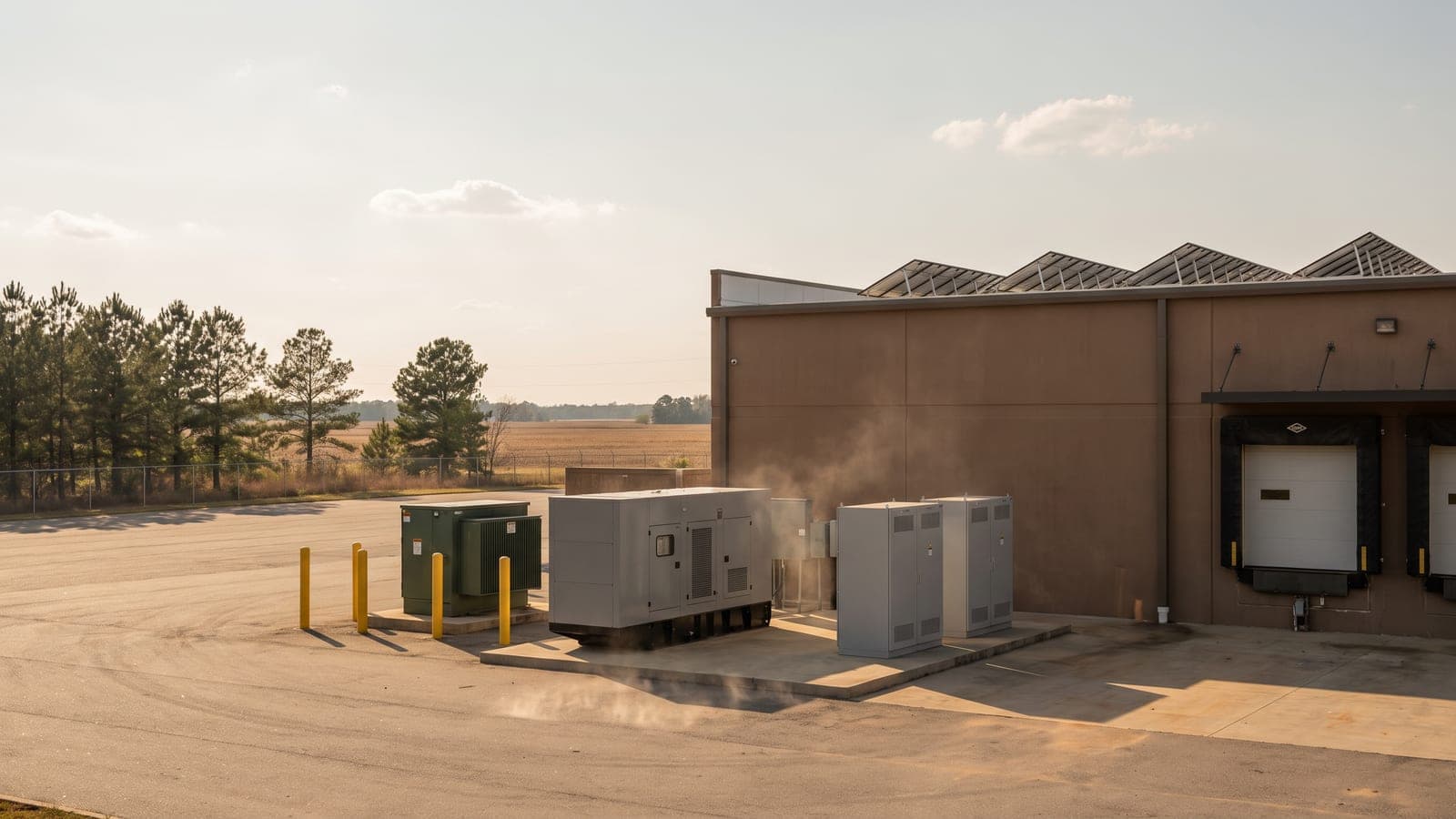
The DOE emergency order for Duke Energy Carolinas over Labor Day weekend said something new about how the Carolinas grid will be run in a heat wave: the backup generators and batteries on the customer side of the meter are now part of the plan. On September 3, 2026 the U.S. Department of Energy issued Order No. 202-26-43 under Section 202(c) of the Federal Power Act, authorizing Duke Energy Carolinas, through September 8, to dispatch specified generating units and to direct backup generation resources to operate as a last resort before or during an Energy Emergency Alert Level 3, the stage at which a utility begins shedding firm load.
The Department's release gave the reason as hot weather that posed blackout risks across the Carolinas. MGRID, reporting on the order the same day, put Duke's forecast peak at about 22,295 MW, with highs near 97°F and a heat index between 100 and 105°F. The Energy Secretary said in the release: "Thanks to this emergency order, Americans will not have to worry about losing access to affordable power this Labor Day weekend."
What did the order let Duke call on?
According to MGRID's reading of the order, the resources Duke could direct to run before load shedding included backup generators at data centers and at large industrial and commercial sites, auxiliary and standby generation, directly connected generation, and battery storage systems. Emissions, operating hours and fuel consumption under the order did not count toward the rolling limits in those facilities' permits, which is the practical barrier that normally keeps a standby generator from running for anything other than an outage or a test.
Some loads were carved out and could not be asked to self-supply: defense and homeland security facilities, first responders and air traffic control, hospitals and 911 centers, water and wastewater plants, and natural gas pipeline infrastructure. Everyone else with a generator or a battery was, for six days, part of the Carolinas' reserve margin.
There is no public record that firm load was shed. The order was precautionary. Its existence is the point.
What this means for a facility in the Carolinas
An Energy Emergency Alert 3 divides customers into two kinds. A facility with no generation or storage of its own is on the list of loads the utility may have to drop. A facility with a generator or a battery is a resource the utility wants to run, and the order put that resource in front of the load shedding rather than behind it. Nothing about the physics changed over Labor Day; what changed is that the arrangement is now written into a federal order, and the next heat wave will start from it.
For a plant, a cold-storage warehouse or a hotel in Duke territory, the question is what stays on if the alert reaches level 3 and the site is not carved out. A commercial microgrid answers it by design: solar and storage sized to the critical loads, islanding controls that separate the site from the grid when the grid drops, and a generator only where the runtime demands one. We set out the trade-offs among the three in microgrid, generator or battery, and how the price of a microgrid is built in what drives the cost of a commercial microgrid.
The same equipment earns its keep when nothing is wrong. Duke's summer peaks are the hours its tariffs price highest, and a battery that discharges into them lowers the demand charge every month, which is the arithmetic in when commercial battery storage pays off. Duke Energy Carolinas' proposed rate increases from January 2027, which we reported in what the Duke Energy Progress settlement means for a North Carolina business, make that arithmetic better, not worse.
How we design for the loads that cannot go dark
Our commercial solar installation in North Carolina and across the Carolinas is engineered by a professional engineer licensed in both states and an electrical contractor holding North Carolina's unlimited classification since 1992. A microgrid starts with a ranked list of the loads a site cannot lose, a battery sized to carry them for the hours that matter and a critical-load panel that separates them from the rest, which is the sequence we describe in microgrid runtime for critical loads. On the 1.267 MW Samsonite and TUMI system in Vidalia, the 55,000 pounds of storage sit beside the utility transformers under the same contract as the roof.
If your facility is in Duke Energy territory, send us twelve months of utility bills and the list of loads that must stay on. We will size the storage to those loads, show you the demand-charge savings on ordinary days, and tell you which side of the next emergency order your site would be on.