
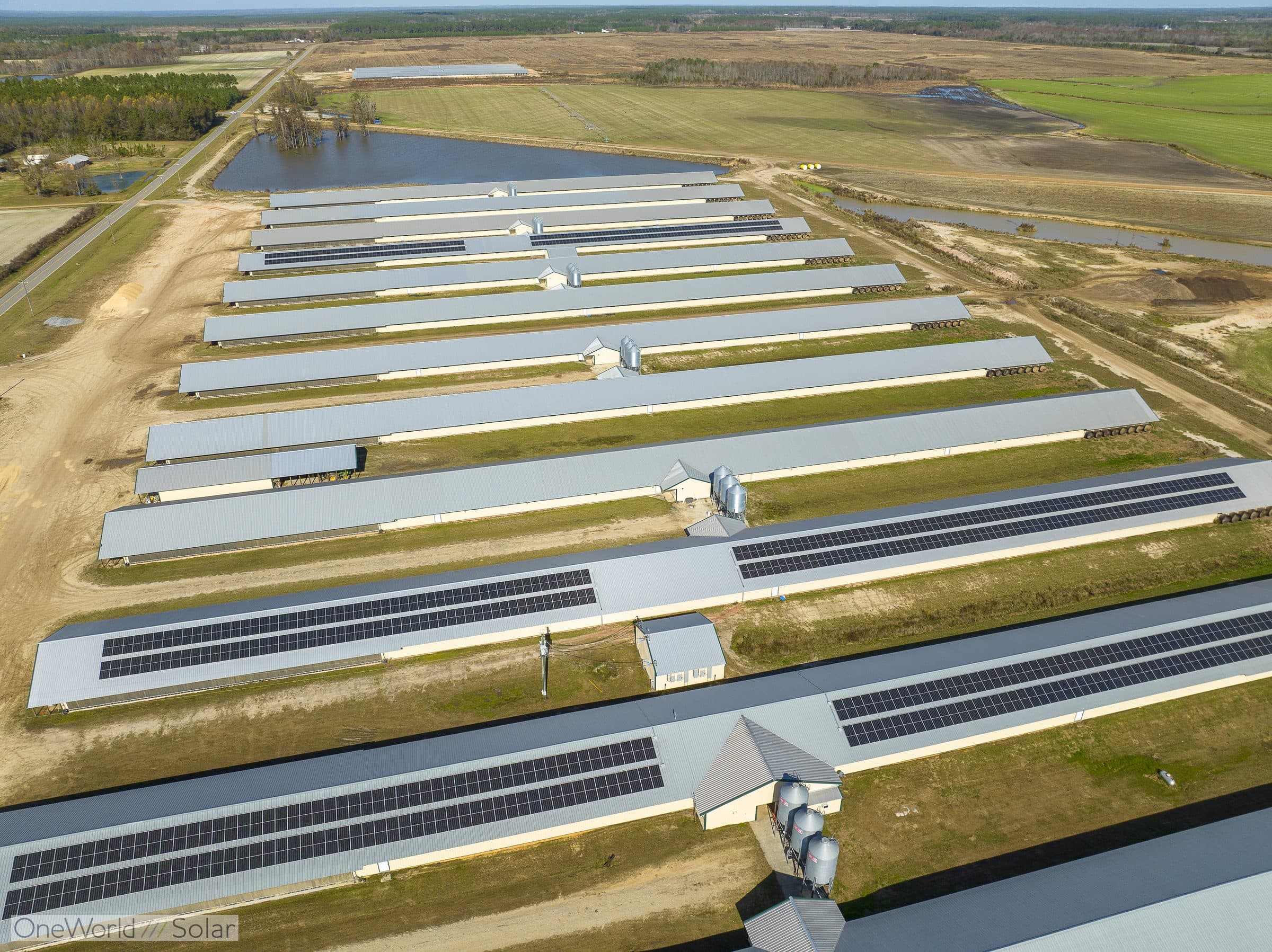
Ask three poultry growers what their neighbors paid for solar and you will get three different answers, all of them true. Poultry farm solar cost does not resolve to a price per house, and the clearest proof of that sits in our own portfolio: three installed Georgia farms whose systems come out at noticeably different kilowatts per house.
OneWorld Solar has installed over 4.8 MW on U.S. poultry houses. Three of those systems are named in our project record, and lining them up next to each other explains more about how to size and price a farm array than any rule of thumb does.
This article is about what we learned building them: what actually drives a grower's power bill, why summer works so well and winter nights do not, how roof condition changes the answer, and what a USDA grant does and does not change. For what the technology does on a farm generally, start with solar panels for poultry farms.
What did three real poultry systems look like?
210 kW
6-house breeder farm
About 35 kW per house — the highest ratio of the three.
450 kW
14-house broiler farm
About 32 kW per house. Our largest poultry site to date.
410 kW
16-house broiler farm
About 26 kW per house, on more houses than the 450 kW farm.
Read those three lines slowly, because the interesting part is easy to miss. The 16-house farm has more houses than the 14-house farm and a smaller array. Per house, the range across the three runs from about 35 kW down to about 26 kW — close to a third of a difference on the same nominal unit.
If kilowatts per house were a constant, solar sizing on a poultry farm would be arithmetic. It is not, and a proposal built on a per-house multiplier is a proposal built on someone else's farm.
Why is kW per house not a constant?
Six things explain most of the spread.
- House size and age. A modern 66 x 600 house is a different electrical animal from a 40 x 400 house built decades earlier. More square footage means more fans, more lighting and more air to move.
- Ventilation and cooling equipment. Tunnel fan count and horsepower is the single biggest driver of a summer bill. Two farms with identical house counts can differ substantially on installed fan capacity, and cool cell pump loads ride on top of that.
- Breeder versus broiler duty. Breeder houses run lighter ventilation but longer and more controlled lighting hours, and the load profile is flatter across the year. Broiler houses swing hard between brooding and grow-out.
- Where you are in the flock cycle. A house half-way through grow-out in July pulls very differently from the same house during brooding in January. Sizing from a single month's bill gets this wrong in both directions.
- Roof orientation and usable area. Houses are laid out for airflow and equipment access, not for the sun. A farm whose houses run north-south gets a different production profile from one running east-west, and vents, ridge caps, fan housings and walkways eat into the usable roof plane.
- Budget and award size. This is the honest one. Sometimes the array is sized by what the roof and the load justify, and sometimes it is sized by what the grower could fund in that year. A farm that covers ten of sixteen roofs is a complete project, not a compromise.
The three projects are documented individually: 210 kW on a 6-house breeder farm, 450 kW on a 14-house broiler farm and 410 kW on a 16-house broiler farm.
What actually drives a poultry farm's power bill?
Four loads account for most of it, and they do not arrive evenly through the year.
Tunnel fans and cool cells dominate summer. On a hot Georgia afternoon a closed house is running fans continuously and pumping water over cool cell pads, and that is the peak the utility bills you on. Brooder heat dominates winter, and on most farms it is propane rather than electricity, which puts it outside what solar can touch. Feed augers and feed line motors run in short, frequent bursts through the day. Well pumps and pressure systems run whenever birds drink, which is daylight-weighted and rises with temperature.
The pattern that matters: your heaviest electrical demand happens in daylight, in summer, on exactly the days a solar array produces most.
Why does summer peak line up so well with solar?
Because both curves are driven by the same thing — heat. The hotter the afternoon, the harder the tunnel fans run and the more the array produces. That correlation is worth more than it sounds, because power you consume on site is worth full retail to you, while power exported to the grid is worth whatever your utility's export arrangement says it is, which is usually less.
A farm that self-consumes most of what it generates has a fundamentally better economic case than a building that exports half its production at midday. This is why poultry houses are one of the better commercial solar hosts in the Southeast, and why so much of our commercial solar installation work in Georgia sits on farms. The same arithmetic holds wherever the houses are: North Carolina is the second-largest poultry state in the country, and commercial solar installation in North Carolina runs into the same ventilation loads and the same REAP eligibility.
What solar will not fix on a poultry farm
Solar does nothing for night-time brooding load. A grid-tied array produces nothing after dark, and winter brooding is both a night load and often a propane load. Any proposal showing a farm at a near-zero power bill year round has either oversized the array or ignored the placement calendar.
What about outages, when ventilation is the whole business?
A summer outage in a closed house is measured in minutes before it is serious, which is why nearly every farm already runs a generator. A grid-tied solar array does not help — it shuts down when the grid does, by design.
What does help is a commercial micro-grid that can island the farm and keep tunnel fans and controllers running on solar and storage. If your standby generator is approaching replacement, comparing that cost against a battery that also shaves daily peaks is a conversation worth having before you buy another diesel.
Does the roof have enough life left?
This is the question that kills more poultry projects than price does, and it should be asked before anything else. An array is a multi-decade asset. Bolting one to a metal roof with under ten years left commits you to paying for removal and reinstallation when the roof is replaced.
On older houses the practical options are re-roofing first, putting the array on the newest houses only, or going to a ground mount on unused ground near the service entrance. All three are legitimate. Pretending the roof is fine is not, and we will say so at the site walk.
How do you build around bird placements?
Carefully, and with your calendar rather than ours. Roof work over an occupied house needs sequencing: we work house by house, schedule the heaviest activity into the down time between flocks, and keep crews and equipment away from the tunnel inlets and cool cell ends when birds are in.
Send us your placement schedule before the construction schedule is written. A poultry solar project is built around the birds; every one that goes badly started with that assumption reversed.
What does a REAP grant change about the payback?
It changes the denominator, not the array. A USDA REAP grant for solar is a competitive, points-based cost-share program that rural agricultural producers may be eligible to apply for. Nobody can promise you an award.
If you receive one, it reduces the capital you put into the project, which shortens the payback on the money you actually spend. As an illustrative example only — not a quote and not a prediction — a project with a simple payback of eight to ten years unassisted might land nearer four to six years once a cost-share award and the federal tax credit are applied. Your own numbers depend on your bills, your rate schedule and what your accountant confirms you can claim.
Our advice to growers is consistent: make the decision on whether the project works without the grant. If it only works with an award nobody can guarantee, you are betting the farm's capital on a scoring committee. Send twelve months of bills and your house count, and we will model both cases before you commit to either.