
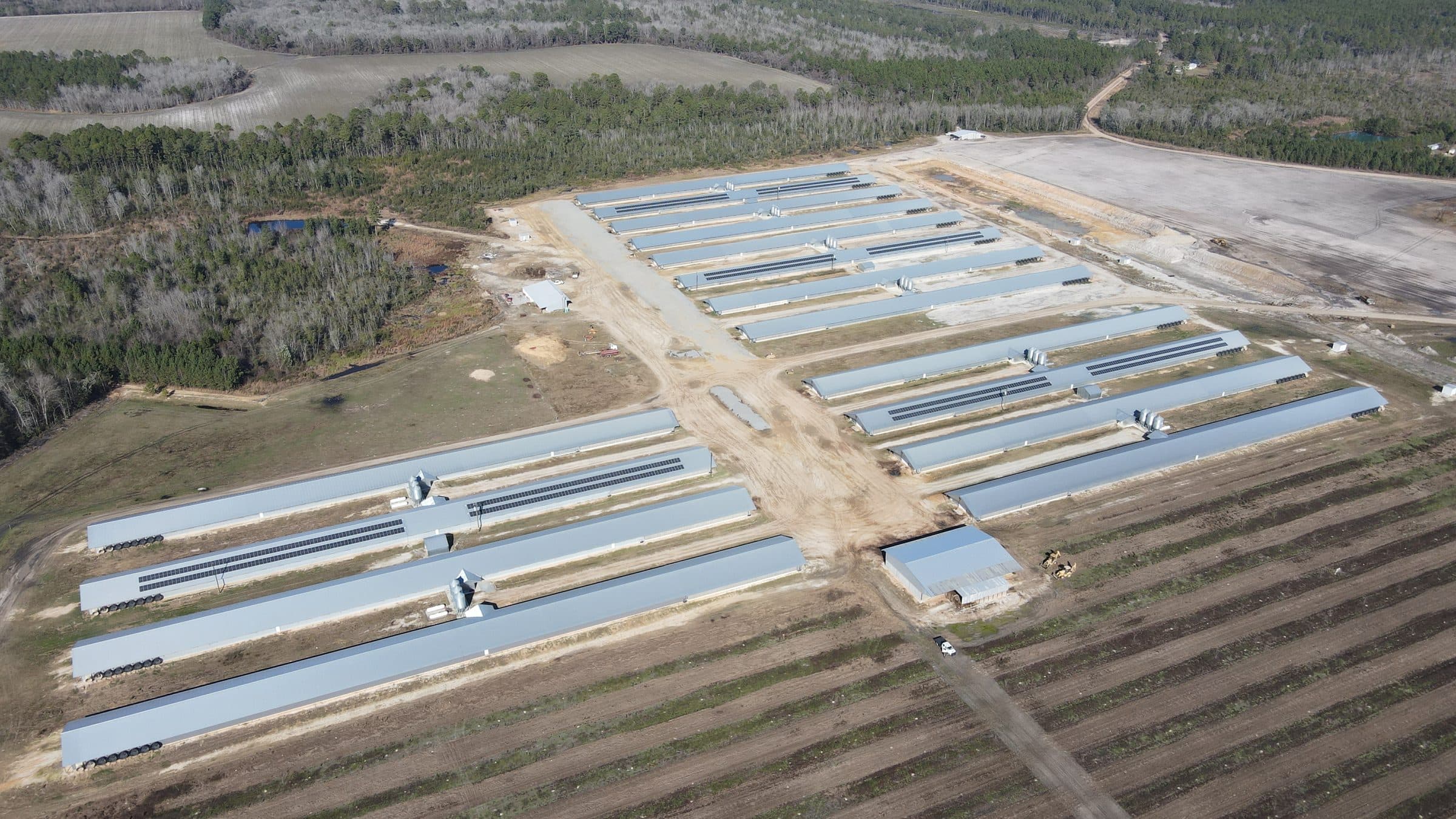
Sixteen houses, 410 kW. Putting solar panels on chicken houses at this scale is one of the more instructive projects we publish, because the headline number is smaller per house than on the 14-house farm we built — and the reason for that is a more useful lesson for a grower than the capacity itself.
The farm is a broiler operation in southeast Georgia, and it is not named at the grower's discretion. It forms part of the 4.8 MW-plus that OneWorld Solar has installed on U.S. poultry houses. The array is roof mounted across all 16 houses and was delivered under one contract.
The problem: more houses does not automatically mean more kilowatts
Growers benchmark by house count because it is the only number everyone has. It is a weak proxy. Averaged out, this farm carries around 26 kW per house, against roughly 32 kW per house on the 450 kW 14-house broiler farm and 35 kW per house on the 210 kW 6-house breeder farm. Four things routinely produce that spread, and normally more than one is in play:
- Usable roof area, not total roof area. Ridge zones, eave setbacks and any run where purlin spacing will not carry the load all come off the top before a single module is placed.
- Orientation and roof pitch. Houses are built on the heading that suited the farm layout, not the sun. A less favorable heading changes what a given square foot is worth and can change whether covering it is worth the racking.
- The electrical load itself. Fan packages, lighting type and flock schedule differ farm to farm. Older or shorter houses often draw less than newer ones.
- The budget or the grant award. A capped project cost is a real design constraint. When a farm is building around an expected award, the array is sized to the funding, and that is a rational decision rather than a compromise.
Which of these applied here
We are not publishing the site-specific reason this farm sized where it did. The load study, roof survey and funding structure belong to the grower, and we will not guess in public. Treat the four drivers above as the checklist to run against your own houses, not as a diagnosis of this one.
The solution: all 16 roofs under one EPC contract
410 kW
Rooftop photovoltaic array
Across every house on the farm.
16
Broiler houses covered
One design, one interconnection.
~26 kW
Average per house
Simple average of system size over house count.
OneWorld Solar handled the farm as a single turnkey commercial solar EPC project: engineering, stamped drawings, the utility interconnection package, procurement, construction and commissioning. Doing 16 roofs in one mobilization is the main reason a farm of this size can reach a competitive cost per watt; the fixed costs of engineering and utility review are carried once, not sixteen times.
Rural agricultural producers building at this scale are usually looking at the USDA REAP grant for solar alongside the 30% federal solar tax credit. Awards are competitive and scored, so nobody can promise you one, and what you can actually claim is validated by your accountant, not by us.
The results
OneWorld Solar has not published production or bill-savings figures for this installation. The scope described above is what the company confirms; anything beyond it should come from OneWorld Solar directly.
The scope is not in question: 410 kW of rooftop generation across 16 broiler houses, engineered, built and interconnected on an operating farm.
What this means if you run broiler houses
The transferable point is that a proposal quoting kilowatts per house without having walked your roofs is a guess. Ask what usable roof area the designer measured, what heading your houses sit on and what the array size would be if the budget moved.
- Start with the fundamentals on solar panels for poultry farms.
- Compare the cost drivers in poultry farm solar cost and results.
- See how the same crews work across commercial solar installation in Georgia.
- Or put your own bill into the commercial solar savings calculator before you talk to anyone.