
The Section 179 expensing limit for solar and every other kind of business equipment is $2,500,000, and the IRS has now put the figure on its own summary of the July 2025 tax law. The page, last reviewed on August 13, 2026, states that the law "increased the total amount a taxpayer can elect to expense under IRC § 179 from $1,000,000 to $2,500,000 for section 179 property placed in service in tax years beginning after December 31, 2024." The limit is reduced, but not below zero, by the amount by which the cost of Section 179 property placed in service during the year exceeds $4,000,000, and both amounts are indexed for inflation for tax years beginning after 2025.
The same page confirms the second half of the first-year story. The law provides "a permanent 100-percent additional first year depreciation deduction for qualified property acquired after January 19, 2025." For the first tax year ending after that date a taxpayer may instead elect 40 percent, or 60 percent for long production period property and certain aircraft. For a solar system placed in service in 2026, 100 percent bonus depreciation is the default.
What does the $2.5 million limit change for a commercial solar project?
Under the old $1,000,000 cap, Section 179 covered a small commercial array outright and only part of a larger one, with the remainder falling to bonus depreciation or the regular schedule. At $2,500,000 the election now reaches the whole cost of most of the systems we build for a single facility, from a dealership roof to a poultry complex to a mid-sized plant, in the year they go into service.
The phase-out is the detail to watch. Because the limit falls dollar for dollar once a business places more than $4,000,000 of qualifying property in service in a year, a company that is also buying trucks, machine tools or a new production line in the same tax year can find the election shrinking. Bonus depreciation has no such cap, which is why the two rules are usually read together rather than chosen between.
Indexing matters too. From tax years beginning after 2025 both the $2,500,000 limit and the $4,000,000 threshold move with inflation, so the figures a business planned around in 2025 will not be the figures on the 2026 return.
What this means for a business in the Southeast
Take a facility in Georgia or the Carolinas placing a solar system in service in 2026. The federal investment tax credit is claimed on the return for that year. The depreciable cost of the system, after the basis adjustment the credit requires, can then be expensed under Section 179 up to the limit, or taken as 100 percent bonus depreciation, or split, depending on the business's income and its other purchases. All three federal benefits land on the same year's return, which is the reason the first year of a commercial solar project looks nothing like the first year of a generator or a roof.
None of that is automatic. The credit and the deductions are elections the owner makes, subject to the owner's tax position, and state conformity with the federal rules varies. What we can do is give the accountant a clean cost breakdown, a placed-in-service date and the documentation the credit requires, and let the accountant decide the order. How the credit and depreciation interact, and why the sequence is the accountant's call, is set out on our Section 179 solar depreciation page and in stacking the solar tax credit with Section 179. The credit's own conditions and deadlines, which the same law tightened, are on our federal solar tax credit page.
Where the first-year math has mattered most
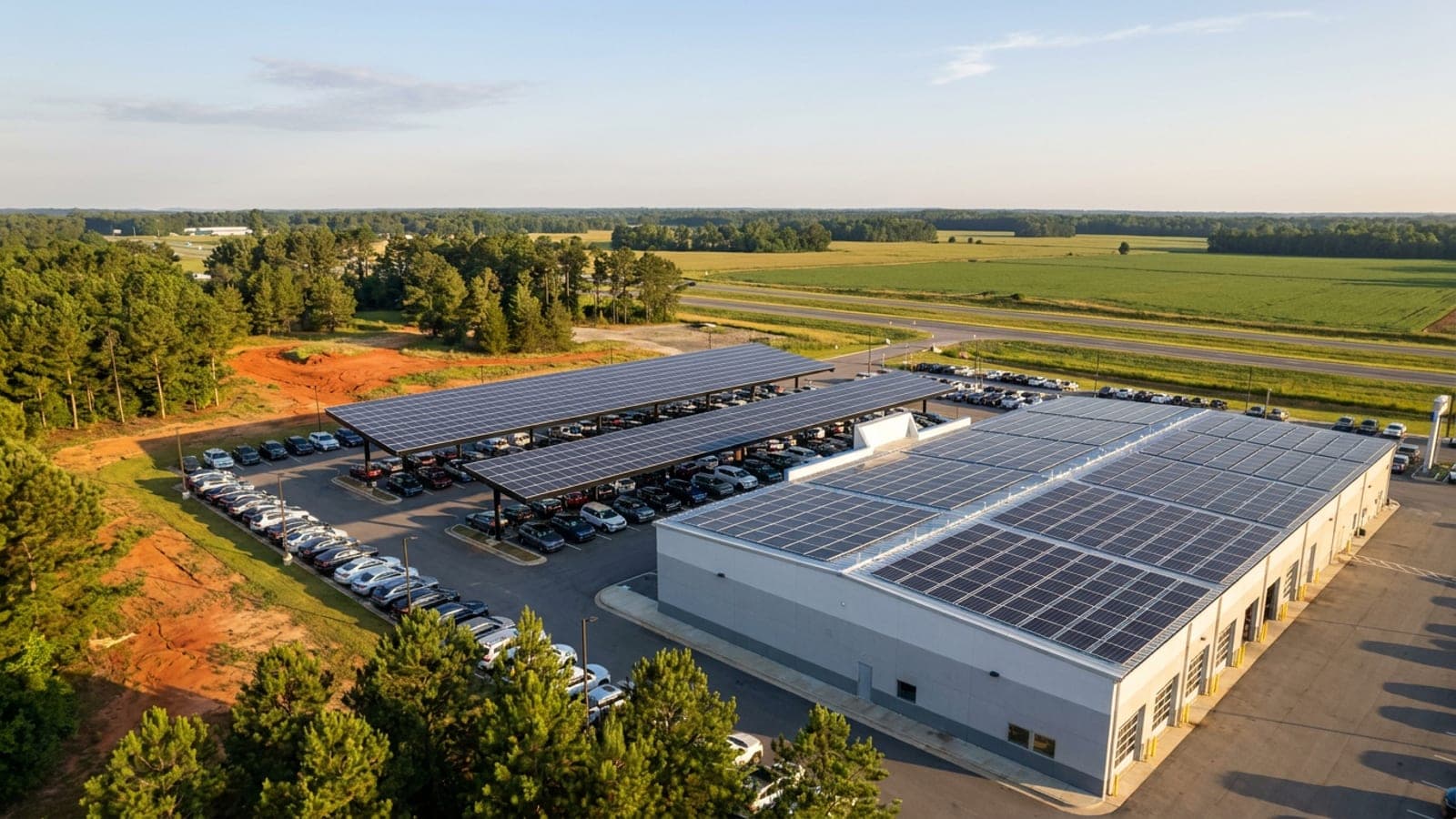
The customers who have used the depreciation rules hardest are the ones with steady taxable income and a large flat roof. Across the Woody Folsom Automotive Group we built more than 1 MW over Chevrolet, Ford and Chrysler Dodge dealerships, the kind of owner-occupied, income-producing property the first-year rules are written for. Our page on solar for car dealerships explains why that industry's load profile suits solar so well, and the payback analysis for dealerships works through the numbers.
Every system we deliver comes under one commercial solar EPC contract, with a single invoice structure that separates equipment, labor and soft costs so the accountant is not reconstructing the basis from a stack of subcontractor bills. That is a small thing until the return is being prepared, and then it is the whole job.
If your business will have taxable income in 2026 and a roof or a lot that could carry a system, the year-one arithmetic is worth running before the year ends. Use our calculator for a first estimate, or send us twelve months of utility bills and we will size the system and give your accountant the numbers the election needs.