
The NFPA 855 2026 changes move the safety paperwork on a commercial battery from an exception to a default. According to a late-August bulletin from The Energy Storage Wire, the 2026 edition of NFPA 855, the Standard for the Installation of Stationary Energy Storage Systems, removes the 600 kWh threshold that previously decided whether a hazard mitigation analysis was required. Under the new edition that analysis applies to any indoor or outdoor energy storage system within the standard's scope, regardless of size.
The same edition adds a documented emergency response plan covering mitigation, preparedness, response and recovery, an annual review of that plan, and an annual refresher training program for the people who work in the facility. Those obligations run for the life of the installation, rather than only through commissioning.
What changed in the 2026 edition of NFPA 855?
Three things, and each one lands on the owner rather than on the equipment.
The hazard mitigation analysis is now universal within scope. Before, a system under 600 kWh could often be permitted without one. A 500 kWh cabinet behind a distribution center or a poultry complex was on the light side of that line. The 2026 edition erases the line.
The emergency response plan is now a document the facility keeps current. The bulletin describes it as covering the four phases of an incident and being reviewed every year, with refresher training for facility personnel on the same cycle. That is a maintenance item, and it belongs in the same calendar as inverter firmware and fire extinguisher inspections.
Section 4.10.22 addresses what keeps the safety systems themselves alive. Critical safety systems are to receive reliable power in line with NFPA 110 or NFPA 111, and the design is subject to review by the fire protection engineer and the authority having jurisdiction. That covers indoor rooms and also outdoor equipment that relies on building services for its ventilation, detection or suppression.
When does the 2026 edition apply to a project in the Southeast?
When your state or local jurisdiction adopts it. NFPA 855 reaches a project through the fire code the authority having jurisdiction enforces, and adoption dates differ. The bulletin points to California, which plans to bring the 2026 edition into its fire code on July 1, 2027, as the example of how the boundary works: a project permitted under an earlier edition keeps the 600 kWh threshold it was permitted with, and a project permitted after adoption does not.
For a business in Georgia, Florida or the Carolinas the practical reading is plain. A project that will be permitted in 2027 or later should be designed today as if the 2026 edition applies, because the cost of the analysis and the plan is small next to the cost of redesigning a pad, a setback or a ventilation scheme after the drawings are in. Confirm the edition in force with the local fire marshal at the start, and design to the newer one if there is any doubt.
What this means for a facility planning battery storage
The analysis and the plan are the same questions a careful owner asks anyway, now written down in a form the fire marshal recognizes. What is in the cabinets, how far from the building, what happens in a thermal event, who is called, how the site is made safe and brought back. A facility that has those answers on paper is a better-run facility.
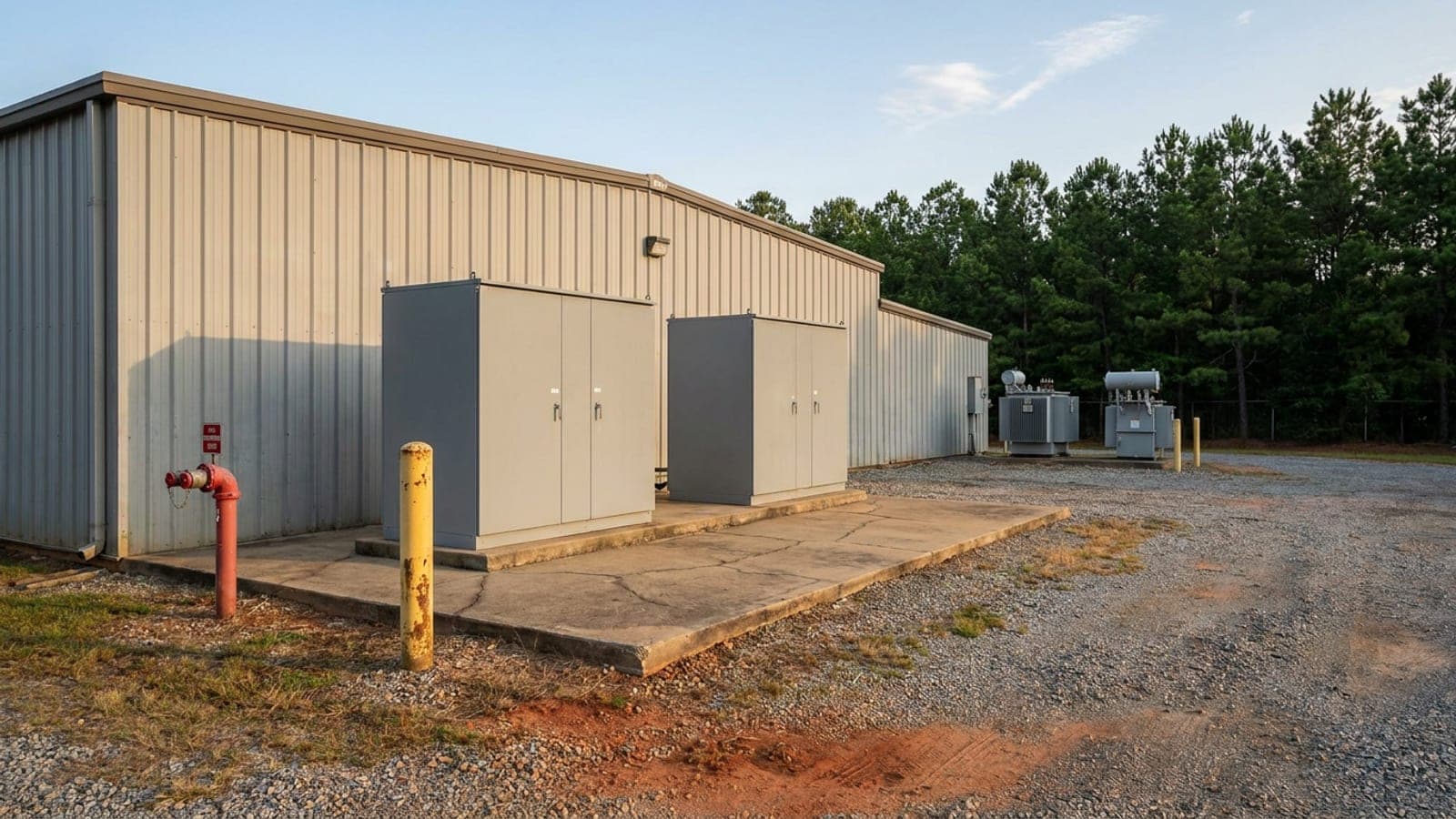
The timing lesson is the one that costs money if it is learned late. Storage that is designed alongside the solar array, on the same drawings and in the same permit set, absorbs these requirements as part of the engineering. Storage bolted on a year after the array, by a different contractor, has to reopen the permit and revisit the site plan. On the 1.267 MW Samsonite and TUMI project in Vidalia, the 55,000 pounds of storage sat in the same contract and the same drawing set as the roof, on an outdoor pad beside the utility transformers, which is the arrangement that keeps a battery out of the building's fire-rated envelope in the first place.
There is a demand-charge case for storage that has nothing to do with resilience or codes, and it is the reason most of our customers buy it. We set that out in when commercial battery storage pays off. The 2026 edition does not change that arithmetic. It changes the order of the paperwork.
How we build storage under NFPA 855
Our commercial battery storage installations are engineered from the outset for outdoor pad mounting next to the point of interconnection, with the hazard analysis and the emergency plan prepared as part of the permit package rather than after it. BatteryCube® is our own line of pad-mounted cabinets built around CATL cells, and because we design, supply and install it under one commercial solar EPC contract, the same engineer who draws the site plan writes the documents the fire marshal reads.
If you are weighing a battery for a facility in Georgia or elsewhere in the Southeast, the right moment to plan for the 2026 edition is before the drawings exist. Send us twelve months of utility bills and we will tell you whether storage has a case on your tariff, how large it should be, and what the permit package will need to contain.