
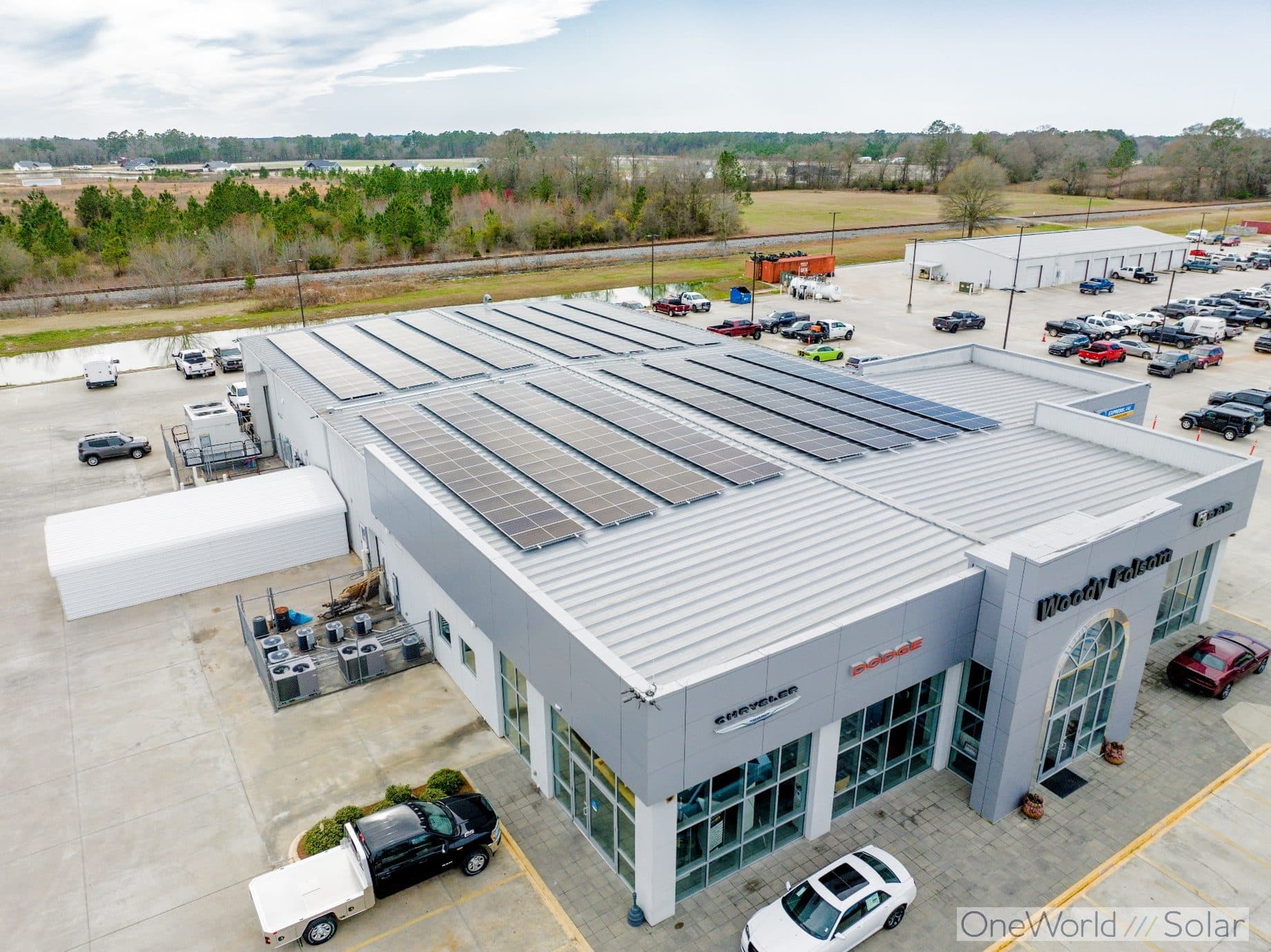
A car dealership electric bill looks like one number and behaves like several. There is the energy you use, the peak you hit, sometimes a penalty for how your equipment draws power, and a lot that stays lit long after the sales floor closes. Each has its own cause, so each has its own fix, and buying the wrong fix first is how a store ends up with an expensive project and a bill that barely moves.
We have built more than 1 MW of solar across the Woody Folsom Automotive Group's Chevrolet, Ford and Chrysler Dodge stores in Georgia, along with a 127 kW rooftop at Headquarter Honda in Clermont, Florida. This article sets out the order we work through a store's bill, including the steps that have nothing to do with solar.
What are you actually paying for?
Pull twelve months of bills and separate the lines. Most commercial accounts break down roughly like this, though your rate schedule has the final word.
| Charge | What drives it at a dealership | What moves it |
|---|---|---|
| Energy (kWh) | Showroom cooling, lighting, service bays, the wash bay | Efficiency, then solar |
| Demand (kW) | The highest measured interval of the month, often compressors, paint booth fans or a fast charger | Load management, then battery storage |
| Power factor | Motor load in the service department | Power factor correction |
| After-dark lighting (kWh) | Lot lighting from dusk to close, or all night | LED fixtures and controls |
The split matters more than the total. Two stores with the same monthly bill can need entirely different projects, because one is paying mostly for kilowatt-hours and the other mostly for a peak it reaches on a handful of mornings.
Why does the order matter?
Every step you take shrinks the problem for the next one. Efficiency work reduces the load an array has to serve. Fixing the peak with operations reduces the size of any battery. If you buy generation first and fix the lighting later, you have paid to offset kilowatt-hours you could have removed for less.
So we go from cheapest to most expensive: read the tariff, check power factor, fix the lighting, manage the peak, then size solar and storage against what is left.
Is a power factor charge hiding on the bill?
Check this before anything else, because it is often the cheapest item to remove. Compressors, lifts and other motors draw reactive power, and some utilities charge for it, either as a named penalty or by billing demand in kVA, which means no penalty line ever appears. A service department with a lot of motor load is exactly where this shows up.
Power factor correction is a small project compared with an array. It also has a clean answer: if your tariff carries no penalty and bills demand in kW, correction saves you nothing, and we will tell you so.
What should you do about lot lighting?
Replace the fixtures before you think about panels. Lot lighting runs after dark, when a grid-tied array produces nothing, and sizing a battery to carry a lot through the night rarely pays for itself on a normal tariff. If your poles still carry metal halide lamps, an LED retrofit is the direct route to a lower overnight load.
The same logic applies to the showroom. Lighting there runs the full business day, so any efficiency gain is earned every day the doors are open, and it lowers the daytime load an array would otherwise be sized against.
Where does your monthly peak come from?
Ask the utility for interval data, or read it from your meter portal if you have one. The demand charge is set by a short measured interval, so the question is what the store was doing at that moment.
Some peaks are self-inflicted. Air handlers, compressors and bay equipment all coming on together at opening time can set the highest reading of the month, and staggering those starts costs little. A paint booth or wash bay running through the same hours as peak cooling is a scheduling question before it is a capital one.
Some peaks cannot be scheduled away. That is where commercial battery storage comes in, discharging into the spike so the meter never records it. Solar is not a dependable answer to this line, because the utility can set your billed peak on a cloudy afternoon or just after sunset. Our guide to commercial battery storage payback shows how to tell whether a battery pays on your rate, including what a demand ratchet does to the math.
What will solar take off the bill?
Daytime energy, and on a dealership that is a large share of the load. The showroom is a glass building working against the afternoon sun, and service bays run through business hours, so production lines up with consumption better than at most commercial buildings. Power you use on site is worth your full retail rate, which is why that overlap matters.
Our page on solar for car dealerships covers load shape and the choice between a rooftop array and a canopy over inventory. For the arithmetic, the breakdown of the solar payback period for car dealerships walks through what moves the timeline. Run the commercial solar savings calculator with your average monthly bill for a first estimate.
Timing counts as well. A solar project that begins construction now has to be placed in service by December 31, 2027 to qualify for the federal credit, and our article on the commercial solar tax credit deadline sets out the dates. The 30% commercial solar tax credit and Section 179 solar depreciation are claimed on your own return, and a Certified Tax Accountant has to validate what you can use. No contractor can promise you either one.
What should you check before adding EV chargers?
Model the charger against your bill before you sign. Level 2 charging on the service drive is a manageable load. A DC fast charger is a different matter, because a single session can set the peak for the entire billing period, and a store with a lightly used charger pays that demand charge just the same.
Three questions are worth answering early. Can the existing electrical service carry the charger, or does the job need a new transformer or service upgrade? What does your manufacturer's program actually require, in writing, for your franchise? And does the utility offer a separate meter or an EV rate that fits your site? Those answers decide whether storage belongs in the same project, and it is far cheaper to find out before the first bill arrives.
Should a dealer group look at every store at once?
If you own several rooftops, yes. Compare the bills side by side first, because the store with the highest bill is not always the one with the best project. The Woody Folsom Automotive rollout treated three dealerships as one program, sharing the engineering standard, procurement and crew mobilization across the group. That is the structure we would start from for any group of stores under a single commercial solar EPC contract.
What we are not claiming
We have not published production or bill-savings figures for our dealership projects, so this article does not quote a percentage saved. Any number we gave you would be a guess until we have read your own bills, and your store's result depends on your tariff, your hours and your equipment.
Send twelve months of bills for one store, or for every store in the group, through our proposal request form. We will split each bill into the lines above, tell you which ones can be reduced and in what order, and say plainly if a solar project is not the right place to start.