
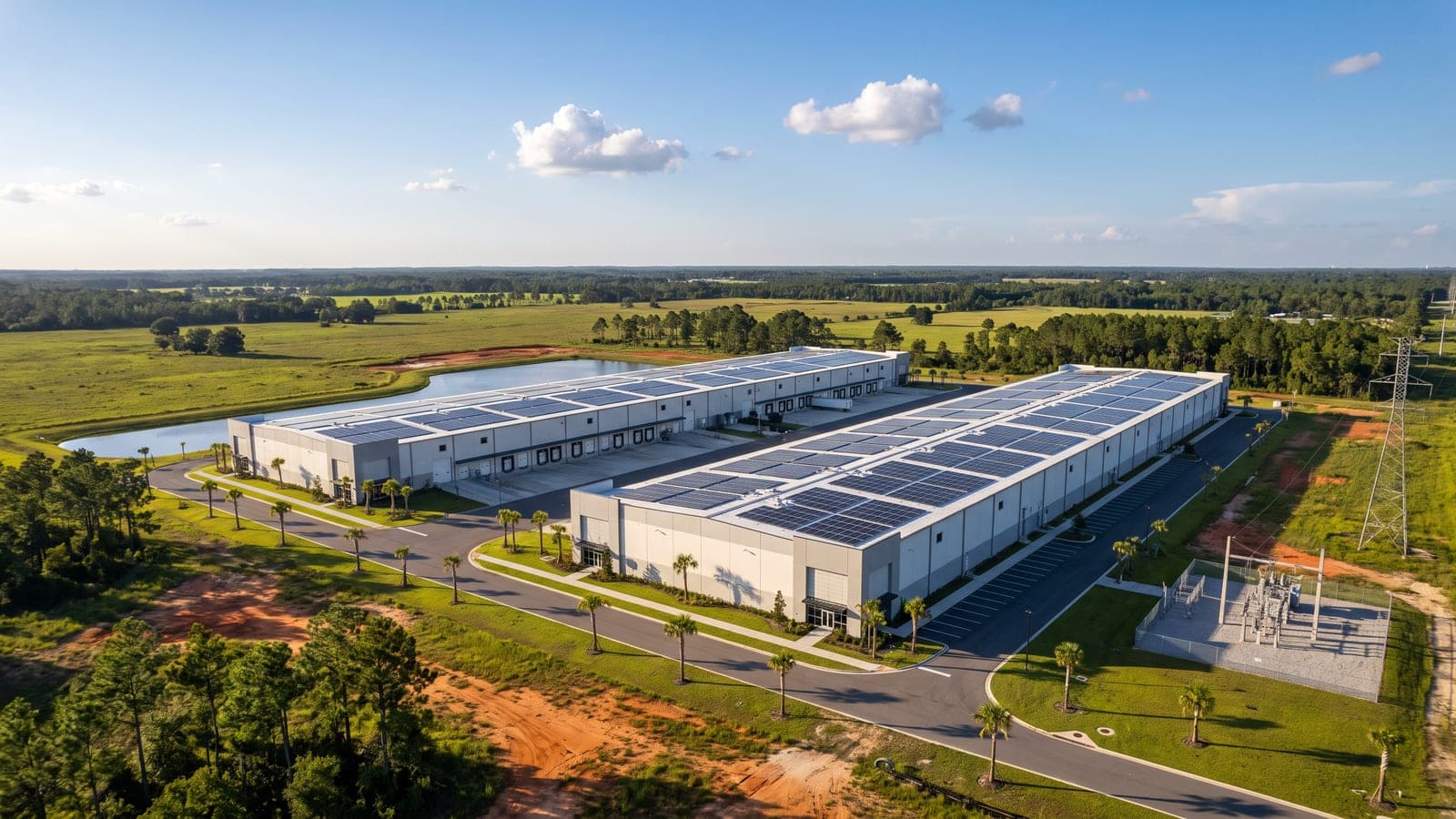
The Florida data center tariff deadline arrives on October 1, and it is the clearest test yet of who pays for the state's fastest-growing electricity load. Under CS/CS/SB 484, the data center law enacted this year, the Florida Senate's summary states that each public utility must file a tariff for Public Service Commission approval by October 1, 2026, and that the tariff must reasonably ensure that large load customers pay for their own cost of service. The summary is blunt about the purpose: the risk of nonpayment of those costs "may not be borne by the general body of ratepayers."
A large load customer, under the statute, is one with an anticipated monthly peak of 50 megawatts or more at a single location, measured as the highest average load over a 15-minute interval. No ordinary commercial customer is close to that. What the filings decide is how much of the generation and transmission built for the customers who are gets charged to everyone else.
What has Florida Power & Light already put in place?
FPL did not wait for the deadline. According to an August 2026 analysis of Florida utility power contracts, the Commission approved the company's Large Load Contract Service tariffs, LLCS-1 and LLCS-2, on January 22, 2026, with an effective date of January 1. They apply to new or incremental load of 50 megawatts or more at a load factor of at least 85 percent, and the terms are strict: a 20-year minimum contract, take-or-pay on 70 percent of contracted demand whether the power is used or not, recovery of 100 percent of the cost of any new generation built for that load, collateral requirements, connection costs paid up front, and accelerated charges if the customer leaves early.
Read as a document about risk, that tariff says a large customer carries its own plant. We described the same structure across the region in large load tariffs in the Southeast, where Georgia Power applies minimum billing above 100 megawatts and Santee Cooper runs an experimental schedule above 50.
Where does Duke Energy Florida's filing stand?
In a different place. Duke's proposal includes a 20-year commitment, financial assurances, early termination obligations, minimum monthly bills and two years' notice before termination, but no separate rate schedule for large load customers. Florida's Office of Public Counsel, the state's statutory advocate for utility customers, has objected in plain terms. Walt Trierweiler said the proposal "doesn't attempt to comply with SB 484's most basic provisions," on the argument that an existing settlement agreement exempts the company from the statute. Florida Rising, a group representing residential customers, has asked the Commission to reject the proposal on affordability grounds.
The Commission is weighing both questions as the October 1 date passes, with a decision on the Duke case expected later this autumn. We covered the company's separate request to lower 2027 rates, which would cut commercial and industrial bills by 0.8 to 3.6 percent, in Duke Energy Florida's rate decrease.
What this means for a business in Florida
Three things follow for a facility that will never see a large load tariff.
The first is that the cost of the next decade of Florida generation is being allocated right now, in filings that run 20 years. A tariff that holds a data center to its own costs protects the general service customer; one that does not sends the difference into future rate cases. Either way the decision is made this autumn and lived with for two decades.
The second is that the part of a commercial bill a business controls is unchanged by any of it. Energy charges follow consumption and demand charges follow the highest interval of the month, and both fall when a site generates its own power and shifts load off the peak. The arithmetic of the second half is in when commercial battery storage pays off.
The third is timing. Florida's summer peaks and the federal credit's deadlines both reward a project started now rather than later, and the conditions on that credit are set out on our federal solar tax credit page. The credit is claimed on the owner's return, subject to the owner's tax position, and is never assured in advance.
What we build in Florida
Our commercial solar installation in Florida work includes the 127 kW rooftop system at Headquarter Honda in Clermont, a 102 kW roof at Valencia College in Orlando and canopies for the Orlando Utilities Commission and the TECO Manatee Viewing Center, all engineered by a professional engineer licensed in the state and designed for Florida wind loads from the first drawing. Array, battery storage and interconnection come under one commercial solar EPC contract.
If your business is in Florida and you would rather set your own power cost than wait for the Commission to allocate someone else's, run our calculator for a first estimate, then send us twelve months of utility bills. We will size the system to your load, your tariff and your peak hours.