
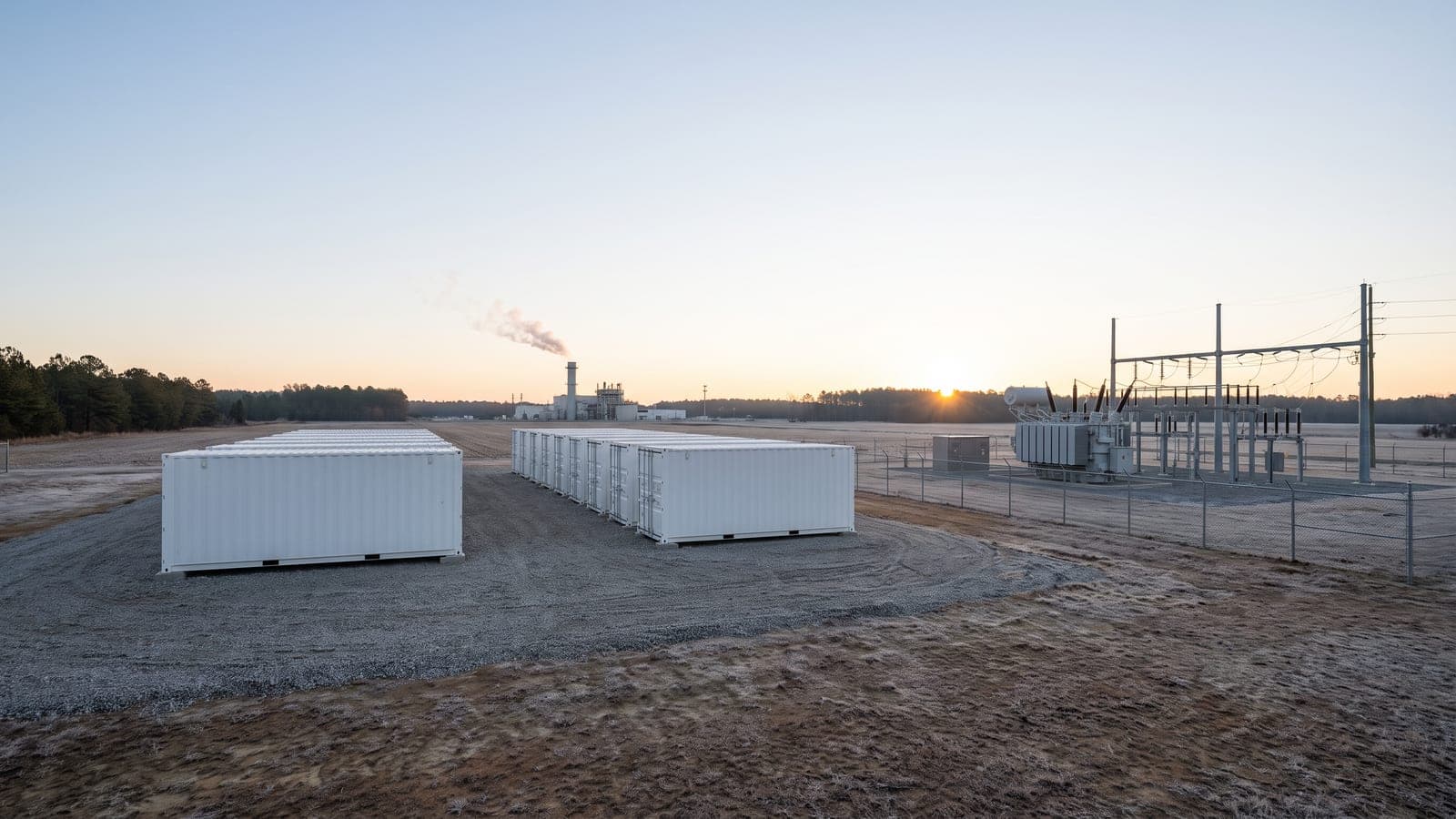
North Carolina regulators have approved a Duke Energy battery storage plan that reaches 5,400 MW by 2034. The North Carolina Utilities Commission issued its order on the 2025 Carolinas Resource Plan on November 16, 2026, and according to Duke Energy's statement the next day, it moves forward 2,700 MW of new battery storage beyond the commission's 2022 and 2024 orders. Solar grows by 2,300 MW in the same order, to 8,100 MW by 2034. On November 17 Duke also announced the first large piece in eastern North Carolina: two four-hour lithium-ion facilities at its H.F. Lee plant in Goldsboro, of 260 MW and 150 MW, for an investment of up to $756 million, WRAL reported.
What did the commission approve on November 16?
The order covers the full generation mix, with batteries as one part of it. Duke lists 2,720 MW of additional combined-cycle gas capacity on top of the 3,920 MW already approved, for five combined-cycle units by 2033, and 1,111 MW of new combustion turbines, for seven by 2032. Nuclear stays in development, with work continuing on both small modular reactors and large reactors. The company is careful to say that some of these projects are already under construction, while others will still need their own project-specific review and approval.
Duke says the plan's projected cost to customers over the next decade is nearly half that of its 2024 plan. It also projects $2.3 billion in customer savings from 2027 to 2040 from combining Duke Energy Carolinas and Duke Energy Progress into a single utility on January 1, although the two keep separate rates for now. The same week brought the rate orders we covered in what North Carolina businesses pay in 2027, and this plan follows the Carolinas resource plan Duke filed in South Carolina in August.
Why is Duke building 410 MW of batteries in Goldsboro?
The two Wayne County facilities sit beside the existing H.F. Lee natural gas plant. Construction is expected to begin in early 2027. The 260 MW system is scheduled to start operating in fall 2028 and the 150 MW system by the end of that year. Duke spokesperson Bill Norton told WRAL that the batteries can store surplus solar for cold winter mornings and reduce the power Duke has to buy from neighboring utilities. The company says the project qualifies for a 50% federal tax credit, combining the energy community and domestic content bonuses.
Duke has not estimated how much the batteries will save customers, and it has not said how much of the investment will reach rates. For a business, the plan matters less as a forecast of next year's bill than as a signal of where the utility sees value: in energy moved from midday into the hours when demand peaks.
What does a utility battery plan mean for a business in North Carolina?
A utility adds storage because meeting a peak with a battery costs less than building a plant that runs a few hundred hours a year. Your demand charge prices the same thing at the scale of one meter. The single highest interval of demand in a month sets a charge that can be a large share of a manufacturing or cold storage bill, and a battery that discharges into those minutes lowers it directly. The utility spreads its savings across every customer over years. A facility that owns its battery sees the result on its own bill, starting with the first billing cycle after commissioning.
Our page on commercial battery storage installation explains how we size a system from interval data, and our guide to commercial battery storage payback shows how to test the economics against your rate schedule before you spend anything. A battery paired with solar may also be eligible for the federal solar tax credit, which the owner claims on its own return. For the state-specific picture, including Duke territory and interconnection, see commercial solar installation in North Carolina.
How we put the same idea to work at one facility
We build storage around our own BatteryCube® commercial battery energy storage system, which uses CATL cells. At the Samsonite and TUMI facility in Vidalia, Georgia, 55,000 lb of BatteryCube cabinets work beside a 1.267 MW rooftop array, the largest system we have installed. The principle is the one Duke applied in Goldsboro, scaled to a single plant: store energy when it's cheap or abundant and release it when the meter is counting the peak.
The utility's batteries come online in 2028. Yours can be designed this winter. Send us twelve months of utility bills and we'll show you where your peaks fall, what a battery sized to them would do to your demand charge, and how solar fits beside it.