
The Georgia PSC new majority takes its seats in January. On November 3, Peter Hubbard was re-elected to the Georgia Public Service Commission and Shelia Edwards won an open seat, each by more than ten points, according to WABE's report on the results. With Alicia Johnson, who was not on the ballot this year, Democrats will hold three of the five seats on the body that regulates Georgia Power, for the first time in decades. Commissioners are elected statewide to six-year terms and represent districts.
For a manufacturer, farm or dealership on Georgia Power, the result raises an obvious question about the power bill. Part of the answer is already written, and the rest depends on decisions that have not been scheduled yet.
What stays fixed on a Georgia Power bill?
Base rates. The commission approved a plan that keeps Georgia Power's base rates stable through at least the end of 2028, as the utility's announcement of the base rate freeze states. Base rates are what you pay under your rate schedule, excluding fuel. The election does not reopen that order.
What sits outside the freeze is the part that moves. Fuel and storm costs are recovered through separate proceedings, and we walked through the current figures in the Georgia Power fuel and storm cost settlement. Those lines are where a new commission's decisions would first show up on a business bill.
What has the new majority said it will do?
Hubbard told WABE that one of his first priorities is an affordability docket, a series of hearings into the reasons for high power bills and ways to save customers money. He also said the majority plans to look closely at upcoming Georgia Power requests to build more generation and adjust rates. Atlanta News First reported that the commission has already voted to order an independent review of the method Georgia Power uses to bill data centers, a question we followed in the Georgia Power real-time pricing docket.
Timing is the honest caveat. "We may not be able to expect immediate effects on our wallets," Emory University associate professor Kristin Phillips told WABE, adding that the types of decisions may change sooner than the bills do. Georgia Public Broadcasting's coverage notes that the commission also influences where Georgia's energy comes from, which is a longer conversation still.
What this means for a business in Georgia
The useful move is to separate the bill into the part a regulator sets and the part you set. The regulator sets the price of each kilowatt-hour and each kilowatt of demand. You set how many kilowatt-hours you buy and how high your monthly peak climbs, and both of those can be changed on your own schedule rather than a docket's.
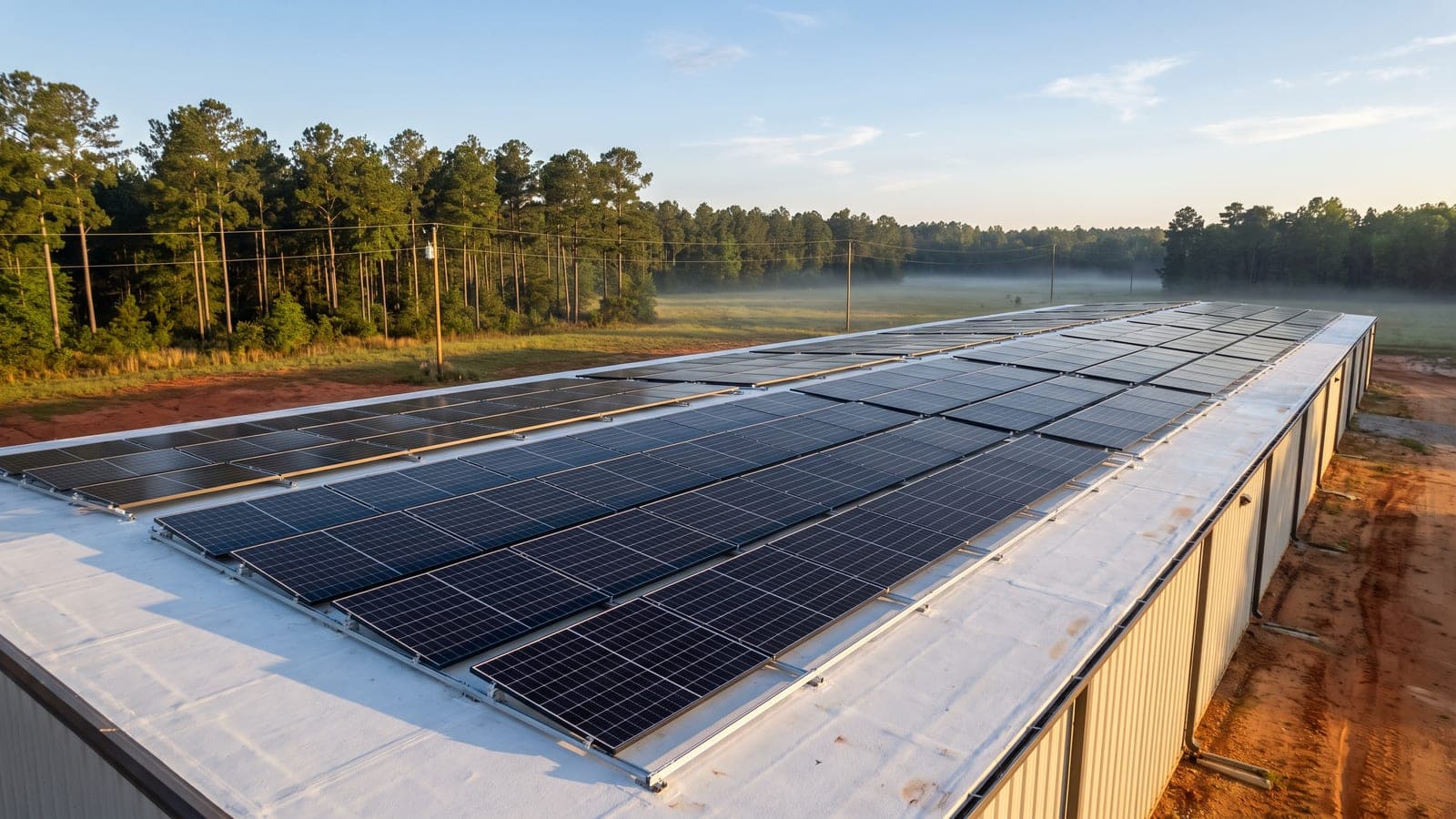
Solar works on the first. Every kilowatt-hour generated on your own roof or ground is one that carries no fuel or storm recovery charge, whatever the next proceeding decides, and our figures on commercial solar cost per kW in Georgia show what a system costs to build here. A battery works on the second: commercial battery storage discharges into the peak so the meter never records it, which lowers the demand charge the freeze holds in place.
The federal side has a fixed date. A solar project that begins construction now has to be placed in service by December 31, 2027 to qualify for the 30% commercial solar tax credit, which is claimed on your own return. That deadline does not depend on who sits on the commission.
What we build in Georgia Power territory
Our largest Georgia system is the 1.267 MW rooftop and battery installation at Samsonite and TUMI in Vidalia, where the batteries were built from CATL cells in our BatteryCube® cabinets. Our commercial solar installation in Georgia runs from that plant to poultry complexes and Georgia Power's own facilities, and every one of those systems was sized from the customer's bills, not from a forecast of what regulators might do.
If your business buys power from Georgia Power, send us twelve months of utility bills. We will show you which lines the freeze protects, which lines can still move, and how much of each a system on your own site would take off.