
The NERC winter reliability assessment for 2026-2027, released on Wednesday, November 18, gives North America a better outlook than last year and gives the Carolinas a specific window to plan around. The North American Electric Reliability Corporation expects enough generation for normal peak demand everywhere this winter. It also names SERC-East, the assessment area covering North Carolina and South Carolina, as the place where severe cold poses an elevated risk, with that risk concentrated in the early-morning hours of January.
The report covers December through February. Across all assessment areas, peak demand has grown by 21 GW, or 2.6%, since last winter, while winter on-peak capacity has grown by 26 GW, or 2.4%. Batteries added the most: 20.6 GW of nameplate capacity, worth 9.2 GW at the winter peak, ahead of 8.7 GW of new natural gas generation. "While the resource outlook has improved, the unpredictable weather of El Niño and rapid load growth present unique challenges this winter," NERC President and CEO Jim Robb said in NERC's announcement of the assessment.
What does NERC say about North and South Carolina?
SERC-East has historically peaked in summer. According to the assessment, it now sees higher winter peaks year over year, driven by load growth across the residential, commercial, industrial and large load sectors, and that growth is what lowers the area's anticipated reserve margin this winter. Under normal conditions, expected resources meet operating reserves and NERC sees no significant fuel or transmission constraints.
The risk appears when extreme cold arrives on a January morning. Heating demand climbs, some generation becomes unavailable and imports from neighboring systems can be limited, all at the same moment. NERC's probabilistic analysis describes that loss-of-load risk as limited, and the area counts on about 1.0 GW of operational and emergency measures to manage it.
Further south the picture is calmer. SERC-Southeast, which includes all or parts of Georgia, Alabama and Mississippi, meets its operating reserve requirements under every scenario NERC assessed, with natural gas deliverability and large load growth listed as the items to watch. The Florida Peninsula area also meets its requirements under the assessed scenarios.
How do grid operators handle a tight winter morning?
The assessment lists the steps in order. Operators first buy extra supply through short-term contracts and arrange imports from neighboring areas, then issue alerts and ask utilities to appeal to the public for conservation. They also call on demand response, the programs in which commercial and industrial customers agree to cut load under set conditions. According to NRECA's summary of the report, demand response across North America has grown to 43.6 GW this winter from 41.7 GW last winter.
For data centers and other large loads, the report notes that operators can seek emergency authority from the Department of Energy to direct those customers onto their backup generators. The Carolinas have already seen that tool used, in the DOE emergency order for Duke Energy Carolinas.
What can a Carolinas facility do before January?
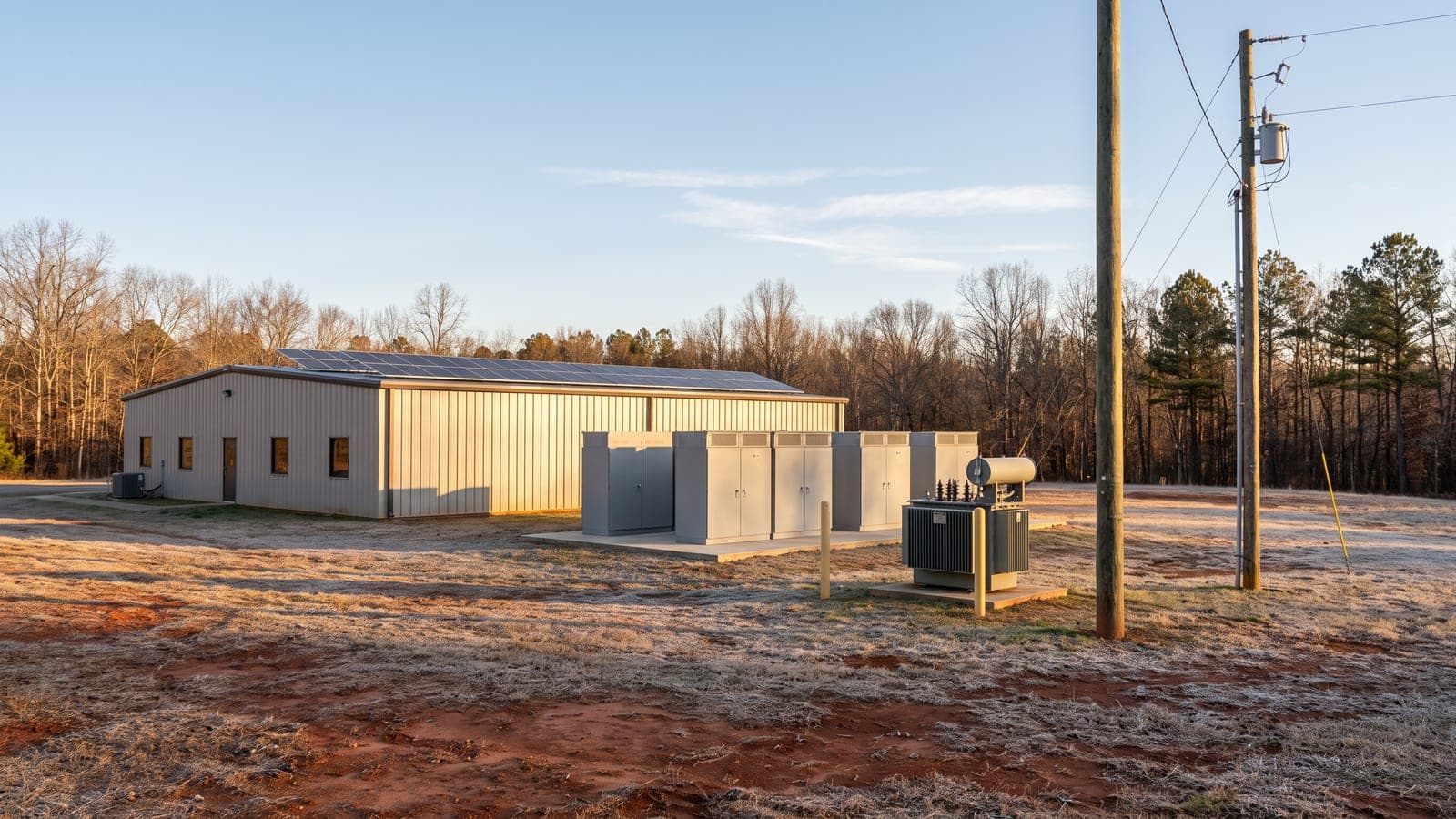
For a plant, a cold storage warehouse or a poultry operation, the practical question is which loads must stay on during a cold morning, and for how long. The January risk window falls around sunrise, when a rooftop array is producing little, so the asset that carries a site through that hour is stored energy. A battery charged by solar the afternoon before, or by the grid overnight, can hold critical loads through the morning peak. It also gives the site a way to take part in a utility's demand response program without stopping production.
That is the design logic of a microgrid. We start with a ranked list of the loads a site cannot lose, size the storage to carry them for the hours that matter, and wire them to a critical-load panel that separates them from the rest of the building. Our comparison of microgrid vs generator vs battery sets out where each option fits, including the sites where a standby generator stays in the plan, and our guide to what a commercial microgrid costs walks through the four factors that set the price.
Where does OneWorld Solar fit in?
Our commercial microgrid installation work pairs rooftop or ground-mount solar with the BatteryCube® storage cabinet, built on CATL cells. On the 1.267 MW Samsonite and TUMI system in Vidalia, 55,000 pounds of batteries sit alongside the array under one contract. Our commercial solar installation in North Carolina and South Carolina is engineered by a professional engineer licensed in both states. The solar portion of a project can qualify for the federal solar tax credit, which you claim on your own return with your accountant's guidance.
A project started today won't be running by this January, and that's fine: NERC describes a pattern of winter peaks rising year over year, not a single season. If you want to see what your own January mornings look like, send us twelve months of utility bills and we'll show you which loads drive your winter peak and what it would take to carry them.