
USDA's rewritten rule for the Rural Energy for America Program took effect on October 16, and it replaces the old separate intake notice with a REAP annual application window that the agency will publish each year. No window has been announced yet. The concession buried in the new text matters more to a project already in the ground than the schedule does: for the first window after the rule, a solar system whose construction finished up to 36 months ago can still be part of an application, against the 24 months the rule sets as the standing limit.
When does the REAP annual application window open?
The rule does not say, and that is a deliberate change rather than an omission. Submission requirements used to live in an annual notice because the regulation itself was vague on the point. They now sit in the regulation, which states that the agency will publish annual application windows.
The last notice of funding opportunity was published on October 16, 2024 and written to cover fiscal years 2025, 2026 and 2027. USDA rescinded that notice on April 15, 2026 while the rewrite was underway, and nothing has replaced it. The final rule published on October 1 is a final rule with comment period, and comments stay open until November 2, 2026 under docket RBS-26-Business-0529.
For anyone budgeting a 2027 project, that is the practical answer. An award cannot be written into the numbers yet, and the work worth doing now is the work that makes an application ready the week a window appears.
The 36-month lookback is the part worth planning around
REAP now pays for what a system has already done. The project period has to end 12 to 24 months before the application date, and the application carries twelve months of actual production or energy savings data alongside twelve months of pre-installation figures. The award is scored on measured performance instead of a projection.
For the first window after this rule, the rule allows that end date to fall 12 to 36 months before submission. A farm or rural business in Georgia or the Carolinas that energized a system during 2024 or 2025 is therefore inside the first cycle, provided the metering data exists and the rest of the rule is satisfied. Production data is the piece that gets lost, because an inverter portal that was never configured to retain history cannot produce a year of readings after the fact.
One other change narrows who can file. REAP now accepts one application per applicant per federal fiscal year, replacing a structure that allowed one renewable energy system application and one energy efficiency application in the same year, and it treats commonly owned entities as one applicant. USDA attributes the restriction to the program's long record of oversubscription.
What the new rule changes for a Southeast facility
Three provisions decide most designs in our region. Ground mounted solar and wind on certified Cropland are prohibited, using the Farm Service Agency definition at 7 CFR 718.2, and systems on Cropland cannot be retrofitted with REAP funds either. A solar system or wind turbine containing any component made in a country named a foreign adversary is prohibited. Stand alone energy storage, and retrofitting an existing array to add storage, are both listed as ineligible for grant funds.
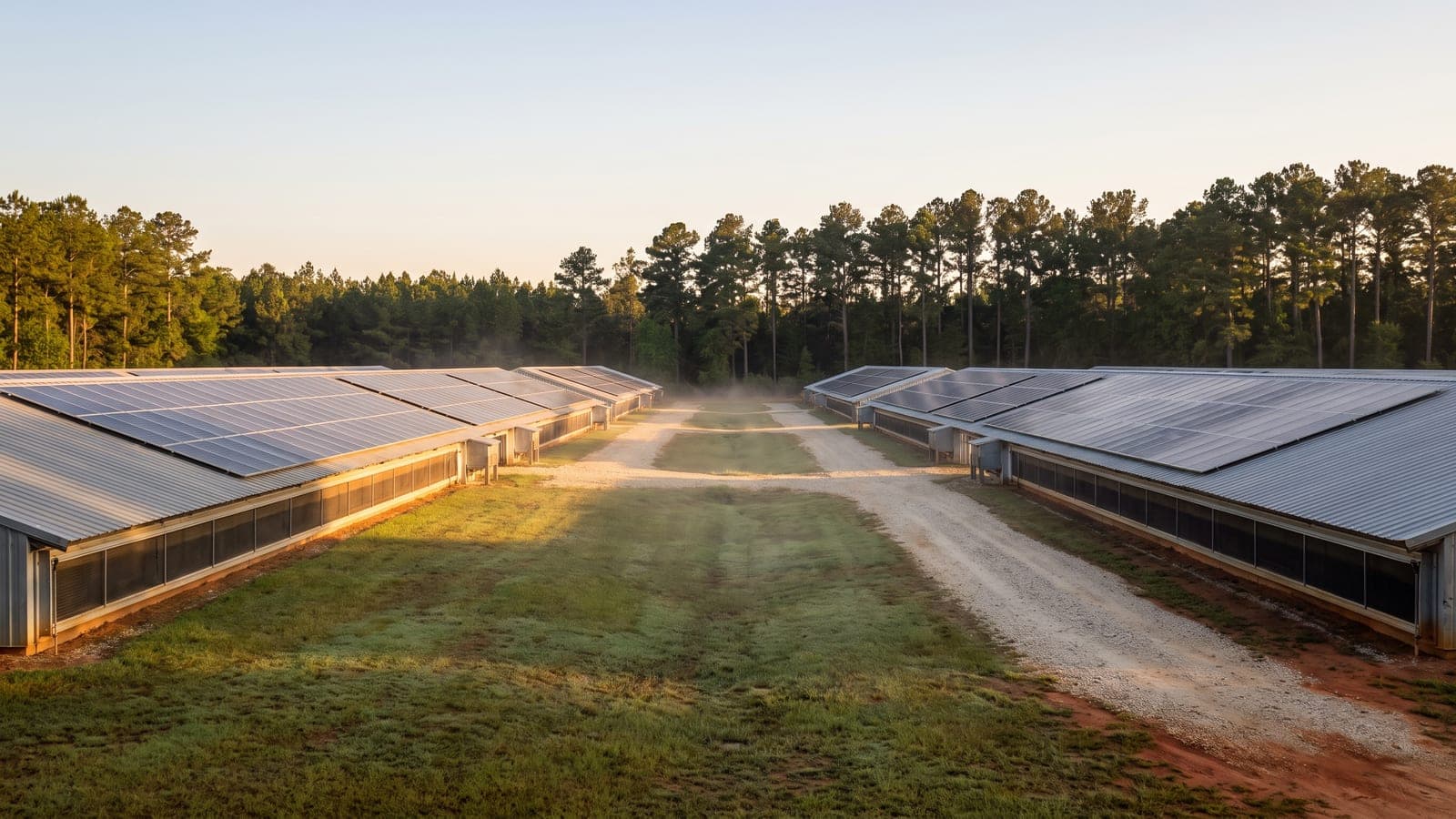
A poultry house roof is not cropland, which is why the roof mounted end of solar for poultry operations came through this rewrite in better shape than ground mount on tilled acreage. Where a ground mount is the only sensible layout, the parcel's own Farm Service Agency determination is now the document that decides the design, and it is cheaper to confirm that before drawings than after.
The money, meanwhile, has not moved. The 30% federal investment tax credit and Section 179 expensing for solar equipment are claimed on the owner's return rather than awarded in competition, and they do the heavier lifting on a commercial system. Swainsboro Supply Company cut about $1,800 a month off its power bill, and none of that saving depended on a grant cycle.
How we work a project that is not waiting on an award
We have been installing commercial solar in the Southeast since 2001, with more than 7.8 MW in the ground for over 300 customers, including more than 4.8 MW across poultry operations. One of those is a 410 kW system across sixteen broiler houses, sized against what the houses actually draw rather than against the roof area available.
That order of work is what the new rule rewards. Our commercial solar EPC work starts from twelve months of meter data, which is the same evidence an application now has to carry, and we keep the production monitoring in place from the first day so the operating year exists as a record instead of an estimate. When you want the grant route examined as well, the USDA REAP grant for solar sets out how awards are scored, and what a REAP application has to contain covers the technical report and the documentation in more detail.
Send us twelve months of utility bills and we will tell you what a system on your roof or your yard would produce, what it would take off the bill, and how the tax treatment works out. Talk to us about your site and we will look at whether the first REAP window is worth preparing for in your case, or whether the project stands up better without it.