
The REAP final rule for solar reached the Federal Register on October 1, 2026, and it takes effect on October 16. The Rural Business-Cooperative Service rebuilt the program around one idea: the agency will consider systems that are already built and running. An applicant files afterward, with twelve months of actual production or energy savings data and twelve months of pre-installation data for comparison, and the award is scored on documented output instead of a projection. Comments are open until November 2, 2026 under docket RBS-26-Business-0529, and the full text sits in the Federal Register.
How the application sequence changed
The old order was apply, wait for a technical merit review, then build. The rule reverses it. The project period now has to end twelve to twenty-four months before the application, so a system needs a full year of operating history on the meter before the agency will look at it. The technical merit review has been taken out of the agency's process, state level competitions give way to a single national scoring and selection process, and an applicant may file one application per funding cycle. Eligibility is limited to the highest level owner of the business, and the definition of a small business now follows the Small Business Administration's.
That changes how a project gets financed, and it deserves plain speaking. You pay for the array first and apply later, with no assurance of an award, so a grant that arrives a year after commissioning behaves like a reimbursement rather than a down payment. The numbers have to work on energy savings and tax treatment on their own. Our page on the USDA REAP grant for solar and our REAP application guide are being updated against the new text, and the records a post completion application needs are the same ones a lender asks for.
Which projects are no longer eligible?
The rule names them directly. Ground mount solar photovoltaic systems and wind turbines installed on certified Cropland, as the Farm Service Agency defines Cropland at 7 CFR 718.2, are out. So are solar and wind systems that cannot document commensurate historical energy usage, which in practice means a system sized past what the operation actually consumed. So are solar and wind systems, ground mount or roof mount, containing any component made in a country named a foreign adversary under 15 CFR 791.4, with an exception the agency carved out for projects completed before the rule was published so that applicants can move to other sources.
The list continues. Projects at more than one location are ineligible. So are projects that combine two different renewable technologies outside a hybrid system, retrofits of an existing ground mount array or of any solar or wind system on cropland, stand-alone energy storage, storage added to an existing renewable system, electric vehicle chargers and charging stations, flexible fuel pumps, and distribution only projects such as biogas pipelines.
USDA sets out its reasoning in the preamble. It cites the Farmers First Small Family Farms Policy Agenda and the National Farm Security Action Plan, and reports that stakeholders raised concerns that some large ground mount projects were inflating land prices, displacing productive cropland, or exceeding a business's actual energy needs. The rule states that REAP support now focuses on appropriately scaled, on farm renewable energy systems rather than large or utility scale solar development.
What it means for a farm or facility in the Southeast
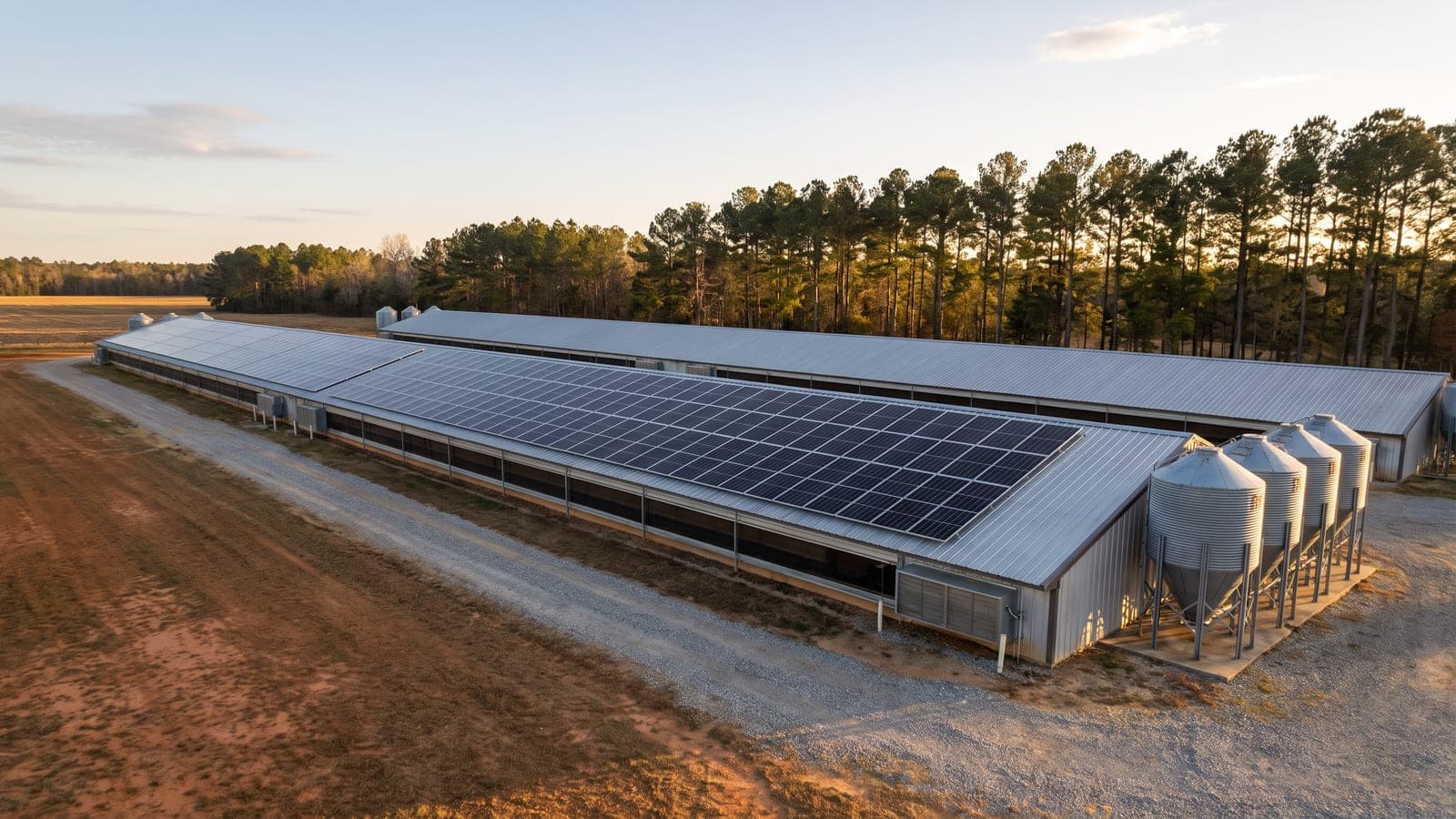
Most of what we build is untouched, and one part of the rule reads like a description of how we already scope a job. A roof mounted array on a poultry house, a packing shed, a shop or a warehouse is not a ground mount system on Cropland, so it stays eligible on that test, and a ground mount on a parcel the Farm Service Agency does not classify as Cropland does too. What changes for every applicant is the sizing standard. The system has to line up with documented historical use, which is exactly why we start from twelve months of bills rather than from a roof measurement. Our write-up of what a poultry solar project actually produced and the 410 kW array on a sixteen house broiler farm show the shape of a system matched to real load, and the same arithmetic runs through solar panels for poultry farms generally.
The component provision is new ground for REAP and familiar from the tax side. Equipment origin already carries weight in the restrictions attached to the 30% federal solar investment tax credit, and now the bill of materials decides REAP eligibility as well, which makes documentation collected at purchase worth more than documentation reconstructed two years later. The cropland and component provisions are written for solar photovoltaic and wind, while solar thermal under REAP keeps its own resource assessment requirement. Storage is the clearest loss: a battery now has to earn its place through demand charge savings and the tax credit, because the program will not take it as a project of its own.
What we would put in order before November 2
Two things are worth doing while the comment window is open. Keep the paperwork a post completion application will ask for, which means twelve months of bills from before the installation, twelve months of metered production after it, the invoices, and origin documentation for every major component. And confirm the Farm Service Agency's Cropland determination for the parcel before a ground mount design goes on paper, since that determination now decides eligibility rather than informing it.
If a project is already in the ground and running, the new sequence may work in your favor, because the data the agency wants is data you already have. Send us twelve months of utility bills and the service address through our contact page and we will tell you what the meter says about system size, what the rule now requires in the file, and whether the numbers stand up without a grant.